
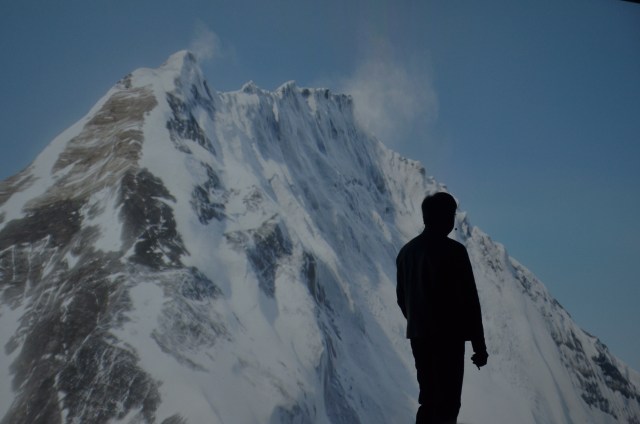
At the opening keynote at the 2016 GPU Technology Conference, Nvidia CEO Jen-Hsun Huang looks at Everest through VR. Photo by Marcus Siu
Article and Photos by Marcus Siu
SAN JOSE, CA April 5, 2016 – CEO of Nvidia, Jen-Hsun Huang, addressed the capacity crowd with his opening keynote at the 2016 GPU Technology Conference at the San Jose Convention Center, and cites VR technology as rapidly growing, along with its components that are continuously improving to accommodate the platform.
He remarked that the biggest advantage for VR over the years was when LCD displays took over and replaced CRT monitors, making it much lighter and thinner, so users can put on head mounts without falling over due to being too bulky and heavy. In addition, the resolution of displays continue to get better, and computer graphics performance continue to improve, making the combination of all to help enable the new platform to allow new applications and new experiences for the user.
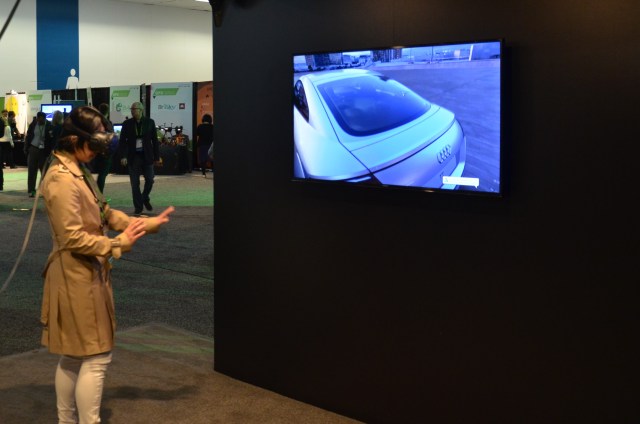
A prospective shopper checking out the trunk space in Paris at a Virtual showroom demo at the Audi Booth at the 2016 GPU Technology Conference. Photo by Marcus Siu
So far, gaming has been the primary point of VR, but that’s about to shift. Huang says that VR will change the way we will design and experience products, such as shopping for cars; basically it’s like being in a virtual showroom. It will be as though you are standing right over (or under) your custom made designed car without having to worry about a haggling salesman over your shoulder. At the conference, Audi had a demonstration booth that was using ZeroLight’s real time 3D technology, which allowed you to walk to your custom-made configured car, open its doors so you can check out the car’s interior. You can also check out how much space it has in the back trunk. Interestingly, in their demo, you could even check out the car in Paris, or even on the moon.
For more information on ZeroLight: www.zerolight.com
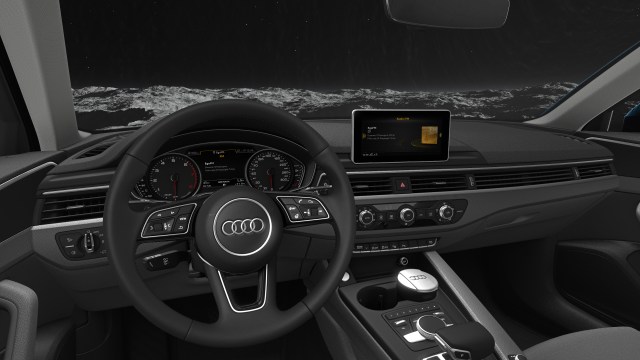
AUDI VR Experience – Courtesy of Audi/Zerolight
The VR demonstrations were quite impressive. There were two demos; “Everest VR” and “Mars 2030”.
“VR can take you places that you can only dream of; places that are too dangerous for example”…
For “Everest VR”, Nvidia partnered with Sólfar, a Nordic VR games company, and RVX, a Nordic visual effects studio for motion pictures, helping movies, such as “Gravity”, win Best Visual Effects at the Academy Awards. They started by taking 108 billion pixels of images, which is equivalent to 14,000 8 Mb pictures, and reconstructed Mount Everest, pixel by pixel…and then rendered it all into 3D. They used graphics to simulate the swirling snow, all in real time. They basically created the definite CGI model of Mount Everest, using advance stereophotogrammetry.
For “Mars 2030”, Nvidia worked with the engineers and scientists at NASA, along with Fusion VR, meticulously taking images from dozens of satellite flybys of Mars. They reconstructed the surface using 8 square kilometers of the Mars surface; rocks were hand sculpted, with millions of them being carefully placed, based on satellite images.
The stunning details are all there. The look and sound of the simulated rover, the lighting of the environment of the habitat with its global illumination dynamic range, the latitude with lava carving in through the massive sub terrain caves, even the look of the space suit which were all from the original designs at NASA.
Billions and billions of dollars were used for R&D. Talk about production value.
As soon as Wozniak slipped on his headset mount over his head, he was transported immediately.
“I can maneuver myself, I can control myself…I got to find the rover now…there’s the rover…WHOA!!! Why do I feel weird like I’m actually moving…now I’m in the rover, I can spin it around a little…WHOA! OMG!!!
“Wow! Am I on Everest after the global warming?”, Wozniak jokes, with the conference crowd enjoying his child-like enthusiasm. “This is going to be incredible whoever really gets do this…”
After awhile of spinning around in his rover, Wozniak quips, “I’m getting dizzy…I’m going to fall out of this chair”.
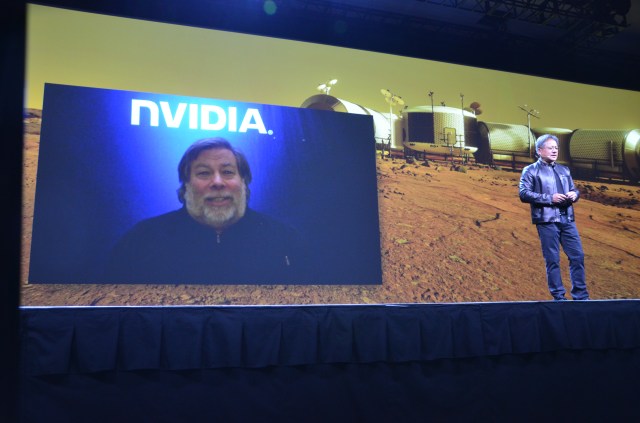
At the opening keynote at the 2016 GPU Technology Conference, Nvidia CEO Jen-Hsun Huang invited Apple co-founder, Steve Wozniak via video chat, to climb aboard and put on his head mount to be the first person to experience Mars. Photo by Marcus Siu.
“Well, Woz, that was not a helpful comment”…”I’ll let you know when you can help me again”, Huang replied back, with the crowd laughing behind him, knowing exactly what Wozniak was probably going through.
Yes, VR may be in its infancy stage, and there are still a number of obstacles to work on, but the future looks exhilarating for the world of VR. Just point me to the line where to get my round trip tickets to places where no man has gone before.
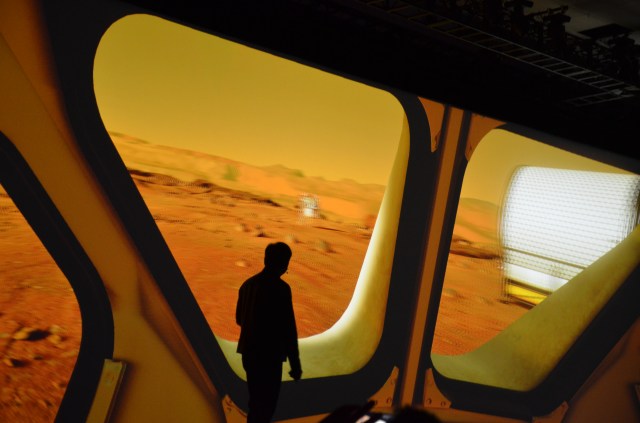
At the opening keynote at the 2016 GPU Technology Conference, Nvidia CEO Jen-Hsun Huang shows us what it’s like to be in the rover on the planet Mars. Photo by Marcus Siu

 mlsentertainment