
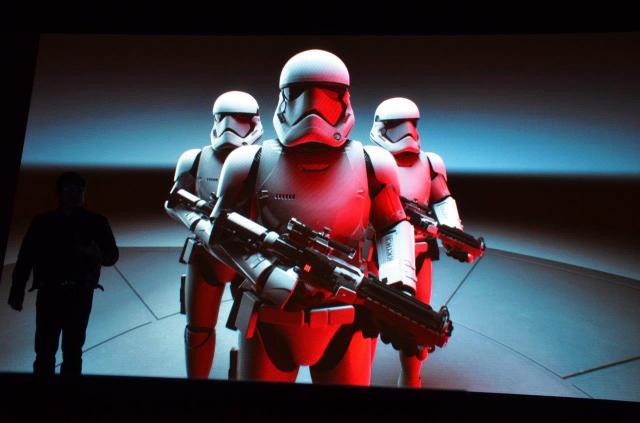
Jensen Huang, CEO of Nvidia, addresses the capacity crowd at the San Jose Convention Center at GTC 2018. Photo by Marcus Siu.
Article and photos by Marcus Siu
SAN JOSE, MARCH 24, 2017 – Over 8,500 people attended GTC 2018 last month at the San Jose Convention Center to attend over 600 hours of sessions, with 400 of those them devoted exclusively to artificial intelligence (A.I.) The GTC conference is also known to have one of the best VR/AR conferences in the world for all industries, including hundreds of startups.
The list of attendees attending GTC is dazzling. All of the top technology companies, film companies, game companies, auto companies, smart city governments, medical universities, among others, all attended the conference. The way attendance has been dramatically growing each year, Nvidia may need to reconsider moving to a bigger venue in the near future.
After a very impressive “I am A.I” trailer introduction demonstrating the various ways Nvidia continues to shape the world with deep learning and A.I. with their collaborative partners, Nvidia’s founder and CEO, Jensen Huang took center stage to open the keynote address to the packed audience. He organized his agenda into four main topics including “amazing” graphics, “amazing” science, “amazing” A.I, and “amazing” robots.
It seemed appropriate Huang opened up his keynote with the subject of ray tracing as part of his “amazing graphics” topic since it was announced a week prior to GTC at the Games Developer’s Conference (GDC) in San Francisco. With the demands of A/R and V/R in recent years, Huang acknowledged this had opened up many avenues and opportunities in GPU technology which eventually progressed, with the assistance of deep learning, computer graphics with real time ray tracing.
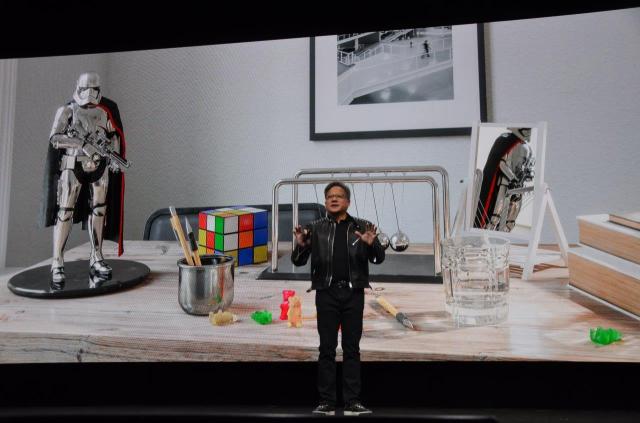
“Ray tracing…is the Holy Grail, the dream for computer scientists for the last 40 years”. Photo by Marcus Siu.
As Huang was presenting his keynote address, there was a huge image of a desk in a modernly lit room background on the giant screen behind him.
“Computer graphics is the driving force of the GPU. It is computationally insatiable, recreating virtual reality in its daunting computer tasks we know”, Huang remarked. “The computer graphics industry all around the world have been pursuing this holy grail, this dream of creating photo realistic images. ”
Huang continued , “it takes thousands and thousands of CPU’s and servers in order to calculate and compute each one of these frames. One CPU would take hours to compute one frame, and a movie…has hundreds of thousands of frames before they can create the final film.”
Taking a closer look of the image of the modernly lit room behind Huang, the image turned out to be a beautifully composed computer graphic photo image rendered by developers. Its quite uncanny how realistic this is, since the image included several objects on the desk, including a crystal glass, rubix cube, storm trooper figurine, Newton’s cradle of silver balls, a mini mirror, and a few colored gummy bears scattered across the table, among an assortment of other items. Each of these items showcased how challenging it is for a computer graphics scientist to render, yet if done well, would be completely indistinguishable from the real thing.
Huang pointed out the beauty and realism of the rendered objects on the desk, commenting on what it takes to make the image as photo realistic as possible with Nvidia’s ray tracing techniques to trick the viewers eyes, such as using screen-space ambient occlusion, baked lighting, global illumination, space screen reflections and environment maps, screen-space refraction, caustics, depth sorting, subsurface scanning approximation and subsurface scanning, which made the gummy bears come to life, for example.
“Using ray tracing, the gummy bear looks like you can just pick it up and eat it”, remarked Huang .
Jedi mind tricks believe you will.
“All of those computational and intensive problems; the effect of light as it travels through your room, the environment, is so hard to compute and that is why ray tracing has become so popular in film and it is the holy grail; the dream of computer scientists for the last forty years”, Huang remarked.
Most of this work will take many hours to render a frame for even the most experienced graphic designers. With the gaming and film industry, the main recipients who will benefit most from the latest RTX technology, it makes it so much easier to compose a photo realistic image for them now as a developer without a supercomputer.
“This is what we can do now; a $68,000 computer vs a super computer.”
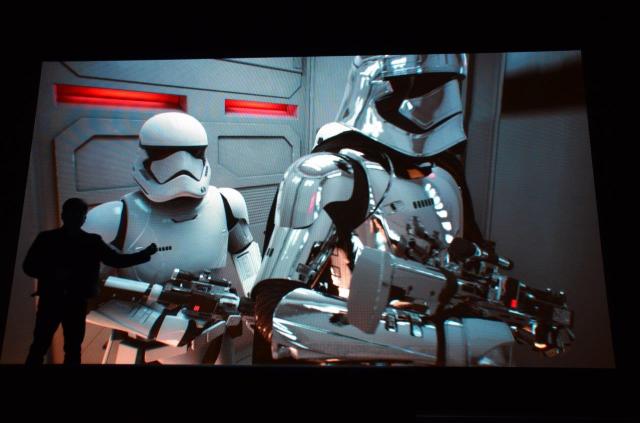
Jensen Huang demonstrates real time ray tracing at GTC 2018. Photo by Marcus Siu.
Steve Parker, an engineer and part of the Nvidia ray tracing team has been working on ray tracing for his entire career since joining them ten years ago, demonstrated along with Huang, an entire Star Wars demo in real time with just one Nvidia DGX station with four Voltas in real time, instead of a super computer rendering these scenes one frame every ten hours, like in a Hollywood movie, such as “The Jungle Book”.
“From tools makers (Adobe, AutoDesk), engine makers (Epic, Unity), film studios (Pixar, Industrial Light & Magic); they’ve all come out to adopt this technology. The Nvidia RTX technology will revolutionize the way they do work. They can finally do ray tracing in real time; try more frames, create more beautiful shots, deliver to the customer faster and on time and most importantly, save millions of dollars in the process.”
“This is technology is the single most important advance in computer graphics in the last 15 years…I believe that Nvidia RTX is going to define the future of computer graphics “This is a very very big deal”, Huang remarked.
REVOLUTIONARY PRODUCTS
“After 10 years, what makes this special, is that for the very first time we can bring real time ray tracing to the market. People can actually use it. The technology has been encapsulated into multiple layers from our GPU architecture to the algorithms that make it possible for us to do this.”
“You are also seeing deep learning in action. Without deep learning, it would impossible to have traced all of those rays…whereas deep learning has been used in the past for super resolution, we’re been using them for super rays; predicting rays, so that we could fill in the spots that we know what the right answer is going to be using A.I.”
“Nvidia’s Volta GPU, the RTX technology, the solvers, the architectures, the library’s have now been integrated into three of the most important rendering API’s; the Nvidia Optics, Microsoft’s DX-12 extension called DX ray tracing DXR, and also available in open GL Vulkan.”
Huang offcially announced the NVIDIA Quadro GV100 GPU with NVIDIA RTX technology, delivering for the first time real-time ray tracing to millions of artists and designers.
Nvidia estimates that a total of one billion images are rendered each year by the graphics industry. That includes images from 400 gaming products , 500 movies from media and entertainment, 12 million product designers, and 150,000 architects. With the use of the Quadro GV100 GPU with the RTX technology, Huang believes that the number of rendered images will jump to a factor of ten.
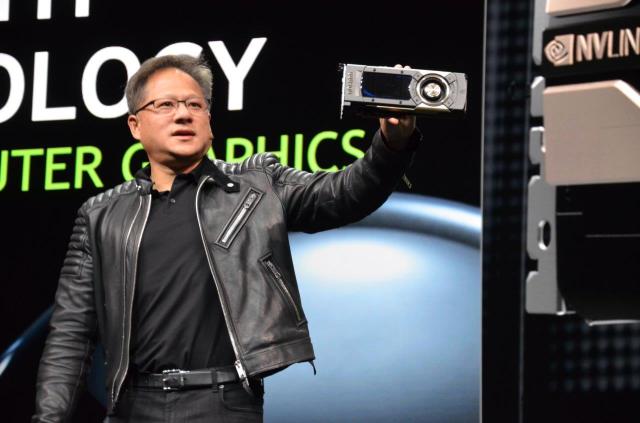
NVIDIA CEO Jensen Huang introduces the Quadro GV100 with Nvidia RTX technology technology at GTC 2018, delivering for the first time real-time ray tracing to millions of artists and designers. Photo by Marcus Siu.
Huang also announced some new upgrades and products during the conference, which include doubling the memory on the NVIDIA Tesla V100, as well as introducing the new Nvidia NV Switch, enabling 16 Tesla V100 GPU’s to communicate at a record speed of 2.4 terabytes per second.
“The world’s first workstation GPU based on the Volta architecture. It’s also the first one that has a brand new interconnect between GPU’s called NVlink2; super high speed interconnect between two GPU’s that basically extends the programming (memory) model out of our GPU into the other GPU, which means all of the memory reads and writes and the autonomic’s work exactly the same. Software doesn’t have to change. The two GPU’s connected through this new interconnect called NVLink is essentially one giant GPU. So these two GPU’s working together; two GV100’s, will become a revolutionary new workstation. It’s going to be available from HP, Dell & Lenovo.”
The specs of the this new “workstation” has 64GB of HBM2 Memory, 10,240 CUDA Cores, 236 teraflops of tensor cores.
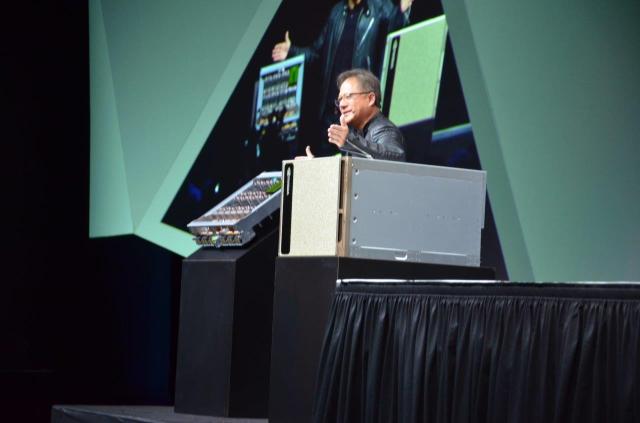
Nvidia founder and CEO introduces the DGX-2, the largest CPU ever created that can replace a typical render farm of 280 Dual-CPU Servers consuming 168 kW with 14 Quad GPU Servers using 24 kW. Photo by Marcus Siu
Huang also announced the DGX-2, which is the first single server capable of delivering two petaflops of computational power, 512GB of HBM2 memory, 81,920 CUDA cores, and 2,000 teraflops of tensor cores. The DGX-2 has the deep learning processing power of 300 servers occupying 15 racks of data- center space, while being 60x smaller and 18x more power efficient.
To Joe Moviemaker, it means with the flip of a switch, it can transfer 14,400 ten gigabyte movies in one second.
For filmmakers, game developers, product designers, architects and anyone in the profession who has a need to render computer graphic images, Nvidia has begun a new evolution now that the holy grail has now been discovered and the universe is now endless.
This means that for all computer scientists, the force will be with them. Always.
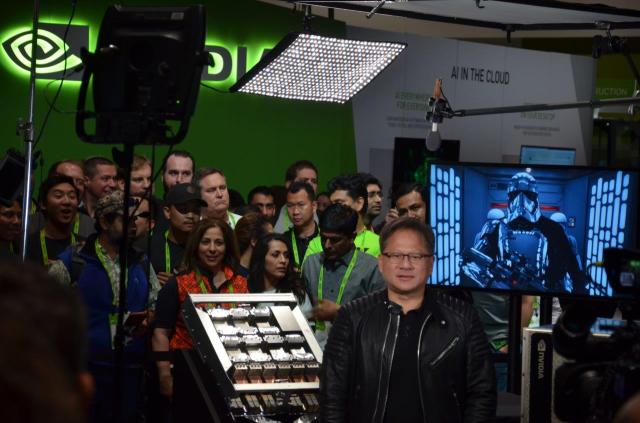
Nvidia CEO and founder, Jensen Huang, interviews with Jim Cramer of “Mad Money” on the Nvidia Expo floor at the San Jose Convention Center. Photo by Marcus Siu.

 mlsentertainment
My the queen goddess lay to rest – Ms Carrie Fisher