
Article by Marcus Siu
“It’s becoming a giant industry and it’s crushing it and it’s growing exponentially. After A.I., it’s the fastest growing tech sector…” – Ori Inbar, CEO and Co-Founder of AWE
The Augmented World Expo USA 2024, had its 15th anniversary this month, sharing the latest in AR, XR and spatial computing innovations. It’s the longest running and largest event focused on Augmented Reality and Virtual Reality (XR) in the world. The annual three day event outgrew the Santa Clara Convention Center where the annual event took place for its first fourteen years, relocating to its new home in Long Beach Convention Center, attracting more than 6,000 attendees, 300 exhibitors and 575 speakers.
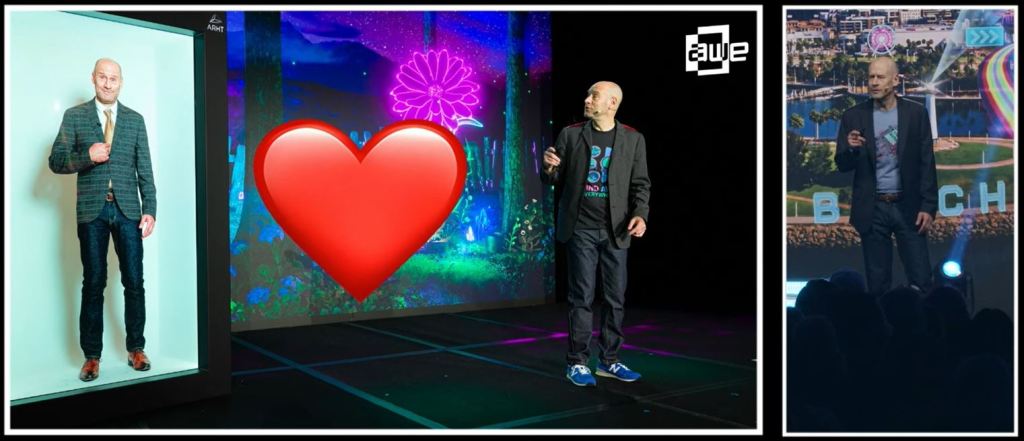
CEO and Co-founder, Ori Inbar, for the first time in its AWE opening keynote history, entered through the convention floor onto the stage wearing a XR headset (Vision Pro) headset, showing all types of mixed reality and face filters that was shown from his headset directly onto the screen entertaining his AWE audience.
LEARNING FROM XR’S PAST TO CREATE THE FUTURE
During his keynote, he summarized the state of XR and went through a brief XR history lesson from the beginnings from 1963, with a photo of Hugo Gernsback, the father of science fiction, wearing a type of headworn device that looks like a transister radio with two antennas on it, then five years later, in 1968 with a photo of the first working demo of a head-mounted display created by Ivan Sadland, along with the first keyboard mouse and 2D screen.
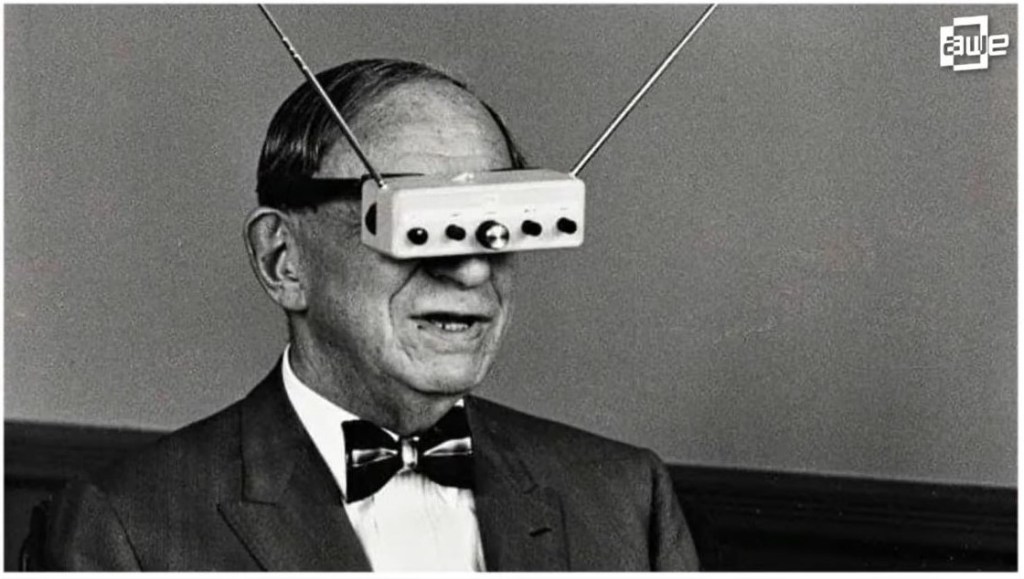
“If we want spatial computing to one day replace 2D computing we all have to become history buffs”, Inbar stresses to the crowd.
For those who unfamiliar with what “spatial computing” means, Wikipedia defines it as follows:
Spatial computing is any of various human–computer interaction techniques that are perceived by users as taking place in the real world, in and around their natural bodies and physical environments, instead of constrained to and perceptually behind computer screens.
For me the essense of spatial computing is very simple and I quote Ivan (Sadland), “The image of an object changes in the same way the real object changes with similar motions of the head”. Inbar continues, “Head computing imitating real life…that’s a concept I would bet my career on…because humans are biologically spatial and so should computing.”
In conjunction to its annual Auggie Awards, AWE had its inauguration and induction ceremony celebrating the first 101 members of the of the XR Hall of fame—a new platform dedicated to honoring the pioneers whose monumental contributions have shaped and propelled the XR industry forward, including Palmer Luckey, the founder of Oculus VR and designer of the Oculus Rift . It also featured an XR museum showcassing over 80 vintage AR and VR devices, including the Gernsback headworn device.
THE FUTURE OF XR INDUSTRY: THE TIME IS NOW
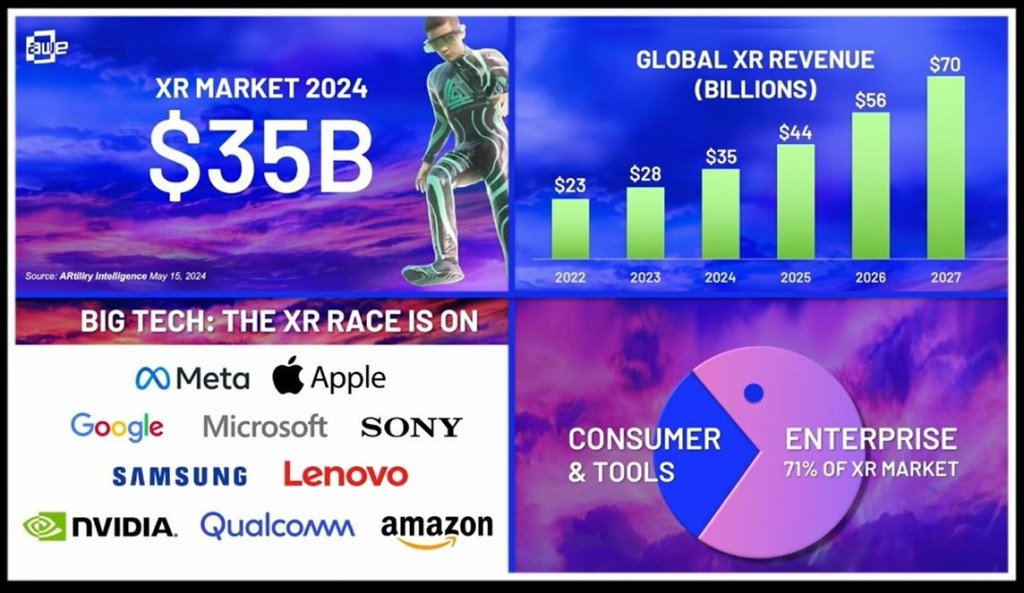
According to ARtillery Intelligence, a research and analyst firm for the business of spatial computing, the XRP market today this year is a $35 billion market. In 2027, it’s expected to double to $70 billion. “It’s becoming a giant industry and it’s crushing it and it’s growing exponentially. After AI, it’s the fastest growing tech sector.” says Inbar.
“Big Tech are all in a tight race to lead the market and it’s rearranging. Each player is retrenching in it to its strengths: software, hardware, operating system, infrastructure…doubling down or opening up and partnering, partnering, partnering. This is good for the market and it’s great for customers.”
According to Inbar, AR penetration has been stagnant around the 30%, but active usage is on the rise and VR adoption is growing where it really matters with the new generation; one in four teenagers are playing in VR.
Almost every single Fortune 1000 company has adopted XR. Enterprise revenue is now over 70% of the XR market. Fortune 1000 companies made its presence at AWE this week. All are participating in AWE’s new enterprise focus program which is ironically called “Focus” with custom export tours, roundtables, networking and really getting business done”, according to Inbar.
“Investments are picking up. Anderson Horwitz, probably the most influential VC in the world is bullish about XR.”, Inbar says. The partner at the firm recently posted this: “We believe AR/VR is among the most underrated markets today”. “Quest has a similar sales trajectory to the iPhone…the time is now” …
“On the Quest store, more than 40 developers have earned over $10 million each”, Inbar continued “amd what’s attractive about XR is that the most popular experiences on the Quest store did it with small teams and no funding.” He cites “Gorilla Tag”, “Penguin Paradise”, and “NoClip” were built with no funding and with one or two people. In addition, games are no longer developed exclusively for XR. Many iOS and Android developers are shifting to spatial with an estimate of over 2 million XR developers in the world.
As an attendee who has been going to the AWE conferences since the very beginnings, never did I have any doubt that VR, AR, MR, XR didn’t have a future. I’m really looking forward to another fifteen years that XR has to offer.
AI❤️XR 2


 mlsentertainment