
Article by Marcus Siu
“I think we’re looking at a future that’s a whole new distribution model where we can have theater grade 3D basically on your head.”
– James Cameron at the Meta Connect 2025 Conference
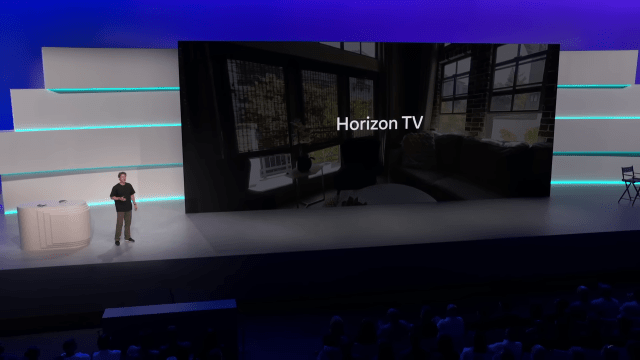
Mark Zuckerberg has just announced Horizon TV at the Meta Connect 2025 conference this month. It is an exclusive new streaming content hub for its Meta Quest VR headsets, featuring major streaming and media companies who have partnered with Meta, including Disney+ (including Hulu and ESPN content), Prime Video, Peacock, Twitch, DAZN and Pluto TV.
In addition, Meta is collaborating with studios like Universal Pictures and Blumhouse to offer immersive and 3D effects on movies like “M3GAN” and The Black Phone, exclusive to the Quest platform.
“It’s been really neat to see how many people are using Quest to watch video content and it’s just a lot more immersive”, Zuckerberg stated, “so we think that this category watching video content is going to be a huge category both in virtual reality headsets and on glasses too.”
Even though the streaming apps are currently individually available on the Meta Quest, they are not grouped together. This will be much easier for the user to access each app and navigate. More importantly Horizon TV will support Dolby Atmos and Dolby Vision for its rich colors, crisp details and spatial sound for a more immersive experience than you could have with any traditional TV.
“I am really excited about what these new technologies are gonna unlock for artists and entertainers” Zuckerberg continued, “I think that this shift towards more immersive storytelling… it’s gonna be one of the more exciting developments in the coming years and I think that it’s gonna drive a new wave of adoption of virtual reality.”
This is very similar to what Apple did with their Apple Vision Pro headsets in 2024. Apple partnered to launch the Disney+app allowing users to stream content in immersive 3D environments inspired by Disney, Pixar, Marvel, and Star Wars.
Disney’s technology teams, including ILM Immersive and Pixar’s Universal Scene Description (USD) developers, collaborated with Apple to create the enhanced viewing experience, which leverages Dolby Vision and MV-HEVC for high-resolution HDR. This collaboration was a key part of Disney’s strategic vision for spatial computing, with Disney CEO Bob Iger highlighting it as a revolutionary platform for storytelling.
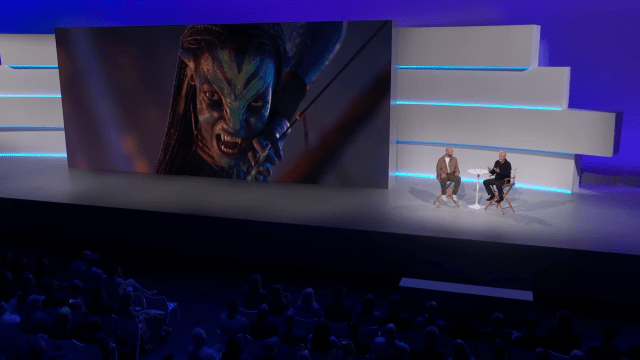
Zuckerberg introduced movie director James Cameron onstage along with Meta’s interviewer, CTO Andrew “Boz” Bosworth. The legendary filmmaker is well known for pushing the boundaries of filmmaking by introducing new cutting-edge CGI 3D technology featured with his ground-breaking blockbuster movies.
During a time when movie theaters and filmmakers were mostly still using analog, he helped pioneered the way for digital film projectors and cameras right before movie they realized 3D would become profitable in the mid 2000’s. He proved it with “Avatar” in 2009, which is still the highest box-office hit of all time. “Avatar: The Way of Water” and “Titanic” are third and fourth on the all-time list, to add to his legacy. He is the most successful director in Hollywood at the box office.
“I just love 3D… I love seeing the end result when it’s done properly and I think it’s how we perceive the world.”, Cameron proclaimed. “Why would we throw away 50% of our of our data and see everything through a single line…it makes no sense to me …I just see the future which I think can be enabled by the new devices that that you have…the Quest series and then some of the new stuff hopefully that’s coming down the line.”
With 3D movies being shown in theaters and at home, the levels of brightness was just not there, which is one of the reasons why 3D has lost its popularity over the years. Movie theater projectors are rarely bright enough, and neither are home projectors. Television does fare better than theaters, but it’s just too dark to see most of the detail.
With all that in mind, Cameron has been fighting with movie theaters over the years to install laser projection systems in order to boost the brightness levels up, but they still continue to use their fifteen year old digital technology. Having an experienced eye of what 3D movies are supposed to look like that he calls “baseline calibration”, he wants to see the light levels beyond the SMPTE (Society of Motion Picture and Television Engineers) standards for theater projection.
“The very very best you’re going to see in the theater is 16 foot-lamberts. Most theaters are at 3 foot-lamberts…one which is like “nits”, but it’s the theater version…the Quest is is at 30 foot-lamberts equivalent.” Cameron argues.
“The brightest gives you the dynamic range, gives you the color space, as it was meant to be and that’s so much more engaging. The work that you guys have done in the in the Quest series to expand the field of view, to get the brightness, to get the spatial resolution to me…it’s like being in my own private movie theater.”
“You mostly look at flat displays: phones, laptops, wall panels, all that sort of thing. This is going to be, a new age. Because we experience the world in 3D, our brains are wired for it, our visual-neural biology is wired for it, and we’ve been able to prove that there’s more emotional engagement, there’s more sense of presence.”
According to Cameron, the future certainly looks promising for the return of immersive 3D storytelling, not only for feature films, but to but everything from short-form content to sports and even news…the low hanging fruit as Zuckerberg calls it.
It certainly looks to be a bright future, at least with VR headsets and future devices down the pipeline. If so…
“I’ll be back”.

 mlsentertainment