Screenwriters of “White Boy Rick”, Logan and Noah Miller. Photo by Marcus Siu.
Article by Marcus Siu
It’s been ten years since identical twins Noah and Logan Miller did the implausible by “literally” breaking into Hollywood. The Fairfax natives snuck past the tight security during the San Francisco International Film Festival to pursue Academy Award winner, Ed Harris, where he just received an acting award at the Castro Theater. Immediately after the standing ovation and Harris’ exit, the twins darted onstage on a mission and followed Harris behind the red curtains with an open laptop and their script.
When the twins got Harris’ attention backstage, the excited fast-talking duo persuaded the amused Harris to go out into the alley by the side of the theatre so he could hear what they desperately wanted to say and to also have him watch their two-minute trailer on their laptop atop a dumpster to pitch him the script of “Touching Home”; their autobiographical coming of age drama about their alcoholic father who attempts to reconcile with his two sons as they pursue their dreams of professional baseball.
Richie Merritt (White Boy Rick, right) and Matthew McConaughey (Richard Wershe Sr.) star in Columbia Pictures’ and Studio 8’s WHITE BOY RICK.
Their mission was to make good on an eternal promise to their father; to make and dedicate a movie about him and show, despite his struggles with alcohol, that he was a good father who did his absolute best to keep his family together.
Along the same lines, it is with this same understanding about family that brought the twins their third writing credit with Sony Pictures, “White Boy Rick”, based on the true story about Richard Wershe Jr., a teenager who became an undercover informant for the FBI in Detroit during the 1980s and was ultimately arrested for drug-trafficking and sentenced to life in prison.
Before production, there were two different scripts floating around from two different production companies of the life of Richard Wershe Jr. However, it was the Miller’s script that won each of the production companies over as both teams were drawn more to the emotional familial elements of the tale over the “gangster” themes.
Logan Miller explains, “I think just trying to look at each character as a fully formed human being in a two hour setting is very forced and restricted, but if you try to go through each person and figure out a little bit about them and not judge them morally, …they’re living their lives, they’re struggling, they’re just trying to get through the day like everybody else”. Miller pauses, “That’s some of the great challenges but also one of the great privileges of writing…trying to understand people better.”.
Regardless if a character is a self-abusive father or a teenage kingpin crack dealer, or even the father of “White Boy” Rick played by Matthew McConaughey, who sells guns for a living, it’s hard to feel empathy for them if you are only looking from the outside in. With the Noah and Logan Miller’s script, it shows the characters as real people who have real dreams but are struggling to make it in life in an ever-changing world.
(Originally printed in the November 2018 issue of CC Magazine)
If you’ve seen the 2009 Oscar winning documentary, “The Cove”, the film that brought international and attention to the masses regarding the slaughtering of dolphins and whales in Japan, led by renowned dolphin trainer Ric O’Barry and his team of activists and espionage filmmakers infiltrating the cove near Taijii, then you may wonder what has been going on since then.
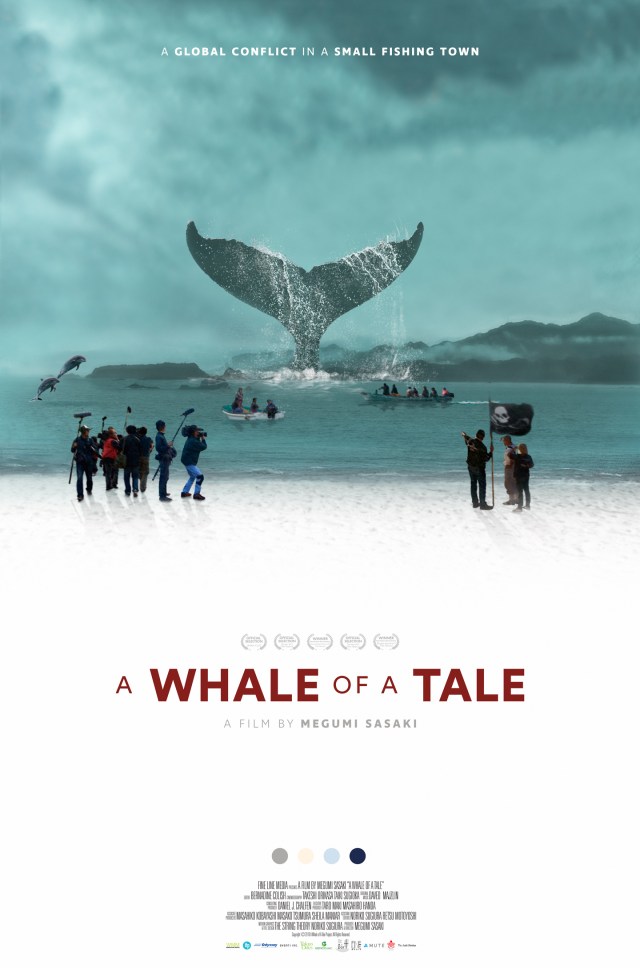
Megumi Sasaki’s latest film, “A Whale of a Tale” covers many of those questions and follows up where “The Cove” ends.
Nearly ten years later, after Taijii become a major destination place to hoards of global activists, things have settled down quite a bit. However, rather than focusing on the angst of the activists, director Sasaki mainly lets the town villagers from Taijii speak out instead, giving them a voice and a sense of more balance and humanity into the delicate subject.
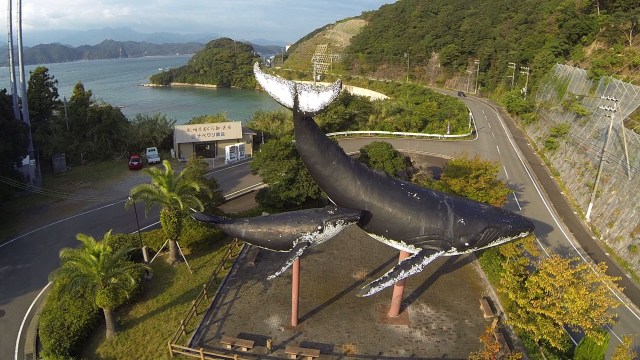
Whale Statue at the Entranceof the Town/ Taijiin Megumi Sasaki’s A WHALE OF A TALE (Photo Credit: FINE LINE MEDIA)
Since traditional whaling has been around for over 400 years, Sasaki also gives us a intimate portrayal and a glimpse into the many generations of the people and village of Taijii. We hear from families who have no other skills, except to hunt for dolphins and whales. We even hear from the people who run the esteemed “Whale Museum”, which is the main attraction in Taijii. We even hear from activists and political figures views, including “The Cove’s activist”, Ric O’Barry, who gets “arrested” in Japan, because he has no passport.
While “The Cove”, with all its wonderful intentions to save the dolphins and whales, and exposing the truth of inhumanity to the western world; it was told mainly from an activists point of view. It unfortunately didn’t represent and capture the real voices of the people who actually live around the cove in Taijii.
That is where the strength of “A Whale of a Tale” comes in.
After all, there are at least two sides to every story.
Taiji Whalers / Taiji in Megumi Sasaki’s A WHALE OF A TALE (Photo Credit: FINE LINE MEDIA)
The documentary A WHALE OF A TALE is opening at the Alamo Drafthouse Cinema – New Mission Theater this weekend. Filmmaker Megumi Sasaki will be in attendance for a post-screening Q&A on Friday, September 7th and Saturday, September 8th at 6:30PM. Read the recent Washington Post review here and get tickets here.
Doug Jones, recipient of the California Independent Film Festival Lifetime Achievement Award presented by CAIFF founder, Derek Zemrak at the Orinda Theater. Photo by Marcus Siu.
Article and photos by Marcus Siu
ORINDA, CA, August 25, 2018 – After pulling off an all-nighter on the set of the popular TV series “Star Trek – Discovery” in his role as Commander Saru, actor Doug Jones was scheduled to fly the next morning from Toronto to San Francisco to be honored and presented onstage with a “Lifetime Achievement Award” at the California Independent Film Festival.
Not bad for an guy who has been unrecognizable to most of the public since he is usually behind layers and layers of prosthetic makeup in the majority of his roles, but has become a Hollywood icon for over his thirty-year career by playing some of the most unforgettable characters ever created on screen. The latest being “Amphibian Man”, the sea creature who falls in love with a mute woman, played by Sally Hawkins in last year’s Best Picture winner, “The Shape of Water”.
As soon as he arrived in the theater, he was sincerely apologetic to the cheering crowd for being late. He certainly didn’t disappoint his legion of fans, including the many Trekkie’s, as some actors in this position might have taken a different approach, such as cancelling all together, but Jones seemed to care more about his fans than about himself and it definitely showed.
EARLY DAYS
Interviewed by CAIFF founder and President, Derek Zemrak , Jones recalled growing up as a “a very tall, goofy, skinny kid” in a small town in Indiana. He was made fun of and picked on by all the other kids over the years. To survive all that, he went on to become the class clown, inspired by the likes of Dick Van Dyke, Jerry Lewis, Danny Kaye…Carol Burnett, Mary Tyler Moore, just to name a few. Those were “his” people.
“I’m inspired by that TV, so I should be on it one day”, Jones reminisced. “All my friends are on there, so I want to join them, right?”.
While going to school at Ball State University in Indiana, in addition to being the team mascot, Charlie Cardinal (with the red bird suit) he was learning mime as part of the mime troupe, “Mime over Matter”. His first job after graduating was as a street mime and contortionist at King’s Island, an amusement park in Cincinnati.
Jones explained that his “excuse” job to move to Los Angeles was to apply for a bank management training position for nine months, but was fired after eight months.
“As they should have!…Banking? You don’t want to trust me with your money.” Jones exclaims.
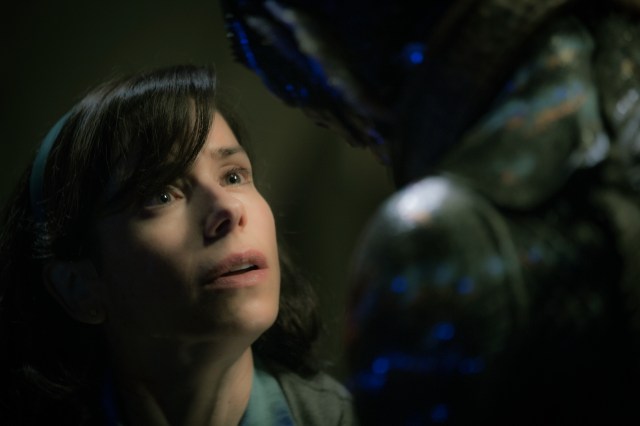
Doug Jones and Sally Hawkins in Guillermo del Toro’s “The Shape of Water”. Photo courtesy of Fox Searchlight.
COMMERCIALS & MOVIES
Then he got involved in TV commercial acting classes in Los Angeles, and within six months he was a dancing mummy on a Southwest Airline spot, and the three years following that, did 27 commercial TV spots for MacDonald’s “Mac tonight” campaign that allowed him to buy his first house.
With his contortionist skills and his “flexible” reputation as “a tall, skinny goofy guy, who moves well; wears a lot of crud on his head and doesn’t complain about it”, his attitude, along with his affable personality helped Jones make that successful transition from TV commercials to the film industry; more specifically the creature effects makeup industry”.
Jones reminisced how he was referred to by a well-known stunt friend, who was well aware Jones could put his legs behind his head, which eventually led him into his first gig on his first major motion picture.
“I got a call from the Stunt department…”, Jones explains. “We want to you to come and meet us”. After Burton demonstrates his skills, the stunt writer says “hang on a second, I’d like you to meet somebody… and he comes back with Tim “freaking” Burton. So, after I wet myself…”, Jones demonstrated his skills again. Jones got the part in “Batman Returns”, without even having any head shots.
In addition to playing the Thin Clown in “Batman Returns”, his other highlights include playing Billy Butcherson in the perennial favorite Halloween movie, “Hocus Pocus” starring Bette Midler; and the title role in “Fantastic Four – Rise of the Silver Surfer”. However, he has become Guillermo del Toro’s “go to man”, in which he no longer needs to read the script for his films to accept the role. He has worked in seven of his films, including roles of Abe Sapien in the Hellboy series, the Faun and Pale Man in Pan’s Labyrinth, and Amphibian Man in the Oscar winning Best Picture, “The Shape of Water”.
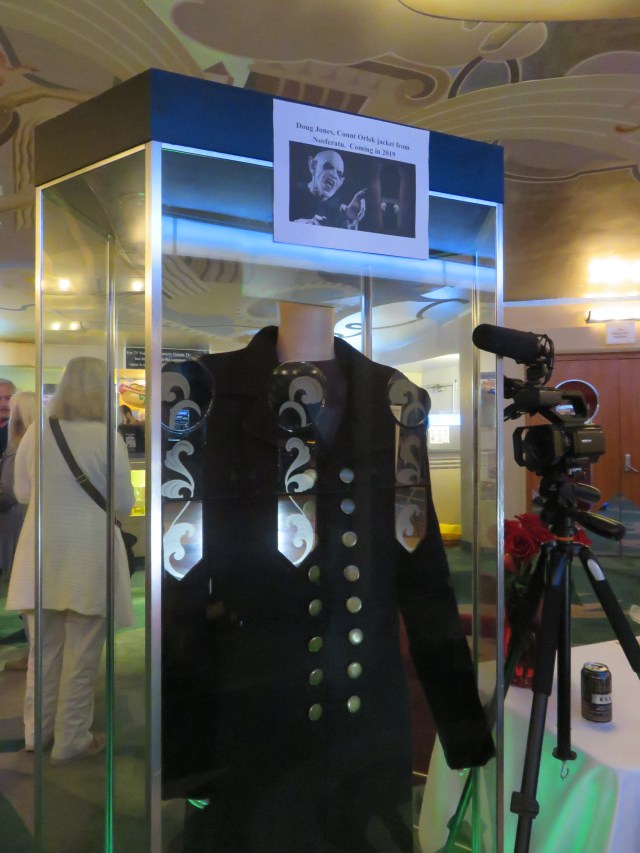
The original costume worn by Doug Jones as Orlok from the forthcoming movie, Nosferatu,, scheduled to be released in 2019. Photo taken at the lobby of the Orinda Theatre. Photo by Marcus Siu.
DREAM ROLE & UPCOMING FILM
After having played so many monsters and creatures, Jones had just one dream role left…
“If you asked me ten years ago, what’s the one role you haven’t played yet you really would love to?” My answer was “I haven’t played a proper vampire yet…I want fangs…I want to be a classic vampire…I’m too old and gross to play a young sparkly vampire. Jones continued. “Who’s old and gross? “Nosferatu!”.”
As chance would have it, Jones would get a call from Director David Lee Fisher, who did a 2005 remake of one of the first original German horror silent films, “The Cabinet of Dr. Caligari” that was shot over a hundred years ago; in which the remake updates the silent film with sound and dialogue. He called to see if Jones wanted to play the lead role in his upcoming project, “Nosferatu”. Little did Fisher know this was Jones’ absolute dream role was to play Count Orlok in “Nosferatu”.
“What’s really special…is the film in the background is all shot in green screen and the original footage from shot nearly 100 years ago will be all in the background.” Zemrak added, who came on board as one of the producers of the film, as well.
Jones also added, “not only did I get to play that character that I longed to play, but I got to play in the environment that Max Schreck got to play in.”
Something tells me with the enthusiasm and amazing talent of Doug Jones, this new and upcoming “Nosferatu” won’t suck.
The California Independent Film Festival continues this week: https://www.caiff.org/
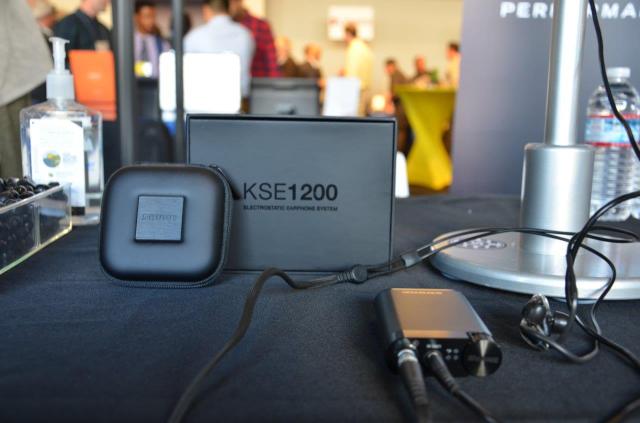
Shure’s KSE1200 portable Electrostatic Earphone System shown at the Pepcom Show in San Francisco. Photo by Marcus Siu
Article and photos by Marcus Siu
Most consumers who listen to music through their personal devices don’t hear much of the nuance and detail that was meticulously crafted and constructed during the recording process in the studios. Sure, they “listen” to their music through their headsets and enjoy it enough to sing and keep listening to it, but they really don’t “hear” the highly detailed and immersive sounds which recording engineers have meticulously captured.
There is quite a lot lost during the journey from that was faithfully recorded initially in the music studio to the path of the consumer’s ears.
At the most recent Pepcom Digital Experience show in San Francisco, some of the most cutting edge companies displayed their latest mobility wares, and featured a few audiophile manufacturers thrown into the mix, which was a refreshing change. Problem was that some of the companies couldn’t instantaneously demonstrate how good their audio products were since the surrounding booths would drown each other out and no one would be able to hear anything in the room.
Luckily, at the Shure booth, they didn’t have that issue. Their audio demo was quite minimalist with a table that included an iPad attached to their KSE1200 analog Electrostatic Earphone System.
Lyle Lovett’s “Her First Mistake” was the first demo from the Shure booth. Photo by Marcus Siu
When I put those little earphones on, the sound was so pure and lifelike that I felt I was put right in the actual recording studio alongside with singer Lyle Lovett and his band. I could hear every little acoustic detail from his band, along with every breath that Lyle took while singing. This demonstrated to me that this is as honest as music is going to get. Even coming from the mainstream iPad, it was still unbelievable that the sound could sound so true.
My initial impression was how could something so light and small put out such detailed and realistic lifelike sound coming from these tiny little 5.8 ounce earphones? It was disbelief for me for the first few minutes, and then I just surrendered to the music and just could not stop listening.
Not only that, but these lightweight earphones were extremely comfortable. There was never an issue with “headphone fatigue” like other headphones I have tried on before. After the first minute or so, I almost forgot I had them in my ears all together once I started hearing the music.
I really got into the music while I was moving and a grooving. I was gettin’ down like James Brown and I’m sure the other fellow journalists around me probably thought I was a nut or just overreacting around the Shure booth to get some attention, but I was most certainly not.
I was so immersed with the music making that was produced through this system and was listening carefully to hear if I could discover any imperfections at all, which never happened. This is as close to hear what the sound engineers hear in the studio. Nothing to obstruct between your ears and the music. It was just me and the music. Pure and simple.
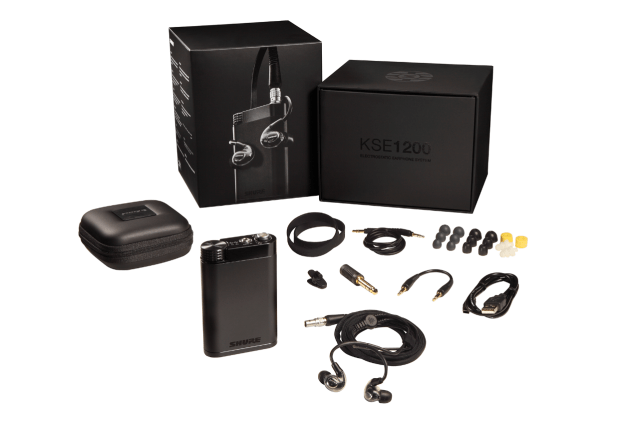
Actually, the KSE1200 Electrostatic Earphone Systems aren’t new with Shure. According to Sean Sullivan, who gave me the demo in the booth, he explained that the Shure KSE1200 is the second product in Shure’s lineup of the Electrostatic Earphone Systems, but is the same system as the Shure KSE1500 (list price $2999) that included the same electrostatic amplifier and earphones, except that the KSE1500’s amplifier included a digital front end (a DAC; a screen on it, and also a DSP built into it).
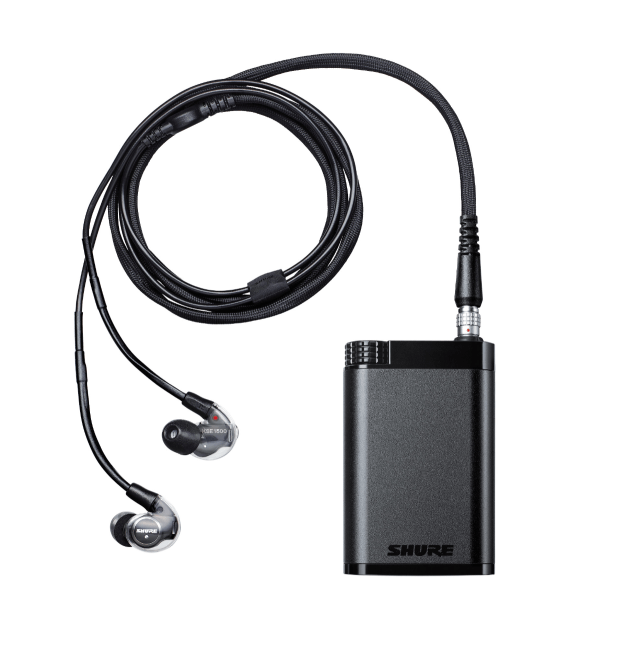
Photo courtesy of Shure
“So many people starting using the KSE1500 ($2999 list) with the analog input, but the price was still a hurdle for that. The KSE1500, and now the KSE1200 both have an analogue input and the same circuity, literally the exact same electrostatic earphones for $1,000 less. Takes all of the digital front end and stream additional components out of the mix that people really already have in their players these days,” Sullivan noted.
Nowadays, most people don’t need the additional components that were built into the KSE1500 system, since many media devices already have these components built in. Bypassing these items, Shure was able to release the KSE1200 for $1000 less. Especially that more than ever, common everyday media players have started sending digital audio out from their devices. More and more of these players that have been coming out allows you to store massive lossless files already have great components, such as DACs, already built right into them.
At $1,000 less, it becomes a pretty good deal. Especially, if you happened to have heard the KSE1500’s when they first came out a few years ago.
But what makes these earphones extremely special compared to all the other ones out there is the electrostatic circuitry technology. This is why these headphones sound like no other.
“The earphone themselves are driven differently than a standard speaker…so, in your dynamic speaker; you have your magnet, you have your coil, you have your diaphragm…all of that has a relative mass to it…and as fast as it could move, we’re so used to using these speakers…they produce really good sound, don’t get me wrong…”, Sullivan explains…
At 5.8 ounces, music will never be “lightweight” ever again. Photo courtesy of Shure.
“however, the electrostatic driver is compiled of a massless diaphragm that literally weighs nothing. It has a DC charge on it, and there are two plates that hold the audio signals at plus or minus 200 volts. Those plates are placed right next to each other, but not touching and they create the electrostatic energy field between them. The diaphragm is suspended between those, and because it’s massless, it moves as fast as that energy field can move, so there is no magnet or coil that has to force back and forth.,, the result is the fastest diaphragm, best transient response, clarity in detail…out of this world.”
I couldn’t agree more. It sounded out of this world…and I felt like I was transported to heaven, but went back to earth after taking the earphones off.
California Gov. Edmund G. Brown Jr. was honored with the Champion of Change Lifetime Achievement AWARD, presented in partnership with the California Solar and Storage Association. Photo by Marcus Siu.
Photos by Marcus Siu
SAN FRANCISCO, July 10, 2018 – Intersolar and ees North America, the premier solar and energy storage exhibition and conference in North America, today welcomed an expected 15,000 attendees to San Francisco’s Moscone Center. Located in the heart of the U.S. solar and storage markets, the event offers more than 40 conference sessions and workshops, exhibitor presentations on two stages, and numerous networking opportunities that connect leaders in the solar, storage and smart renewable energy industries.
A packed room was on hand for this morning’s Opening Ceremony, which featured keynote speakers Dr. Elaine Ulrich, senior advisor to the U.S. Department of Energy, and Tony Seba, author and Silicon Valley entrepreneur.
The keynote speakers reflected on the continued growth across the solar and storage industries, spurred by technology developments and groundbreaking policies. Dr. Ulrich also reminded attendees of how collaboration accelerates efforts to bring valuable technologies and services to the new energy economy.
“This industry is incredibly innovative and we’re excited about the future we’ll see together,” noted Dr. Ulrich. “We know that industry partnerships are the cornerstone of our success. Without broad industry-wide participation, we would not be where we are today.”
Mr. Seba focused on how smart energy technologies are enabling a major shift in the automotive industry, drawing parallels between the evolution of telecommunications and the electrification of the transportation sector.
Tony Seba, author and Silicon Valley entrepreneur at Intersolar Press Conference. Photo by Marcus Siu.
“By 2030, because of pure economics, every building, house, device, will have a battery,” he said. “That is going to enable another disruption: the electric vehicle disruption. By 2025, if this cost curve persists, essentially every new vehicle will be electric.”
During the Opening Ceremony, California Gov. Edmund G. Brown Jr. was honored with the Champion of Change Lifetime Achievement AWARD, presented in partnership with the California Solar and Storage Association (CALSSA), for his unwavering commitment to solar industry advocacy over the past three decades. Bernadette Del Chiaro, executive director of CALSSA, presented the award, and commended Gov. Brown for his dedication to the advancement of solar throughout California.
“Many of you remember [Gov. Brown’s] first foray into solar back in the 1980s. He was supporting our technology way before anyone else saw the potential for it,” said Del Chiaro. “During his first term in 2011, we had 2 GW of solar in California. Today, we have 10 times that.”
Gov. Brown described Intersolar as a “gathering that can re-inspire so many innovators” before thanking organizers for the award. He went on to note: “It is California that is setting the pace. And yet we ourselves have so much more to do. Recognize, celebrate what we’ve done, but never for a moment think we are close to the goal – we have miles and miles to go.”
The Intersolar and ees North America exhibitions will showcase the latest trends in solar PV, energy storage, and smart renewable energy in six exhibition segments. With approximately 450 international companies present on the exhibition floor, attendees will gain early access to some of the most innovative solar and energy storage technologies being brought to market from across the industry value chain. The co-located conferences will feature over 170 influential speakers who will share their insights into market dynamics and opportunities for growth in 2018.
Solar and energy storage installations in the United States continue to set records and demonstrate their economic viability. According to GTM Research, 55 percent of all new electric generating capacity brought online in the U.S. in Q1 2018 came from solar. Solar installations are forecasted to reach 104 GW this year – moving forward, annual installations in the U.S. are expected to exceed the 100 GW threshold through at least 2022. The U.S. energy storage market is estimated to grow 17 times from 2017 to 2023, while the solar-plus-storage annual market is expected to reach 2.2 GW by 2023.
Focus on Smart Renewable Energy Previews Next Major Industry Development
Increasingly, utilities worldwide are looking for smarter ways to manage renewable assets, including solar, energy storage technologies, and rising energy demand from electric vehicles (EVs). A recent report from the Rocky Mountain Institute projected that 2.9 million EVs will hit the roads by 2022, adding over 11,000 gigawatt-hours of electricity demand to electric grids across the globe.
Reflecting its commitment to anticipating industry trends, ees North America debuted the Power2Drive conference track, which features four sessions on managing the storage and infrastructure demands of the electrification of transportation. An exclusive white paper from GTM Research, “Grid Edge Innovation – Technologies, Business Models and the Future of Demand Flexibility,” offered further discussion on these trends, as well as the market potential for solar-plus-storage. The paper is available for download at http://www.intersolar.us> News & Press > White Paper.
Governor Brown addresses the crowd at the 11th Annual Intersolar Conference. Photo by Marcus Siu
Just like Superman who disguises himself as a mild-mannered spectacled newspaper reporter from “The Daily Planet” newspaper, easily blending in with the citizens of Metropolis as Clark Kent, the IRIScan Mouse Wifi in comparison seems to be a typical mouse blended in among an all too overcrowded world of accessories.
Clark Kent may “look” somewhat awkward and unintimidating at times to the people around him, but that is just him masquerading as Superman, just like this seven-ounce IRIScan Mouse does well, acting as an all-in-one scanner and wireless mouse with super powers.
When observing the IRIScan mouse side by side next to a laptop, there is nothing extraordinary about it when comparing other wireless mice. It scrolls, like a mouse, it, clicks like a mouse, and moves every which way just like a typical midsize mouse should. With its standard three mouse buttons and dialing wheel, it’s quite mild-mannered, just like Clark Kent, and it functions quite well for an everyday mouse.
Like Superman’s “x-ray vision”, the IRIScan mouse, has similar super powers and can suddenly transform itself to become a scanner within seconds from the touch of a button. Located on the bottom interior, its glass plate is free to roam and glide anywhere due to its wireless capability. It features a 1,500-dpi optical sensor which can create a scan with a resolution of up to 400 dpi for crisp, sharp documents using Slam Scan Technology, which is designed to allow users to scan documents up to A3 (11.7 x 16.5″) in size in a single bound. This IRIScan mouse has super powers that are “out of this world.
INSTALLING THE SOFTWARE
Without the software, this mouse would have no super powers. It’s the IRIScan and CardIris software and the hardware that makes this lithium chargeable mouse mighty unlike no other.
The first thing you need to do is to insert the dongle into the USB port of your computer and then install the IRIScan Mouse Wi-Fi software. Once the software is installed, you will have some very powerful tools that will make it easy to make to convert and edit into different files. By the touch of the button on the top of the mouse, the software loads the program onto your screen and immediately you are ready to scan.
THE SCANNING PROCESS: FREEHAND VS SCANPAD
To test the initial scanning of the IRIScan mouse, I grabbed a few items around the office; a credit card and credit card receipt, a business card, a film festival program, a political campaign mailer measuring 8.5”x11, as well as a CD jacket cover. I even took a bound music book to see if I could copy a page of music without having to crease the spine.
As I was scanning each of these items by hand, I began to realize that I didn’t have a smooth flat surface to work with, making it difficult to get a good initial scan from my documents. In addition, it was a tricky process, as I had to secure the documents using one hand and scan with the other. If the document was larger than my hand, than it would be difficult to get a good scan because of the documents not being securely held down.
As it turned out, I was still able to create perfect scans of the credit card receipt, business card, and CD jacket cover. I also was able to take capture a portion of the the film festival program containing a picture from the movie and the corresponding text description of it. However, I found myself having to rescan or “repaint” the spots that I initially missed. Luckily, they were small enough, so it wasn’t too troublesome.
Larger documents, especially if it contained both text and a photo on them, were more involving and definitely tested my patience, though I finally got the results I needed after several attempts keeping the document flat and still. I managed to scan a whole page of piano music from a bounded book perfectly, but that also took some practice to get to get it right.
As with the 8 ½“x 11” campaign flyer that included a slogan in the picture, I had absolutely no luck in scanning it in successfully. IRIScan even attempted to correct it through its OCR recognition, but as I rescanned the spots I had missed, it ran out of memory before completion of the image. It’s as though I was re-painting over the painted picture over and over without ever getting it just right.
Even with IRIScan’s capability to scan up to A3, it was very difficult to get the output to perfection, even with its OCR capability. My initial impression after freehand scanning was that this was way too much trouble for what it is worth, even for small documents, but that was before I realized that IRIScan included a ScanPad in the packaging.
IRIScan ScanPad
The 4”x7” ScanPad includes a clear plastic cover that you can use to place over your document before scanning, allowing the mouse to scan over the documents with ease while holding the documents securely. This was the perfect solution making scanning very simple and quick for smaller documents. The ScanPad was a pure “life saver” and was a joy to re-scan all of those documents that I previously did freehand, which was finished in seconds.
I suggest this ScanPad should always be used with the IRIScan mouse scanner.
It even scanned a credit card that wasn’t completely flat because of the numbers protruding, which made the scan a little bumpy. The results were still perfect as it just took two swipes. Impressive indeed.
For larger documents that do not fit in the ScanPad, I was curious to know if a larger size ScanPad would have taken care of this issue had IRIScan included it in their package. If so, I gladly would have paid for the extra cost.
THE CONVERSION, EDIT, AND SHARING PROCESS
Once you have captured what you needed to have scanned with the touch of the button, it will automatically capture it and convert it by straightening it and applying a suggested crop that you can resize. It does a wonderful job allowing you to crop off the excess that you don’t need. Usually there is no need to rotate the document, as well. The software is very intuitive and user friendly during the editing process.
As soon as you are ready to save the editable document, it uses an embedded OCR (Optical Character Recognition) solution that supports well over 130 different languages that will identify text and allow users to easily copy and paste it into their most used applications, such as Microsoft Office, Adobe Acrobat, or even Apple. You can convert your scanned document into a TXT, XLS, or even an PDF, and since OCR is being utilized by the software, you can fully edit your text, whether it’s a Word, Notepad, Excel, or an Acrobat reader document.
Also, if you are scanning business cards, through CardIris, it will convert into digital contacts filling out the regular fields through OCR. Though not 100% perfect, you will still save a massive amount of time, since they are all editable fields. From there, you can save them into your Outlook, Gmail, etc.
If you are scanning a picture, you have your choice of choosing a JPG, TIFF, or even BMP format you can export it as a fully editable PDF or text file compatible with popular text and spreadsheet editors. Once saved, you can also have it backed easily on to your personal cloud hosting service (Dropbox, Evernote, Google Translate.) with just a click. This mouse scanner also lets you share pictures or drawings from your children with friends and families on Facebook and/or Twitter.
This must be one of the most ingenious innovative ideas in quite a while and this mouse has some super powers that no other mouse has ever seen.
While the IRIScan Mouse WiFi may not replace your scanning equipment, it will supplement them by being able to scan documents that would not normally be used by a typical flatbed or feedable scanner, such as pages from bound magazines, books or music scores, due to its bulkiness. It will also make scanning smaller documents much easier and convenient, especially when on the road with your MousePad. However, if you have two-sided scanning to do, I would recommend a portable scanner.
A wonderful selling point of this mouse is its’ mobility features. This will appeal to those who travel for work and who collects many business cards and needs to update his contacts frequently onto his computer, as well as scanning receipts for his expense reports for a timely reimbursement from his employer. If you bring your MousePad with you to scan documents, everything will scan perfectly and it will be much quicker to edit, if needed. No longer will you need to type in text from a document.
If you have items larger than 4”x7”, you may have probably issues with it by not being able to scan perfectly the first time, though it might help to find a a completely smooth non-glare surface such as a clear deskpad that you can put documents under to scan so there wouldn’t be any movement. One of the challenges that I face is that paper moves, and it is difficult for the scanner to “paint” the document. It is best if the documents don’t move and stay as flat on the surface as possible. It also helps if the surface holds the paper down and is on a blank white neutral background.
This is simply not just a regular mouse, but supplemented by its useful software is a powerful all-in-one wireless mighty mouse scanner.
Faster than a speeding bullet, stronger than a locomotive, able to jump tall buildings in A single bound
… It’s a mouse…Its a scanner, It’s “IRIScan Mouse!
Though, I’m not sure why they didn’t provide the IRIScan Mouse with a cape.
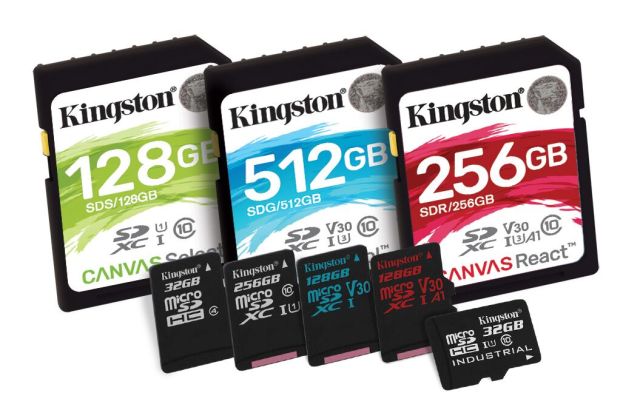
The Canvas line of Flash Cards, available in SD & Micro SD formats. Courtesy of Kingston Technologies.
Article by Marcus Siu
Before the days of HD video becoming popular and when point and shoot cameras were the main reason why consumers bought SD cards, memory card companies designated speed classes with numbers 1-10 on them. If a card was rated a “4”, then it meant 4 MB per second. If it was rated a “10”, then it meant 10 MB per second.
At that time, “ten” was the absolute best.
Then hi-speed camera, HD video, and smartphones came into the picture and the speed class system seemed to be somewhat outdated since it is now very difficult to find a card that is less than a “ten”. It seems like they have been extinct, except those sold at the Dollar Store. Therefore another type of classification was introduced onto the flash cards; the UHS-I Speed class, which stands for “Ultra High Speed”.
Now that pretty much all the SD cards are rated a “ten” and “HD” has gone mainstream, the question comes up… how much speed do you need from an SD card for your device?
Currently there is a UHS-I Speed 1, which is perfect for full HD videos and 3D video, and UHS-I Speed 3, which is for 4K, full 1080p HD video and burst-mode action photography.
With so many different brands and product lines, it has always been confusing to know which card to choose and to know how fast an SD card you really need. Now with their “Canvas” line that was just introduced in March, Kingston Technology has made it so much easier for the average consumer to buy SD cards in the marketplace.
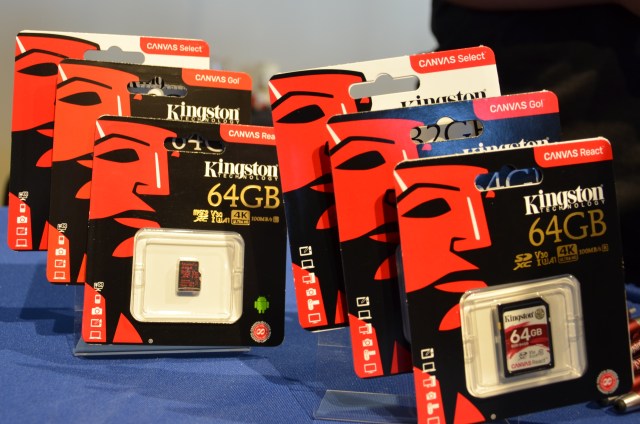
The Canvas series comes in SD or Micro SD formats with the “React”, “Go!”, and “Select” on display at Pepcom’s “Digital Experience” in San Francisco. Photo by Marcus Siu.
The new “Canvas” line (from top to bottom) is “Canvas React” (in gold lettering), “Canvas Go” (in silver lettering), and “Canvas Select” (in black lettering).
In other words, “great”, “even greater” and “absolute best”.
As a photographer and videographer, it is absolutely crucial to choose the right SD card for your camera equipment. As I’m shooting in HD video and bursting photo shots at a moving subject with my camera, I need to find an appropriate card that writes as fast as my camera shoots, so I would be ensured of getting all the footage that I intended without any unpleasant surprises.
If your SD card doesn’t have a high enough speed, it will stop recording video since the camera will pause and the video clip will abruptly end due to the slower speed of the SD card and the faster speed of the camera. This has happened to me on many occasions and I was blaming the camera for it at the time. Now I know better about the technical limitations of SD cards.
For people like me, who use high end DSLR’s, mirrorless cameras and 4K video, then Patriot’s “Canvas React” is optimum, with it’s amazing 100 mb read speed, and even more impressive 80 mb write speed. It’s amazing that it almost writes as fast as it reads.
However, if I am shopping for an SD card just for my mom, who just takes pictures from her Kodak point and shoot camera, so there is no need to get the absolute best for her $59 economy camera. In her case, the “Canvas Select” would be the appropriate choice.
Jensen Huang, CEO of Nvidia, addresses the capacity crowd at the San Jose Convention Center at GTC 2018. Photo by Marcus Siu.
Article and photos by Marcus Siu
SAN JOSE, MARCH 24, 2017 – Over 8,500 people attended GTC 2018 last month at the San Jose Convention Center to attend over 600 hours of sessions, with 400 of those them devoted exclusively to artificial intelligence (A.I.) The GTC conference is also known to have one of the best VR/AR conferences in the world for all industries, including hundreds of startups.
The list of attendees attending GTC is dazzling. All of the top technology companies, film companies, game companies, auto companies, smart city governments, medical universities, among others, all attended the conference. The way attendance has been dramatically growing each year, Nvidia may need to reconsider moving to a bigger venue in the near future.
After a very impressive “I am A.I” trailer introduction demonstrating the various ways Nvidia continues to shape the world with deep learning and A.I. with their collaborative partners, Nvidia’s founder and CEO, Jensen Huang took center stage to open the keynote address to the packed audience. He organized his agenda into four main topics including “amazing” graphics, “amazing” science, “amazing” A.I, and “amazing” robots.
It seemed appropriate Huang opened up his keynote with the subject of ray tracing as part of his “amazing graphics” topic since it was announced a week prior to GTC at the Games Developer’s Conference (GDC) in San Francisco. With the demands of A/R and V/R in recent years, Huang acknowledged this had opened up many avenues and opportunities in GPU technology which eventually progressed, with the assistance of deep learning, computer graphics with real time ray tracing.
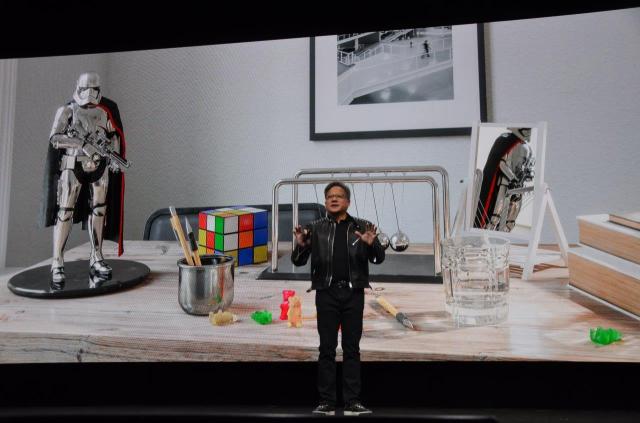
“Ray tracing…is the Holy Grail, the dream for computer scientists for the last 40 years”. Photo by Marcus Siu.
As Huang was presenting his keynote address, there was a huge image of a desk in a modernly lit room background on the giant screen behind him.
“Computer graphics is the driving force of the GPU. It is computationally insatiable, recreating virtual reality in its daunting computer tasks we know”, Huang remarked. “The computer graphics industry all around the world have been pursuing this holy grail, this dream of creating photo realistic images. ”
Huang continued , “it takes thousands and thousands of CPU’s and servers in order to calculate and compute each one of these frames. One CPU would take hours to compute one frame, and a movie…has hundreds of thousands of frames before they can create the final film.”
Taking a closer look of the image of the modernly lit room behind Huang, the image turned out to be a beautifully composed computer graphic photo image rendered by developers. Its quite uncanny how realistic this is, since the image included several objects on the desk, including a crystal glass, rubix cube, storm trooper figurine, Newton’s cradle of silver balls, a mini mirror, and a few colored gummy bears scattered across the table, among an assortment of other items. Each of these items showcased how challenging it is for a computer graphics scientist to render, yet if done well, would be completely indistinguishable from the real thing.
Huang pointed out the beauty and realism of the rendered objects on the desk, commenting on what it takes to make the image as photo realistic as possible with Nvidia’s ray tracing techniques to trick the viewers eyes, such as using screen-space ambient occlusion, baked lighting, global illumination, space screen reflections and environment maps, screen-space refraction, caustics, depth sorting, subsurface scanning approximation and subsurface scanning, which made the gummy bears come to life, for example.
“Using ray tracing, the gummy bear looks like you can just pick it up and eat it”, remarked Huang .
Jedi mind tricks believe you will.
“All of those computational and intensive problems; the effect of light as it travels through your room, the environment, is so hard to compute and that is why ray tracing has become so popular in film and it is the holy grail; the dream of computer scientists for the last forty years”, Huang remarked.
Most of this work will take many hours to render a frame for even the most experienced graphic designers. With the gaming and film industry, the main recipients who will benefit most from the latest RTX technology, it makes it so much easier to compose a photo realistic image for them now as a developer without a supercomputer.
“This is what we can do now; a $68,000 computer vs a super computer.”
Jensen Huang demonstrates real time ray tracing at GTC 2018. Photo by Marcus Siu.
Steve Parker, an engineer and part of the Nvidia ray tracing team has been working on ray tracing for his entire career since joining them ten years ago, demonstrated along with Huang, an entire Star Wars demo in real time with just one Nvidia DGX station with four Voltas in real time, instead of a super computer rendering these scenes one frame every ten hours, like in a Hollywood movie, such as “The Jungle Book”.
“From tools makers (Adobe, AutoDesk), engine makers (Epic, Unity), film studios (Pixar, Industrial Light & Magic); they’ve all come out to adopt this technology. The Nvidia RTX technology will revolutionize the way they do work. They can finally do ray tracing in real time; try more frames, create more beautiful shots, deliver to the customer faster and on time and most importantly, save millions of dollars in the process.”
“This is technology is the single most important advance in computer graphics in the last 15 years…I believe that Nvidia RTX is going to define the future of computer graphics “This is a very very big deal”, Huang remarked.
REVOLUTIONARY PRODUCTS
“After 10 years, what makes this special, is that for the very first time we can bring real time ray tracing to the market. People can actually use it. The technology has been encapsulated into multiple layers from our GPU architecture to the algorithms that make it possible for us to do this.”
“You are also seeing deep learning in action. Without deep learning, it would impossible to have traced all of those rays…whereas deep learning has been used in the past for super resolution, we’re been using them for super rays; predicting rays, so that we could fill in the spots that we know what the right answer is going to be using A.I.”
“Nvidia’s Volta GPU, the RTX technology, the solvers, the architectures, the library’s have now been integrated into three of the most important rendering API’s; the Nvidia Optics, Microsoft’s DX-12 extension called DX ray tracing DXR, and also available in open GL Vulkan.”
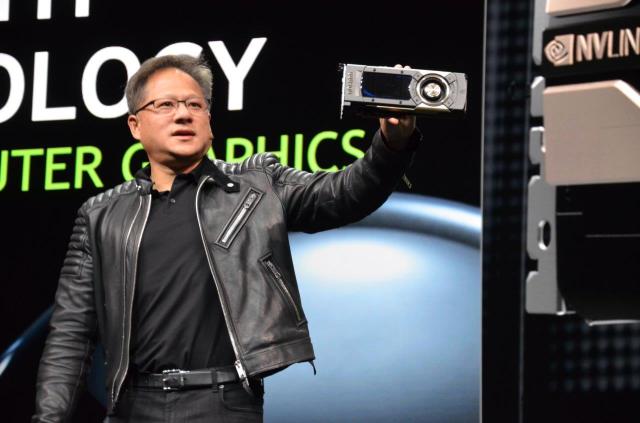
Huang offcially announced the NVIDIA Quadro GV100 GPU with NVIDIA RTX technology, delivering for the first time real-time ray tracing to millions of artists and designers.
Nvidia estimates that a total of one billion images are rendered each year by the graphics industry. That includes images from 400 gaming products , 500 movies from media and entertainment, 12 million product designers, and 150,000 architects. With the use of the Quadro GV100 GPU with the RTX technology, Huang believes that the number of rendered images will jump to a factor of ten.
NVIDIA CEO Jensen Huang introduces the Quadro GV100 with Nvidia RTX technology technology at GTC 2018, delivering for the first time real-time ray tracing to millions of artists and designers. Photo by Marcus Siu.
Huang also announced some new upgrades and products during the conference, which include doubling the memory on the NVIDIA Tesla V100, as well as introducing the new Nvidia NV Switch, enabling 16 Tesla V100 GPU’s to communicate at a record speed of 2.4 terabytes per second.
“The world’s first workstation GPU based on the Volta architecture. It’s also the first one that has a brand new interconnect between GPU’s called NVlink2; super high speed interconnect between two GPU’s that basically extends the programming (memory) model out of our GPU into the other GPU, which means all of the memory reads and writes and the autonomic’s work exactly the same. Software doesn’t have to change. The two GPU’s connected through this new interconnect called NVLink is essentially one giant GPU. So these two GPU’s working together; two GV100’s, will become a revolutionary new workstation. It’s going to be available from HP, Dell & Lenovo.”
The specs of the this new “workstation” has 64GB of HBM2 Memory, 10,240 CUDA Cores, 236 teraflops of tensor cores.
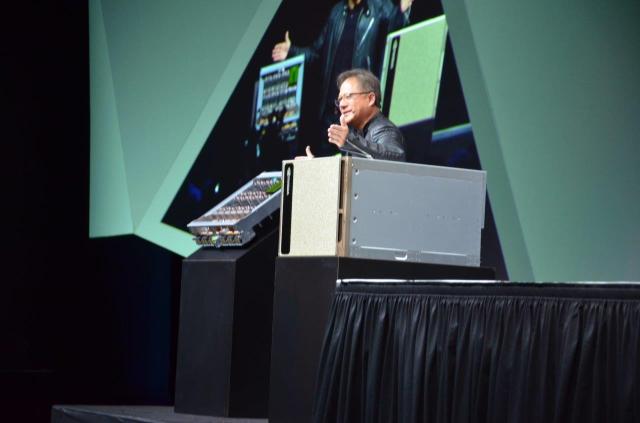
Nvidia founder and CEO introduces the DGX-2, the largest CPU ever created that can replace a typical render farm of 280 Dual-CPU Servers consuming 168 kW with 14 Quad GPU Servers using 24 kW. Photo by Marcus Siu
Huang also announced the DGX-2, which isthe first single server capable of delivering two petaflops of computational power, 512GB of HBM2 memory, 81,920 CUDA cores, and 2,000 teraflops of tensor cores. The DGX-2 has the deep learning processing power of 300 servers occupying 15 racks of data- center space, while being 60x smaller and 18x more power efficient.
To Joe Moviemaker, it means with the flip of a switch, it can transfer 14,400 ten gigabyte movies in one second.
For filmmakers, game developers, product designers, architects and anyone in the profession who has a need to render computer graphic images, Nvidia has begun a new evolution now that the holy grail has now been discovered and the universe is now endless.
This means that for all computer scientists, the force will be with them. Always.
Nvidia CEO and founder, Jensen Huang, interviews with Jim Cramer of “Mad Money” on the Nvidia Expo floor at the San Jose Convention Center. Photo by Marcus Siu.
SAN FRANCISCO, MARCH 25, 2018. At this year’s GDC 2018 (Game Developer’s Conference), there were a couple of demos that stood out that strongly reinforced my thoughts about the eventual futuristic merging of computer gaming and movies.
After just a few demos on the GDC expo floor, I was not be able to discern the difference between the computer game graphics and the live action from movies anymore. Realism for game developers have never looked so real.
On the first day of GDC, NVIDIA announced their latest RTX technology of Real time-Cinematic rendering. Nvidia’s RTX technology, alongside Microsoft’s new DirectX® Raytracing (DXR) API, has been an intensive work-in-progress for the last ten years. It’s ray tracing renders lifelike and realistic lighting, along with reflections and shadows that make it nearly impossible to distinguish what is real and what is not, in terms of computer graphics. It brings real-time, cinematic-quality rendering to content creators and game developers.
Yes, you read right: “real time”.
This new technology is a milestone for not just gaming developers and filmmakers, but any creator who needs to render an object as realistic as can be. The computer graphics of tomorrow will make computer graphics of today look like a lifeless imitation.
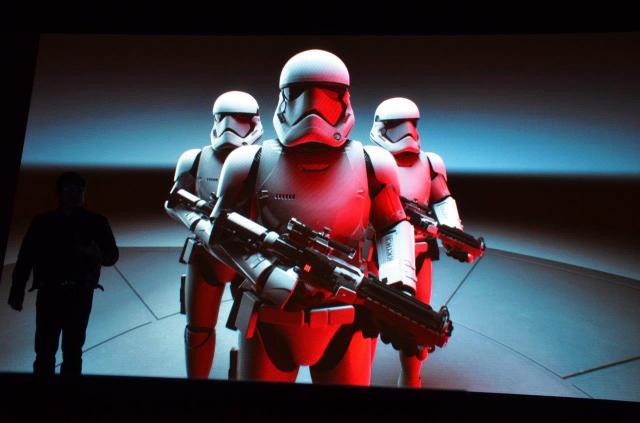
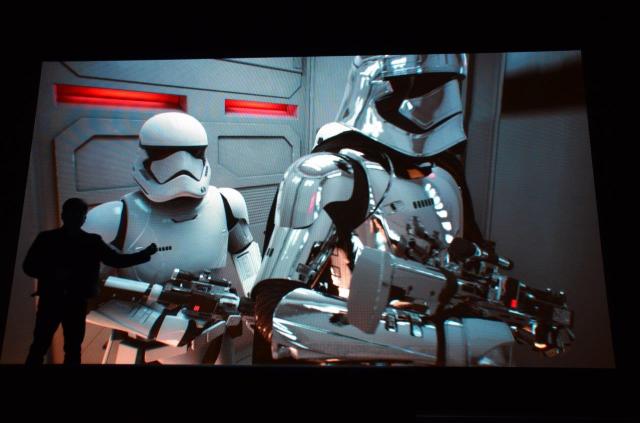
Nvidia had Project Spotlight “Reflections” at their booth at GDC, which looks more like a teaser trailer for the next Star Wars feature film, but in reality, it’s a real time tracing demo, which Epic’s team along with ILMxLAB and NVIDIA’s DGX Station, equipped with four Tesla V100 GPUs, Epic’s Unreal Engine and NVIDIA’s RTX ray-tracing technology.
It definitely wowed the enthusiastic GDC crowd as it was hard to believe that there were no actual actors used in the storm troopers costumes. It was all computer graphics being rendered.
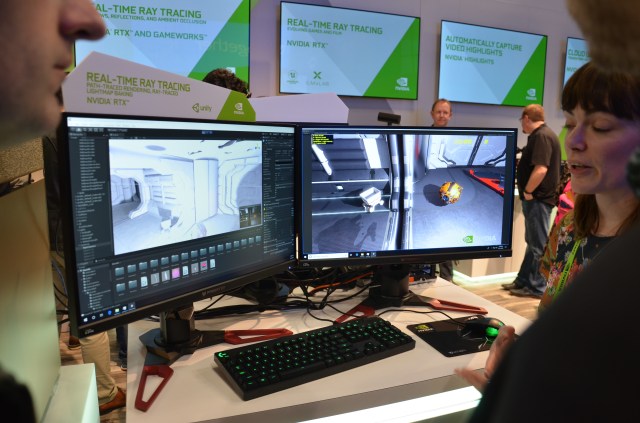
NVIDIA has also announced that the GameWorks SDK will add a ray-tracing denoiser module, helping game developers take advantage of new capabilities. This updated SDK, which is coming soon, includes support for ray-traced area light shadows, glossy reflections and ambient occlusion. This will help save a huge amount of time for creators.
At GDC, game developers will have access to ray-tracing denoiser module, part of the GameWorks SDK from Nvidia. Photo by Marcus Siu.
Imagine how the Screen Actor’s will feel after they realize that computer graphics characters may jeopardize their career in the near future. One of those actors will
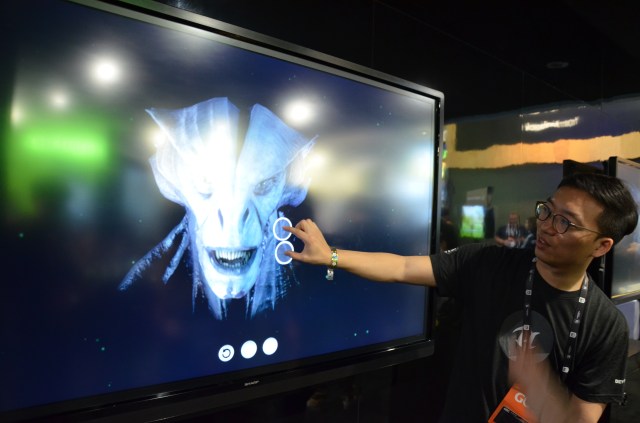
Motion capture performance artist, Andy Serkis, known for playing “Gollum” in “The Lord of the Rings” trilogy and “Caesar” in the “Planet of the Apes” trilogy may not have problems finding work. Just a few sections away from the Nvidia booth, I saw a computer generated “digital” Andy Serkis acting out his lines as his alien creature character was being rendered in real time at the Unreal booth.
Unreal indeed.
Just unreal – Andy Serkis’s character talks as Andy talks in real time at the GDC 2018. Photo by Marcus Siu
Maybe in the near distant future, we can just get rid of the entire Screen Actor’s Guild with the exception of performance capture or voice-over actors. Or perhaps one day we can just clone the actors so there wouldn’t be any need for them to come in and perform on a sound stage.
Imagine at the Academy Awards…, “and the nominees for “Best Clone Actor in Supporting Role are”…
In addition with the progress of computer graphics coming from ray tracing in the visual sides, audio will also be just as important for content creators. End user consumers are continuously looking for an immersive experience with their gaming, so many are reaching out to THX certified equipment for their PC gaming.
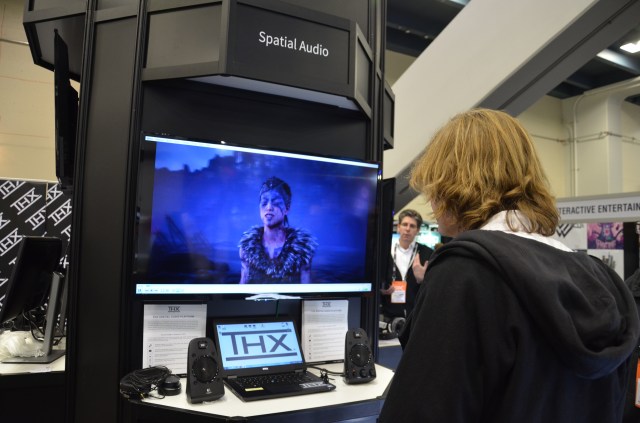
THX demonstrated their spatial audio platform, using the latest audio standard, MPEG-H, as well as UHD. They were using the game trailer for “Helblade”, which ironically, was one of the first live motion capture technology for Epic Games in 2006. It was in a way, ahead of its time. Coming from a 2.1 THX certified Logitech speakers and a sub-woofer, it was quite sonically immersive. I felt that I was right in the middle of the soundscape.
There was also a demo of it using headphones, but I still preferred the speakers.
Certified THX Logitech Speakers at GDC. Photo by Marcus Siu.
In addition, they utilize personalized audio profiles using HRTS’s (Head-Related Transfer Functions), which are optimized and customized for each listener, based on user’s unique hearing anatomy.
Long associated with the Lucasfilm movie sound in movie theatres in the 80’s, it seems that THX is staging a comeback into the public eye in the marketplace. In addition to its traditional THX certified products such as home entertainment products over the years, such as projectors, pre-amps, receivers and speakers, they have been gaining momentum into the gaming world by introducing THX certified products, such as laptops, headsets and satellite speakers.
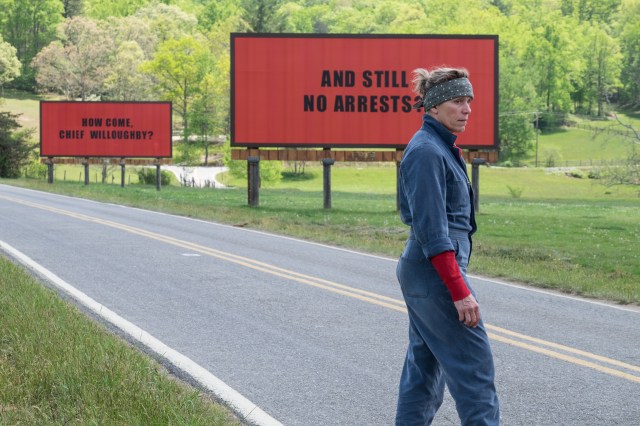
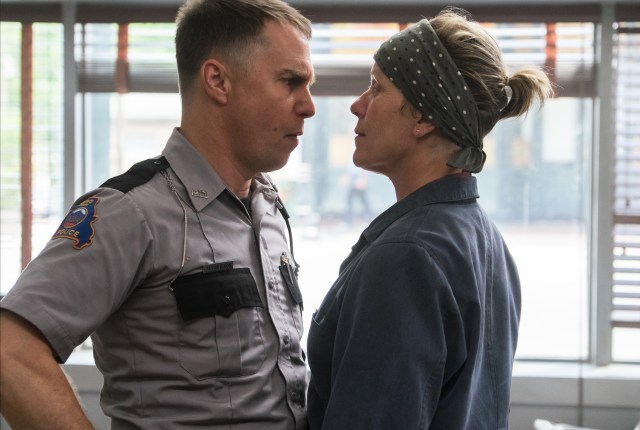
Frances McDormand as “Mildred Hayes” in THREE BILLBOARDS OUTSIDE EBBING, MISSOURI.
Article by Marcus Siu
It seems like Deja Vu all over again, with “The Shape of Water” landing 13 nominations this year, which was the same exact amount that “La La Land” landed a year ago, but failed to win Best Picture. I predicted “La La Land” to win, and after a year was still trying to analyze why it lost. My conclusion was because it was too much of a “fantasy” movie. After all, it’s a movie about “dreamers”.
Historically, the Academy has never voted for a science fiction film for Best Picture, nor a “fantasy” film, with the exception for the “Lord of the Rings – Return of the King”. You would think something like “2001: A Space Odyssey” could have won it for Best Picture, but it wasn’t even nominated that year. The Academy tends now to vote for films that have a social message with serious subjects and issues rather than just pure spectacle and escapism, which is probably why “Moonlight” won Best Picture over “La La Land”.
Gone are the days when all you had to do was go by the most number of Academy Award nominations and you be able to predict your Best Picture winner. For example, giant epic Hollywood movies blockbusters such as “Gone with the Wind”, “Lawrence of Arabia”, “Titanic”, etc, would receive ten to thirteen nominations each and end up getting the Best Picture Oscar 90% of the time, but this is no longer the case.
Now with the more “diversity” that recently got recruited as Academy members over the last several years, it’s no longer about pure spectacle and studio production budgets that scores points and connects with the Academy. It’s more about an original script that dares to be different from the ordinary, along with the passion, commitment and performances from all its cast members and direction. It’s all about filmmakers who aren’t afraid to take studio risks to tell a story that needs to be told.
In fact, over the years, it seemed like movies that critics liked differed from what the Academy’s Best Picture choices were. They were never the same. Critics were always more into story driven dialogue films, whereas the Academy was more into production driven ones. However, the gap has become smaller and smaller, as many of these small indie budget films with great scripts and casts are winning the Oscar for movies such as “Spotlight”, “Moonlight”, “The Artist” or even “Birdman”. These films were made because of the filmmakers believed in them, even if the studio didn’t. These movies resonated with the Academy, so it was no longer required to have a big studio budget to win the Best Picture Oscar.
Look for “Three Billboards outside Ebbing Missouri” to edge out “The Shape of Water”. “Billboards” has everything going for it including a solid supporting cast that couldn’t have been better, and a witty screenplay by one of the greatest playwrights in the world, Martin McDonagh, with a social message that the Academy finds mandatory for “Best Picture” material.
“The Shape of Water”, with its 13 Oscar nominations would normally have been the indicator to win Best Picture, especially when the runner up film “Dunkirk” had “only” eight nods. I still don’t believe the Academy will vote for a movie about a romance between a mute woman and a fish man, though I wouldn’t be surprised if it won. My theory still stands, academy voters tend to vote for human dramas about real people, instead of fantasy films. Fantasy films just don’t seem to survive for the Academy. It’s like a fish out of water.
Another possible upset for the Best Picture trophy is “Get Out”, which is definitely a timely social-political film about racism that surprised many when its nominations were announced. However, the movie is too much of a psychological horror story that doesn’t fit the bill for a Best Picture winner, either. It has to be on the top of the heap for pulling an upset if “Three Billboards” or “The Shape of Water” doesn’t win, with Jordan Peele, getting a Best Director nomination, along with his lead actor, Daniel Kaluuya, as well as a Best Original Screenplay.
Historically, the movie that gets Best Picture gets the Best Director Oscar, as well, but this may not the case this year, if “Three Billboards” gets Best Picture, since its director wasn’t even nominated. This time the Oscar will most likely go to director, Guillermo del Toro for “The Shape of Water”. He has already taken the DGA and BAFTA awards, so he should take home the Best Director Oscar hands down.
Gary Oldman should be a shoo-in to win Best Actor for playing Winston Churchill in “The Darkest Hour”. He deserves it, not because he had to sit through four hours of makeup every day, but because he stayed in it all the time on set. In addition, his performance was way beyond extraordinary. Over the years he has been a reliable chameleon, usually unrecognizable, and still continued to put up great performances role after role. However, this is the performance may be the one that he will be remembered as his crowning achievement and his the best ever.
“Three Billboards” will probably take home statuettes for Frances McDormand and Sam Rockwell, as they have seemed to have swept all the other major awards in this dramedy. Like Oldman, it’s great to see Rockwell finally being recognized and paying his dues as a character actor, as well. Let’s see if he will be getting more “leading” roles in the future after he wins his trophy.
Look for Allison Janney to take the Supporting Actress Oscar as Tonya Harding’s mother in “I, Tonya”, as the character she plays was written directly for her. Writer Steven Rogers, a long-time friend of Janney, wrote the role of LaVona Golden with her in mind. Janney also had to find the right bird to perch on her shoulder, as she is not a “bird” person. She nailed the performance and has taken every single major award.
LaVona Golden (Allison-Janney) and her pet bird in I, TONYA, courtesy of NEON
For Best Original Screenplay, it’s between “Billboards”, Martin McDonagh and “Lady Bird’s” Greta Gerwig. The Academy will most likely recognize Greta Gerwig since she was also nominated for Best Director for “Lady Bird”, in addition to getting Oscar nods for her lead actors, Saoirse Ronan and Laurie Metcalf.
James Ivory should take Best Adapted Screenplay for “Call Me By Your Name”, as there really is no serious competition, as “Mudbound” or “Molly’s Game”, is a distant second and third. If he receives the awards, he will be the oldest Oscar recipient at 89, unless Agnes Varda gets the “Best Documentary” the same night.
Look for Pixar’s “Coco” to win another two Oscars and win Best Animated film, along with its Best Original Song “Remember Me”. The other competition is the song, “This is Me”, from “The Greatest Showman” which was a big commercial hit on the radio that can beat Coco, but “Remember Me” was very integral to the movie and not merely an end credit song.
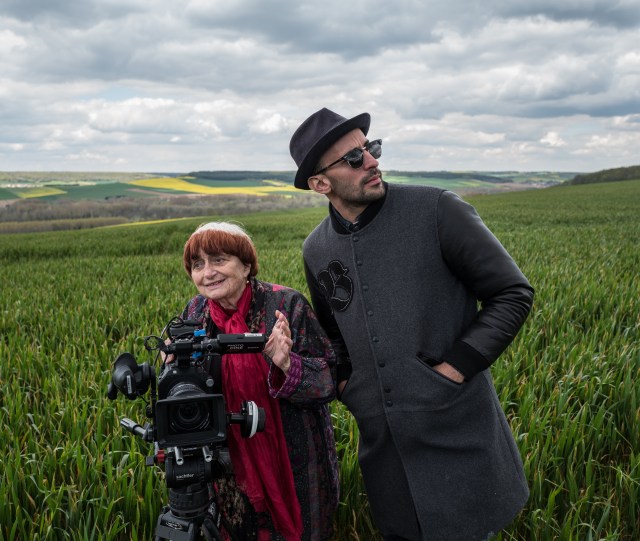
Agnès Varda (left) and JR (right) in Faces Places directed by Agnès Varda and JR. Photo courtesy of Cohen Media Group
In the Documentary category, all the films have equally powerful subjects. It’s just Varda’s buddy-buddy, “Faces Places” stand out because it is delightful to watch, though difficult to categorize as your traditional documentary. Though, “Icarus”, a film about Russian doping on their Olympic athletes and “The Last Men in Aleppo” from Syria, and Steve James’ “Abacus” really caught my attention and definitely deserve the golden statuette, as well.
In the animated shorts categories, it would be hard to not want to see your favorite local hometown L.A. Laker, Kobe Bryant, accept a speech for “Dear Basketball”. It’s a little unfair for the other nominees, since the Academy from would want to reward their sports town hero a nice little retirement gift as a token of appreciation. To be fair, it is quite a terrific short film with John Williams providing the musical score. It should be a slam dunk for the film, but I hope to see “Garden Party” frogs take the Oscar.
Saoirse Ronan and Greta Gerwig on the set of LADY BIRD
In the Live Action shorts, the Australian light-hearted comedy gets the edge, as it is the only one that we can laugh at. The other shorts are heart-wrenching dramas about racial and social situations regarding death and violence, with the exception of “The Silent Child”, which gets my vote as a runner-up. They are all solid, but after watching them, you need a sense of relief.
AND THE REST OF THEM:
Best Picture: Three Billboards outside Ebbing, Missouri
Actor in a Leading Role: Gary Oldman, Darkest Hour
Actress in a Leading Role: Frances McDormand, Three Billboards outside Ebbing, Missouri
Actor in a Supporting Role: Sam Rockwell, Three Billboards outside Ebbing, Missouri
Actress in a Supporting Role: Allison Janney, I, Tonya
Directing: The Shape of Water – Guillermo del Toro –
Adapted Screenplay: Call Me by Your Name – James Ivory
Writing (Original Screenplay) – Lady Bird – Greta Gerwig
Cinematography: Blade Runner 2049 – Roger A. Deakins
Costume Design: Phantom Thread – Mark Bridges
Sound Mixing – Baby Driver – Paul Machliss and Jonathan Amos
Film Editing: Dunkirk – Lee Smith
Sound Editing: Dunkirk – Richard King and Alex Gibson
Visual Effects: War For The Planet of the Apes – Joe Letteri, Daniel Barrett, Dan Lemmon and Joel Whist
Makeup and Hairstyling: Darkest Hour – Kazuhiro Tsuji, David Malinowski and Lucy Sibbick
Music (Original Song) – Coco – Remember Me
Music (Original Score) – The Shape of Water – Alexandre Desplat











 Product review by Marcus Siu