She is an amazing artist like no other of her generation; she has no peers who can come close for comparison at her performance level. She initially started out in sculpture, then gradually as an abstract painter, and then as a musician performing to “open jowled” audiences around the world…
I’m referring to the extraordinary renowned artist, Lolabelle, a beloved rat terrier dog, who ironically also happens to be owned and “conceived” by the internationally renowned multimedia performance artist in her own right; Laurie Anderson.
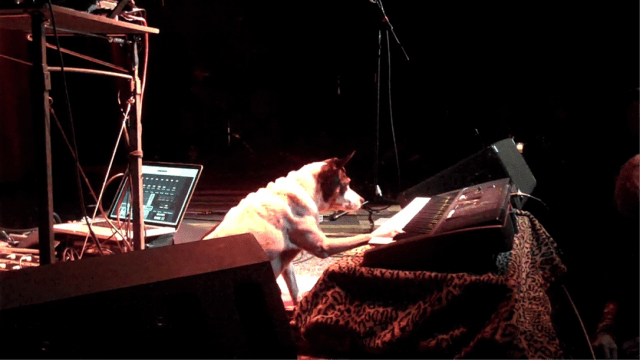
As Lolabelle was losing her sight during her later years, she would discover, with the guidance of Anderson, a new way to be creative. She took on art and piano lessons and became a quick learner with an ear probably keener than “Nipper”, the RCA dog. It probably also didn’t hurt that she grew up in an iconic and creative musical household.
Heart of a Dog – Lolabelle in Concert Courtesy of HBO Documentary Films
“Heart of a Dog” was first conceived by Arte, a French/German TV network, who asked Anderson to compose a personal essay about the meaning of life and work, and specifically about her dog. Anderson thought it was going to be a short project, but soon found herself immersed with much more material to build on, especially when she was left alone with no pressure from Arte. It became an instant hobby for her.
The finished product would become her philosophy of life, comprising a collection of short stories on film.
Topics and observations include questioning the need for post 9/11 surveillance cameras all over New York City; the government obsession of storing personal information in the cloud; her mother giving a barely audible deathbed speech to her eight children as she died; memories of her childhood saving her twin brothers by diving into the hole through a frozen lake, and her own”life confirming” incident from a diving board accident that almost ended her life when she was 12 years old.
Though life and death are the major subject of the film; so is love and loss. In addition to losing her dog, Lolabelle, who she loved forever when she met face to face in the hospital room in her recurring dreams, she had recently lost two other major forces in her life: her mother and the person she loved more than anyone in the world, her husband and soul mate, Lou Reed.
One of Anderson’s Buddhist teachers, Mingyur Rinpoche quotes “You should try to practice how to feel sad without actually being sad”. This represents the center section of the film, depicting the bardo or the Tibetan afterlife.
Anderson, one of our greatest storytellers, known for being technologically innovative at her multimedia performances, and even calls herself a “tech geek”, ironically used low tech devices in the film, such as iPhones, drone cameras and GoPro’s.
In addition, her brother handed her undeveloped reels of 8mm films of their childhood, which captivated Anderson, as she was reminded of her almost forgotten childhood with her seven other siblings along with her mother, when she almost lost her twin brothers in the middle of a frozen lake in the Midwest. When watching these timeless images of these recently developed films, it almost looked like post production was used, but it was actually just the way the chemicals disintegrated the film naturally over time.
The film captures a hallucinatory and hypnotic mood, along with the sound of Anderson’s signature violin effects that are familiar to it from her live multimedia performances. She showcases her personal and intimate storytelling ability that demonstrates her magical ability to reach and connect to an audience like no other.
“We are in the middle of a generational shift in computing that is no less important than our shift to personal computing, when mainframes and mini computers dominated our industries…it seems like early days, since our biggest cloud business are only $6 billion…not $100 billion… – Larry Ellison
Larry Ellison’s Opening Keynote Address at the Oracle OpenWorld 2015 Photo by Marcus Siu
Article and Photo by Marcus Siu
SAN FRANCISCO, October 25, 2015 – Executive Chairman and CTO, Larry Ellison’s Opening Keynote address at Oracle’s OpenWorld 2015 at the Moscone Center in San Francisco last Sunday, reminded us that the “Cloud” has now been around for over 15 years, even before there was a term known as the “Cloud”. Companies such as NetSuite and Salesforce were already engaged in doing business as a Software as a Service (SaaS) at its infancy around the beginning of 2000.
It’s been ten years since Oracle realized that in order to compete with these companies and an untapped industry, they had to rewrite virtually all of their applications in order to make them run on the cloud. For Oracle’s fusion project, not only did they have to rewrite the applications, but they also had to rewrite the middleware, which took a tremendous amount of resources, including the complexities of dealing with the Oracle multitenant database.
Around the same time, Amazon pioneered their “EC2”, (Elastic Compute Cloud); also known today as AWS (Amazon Web Services), which provides resizable compute capacity in the cloud services. Oracle immediately realized that if they were going to compete in the PaaS business (platform as a service), then they had to be in the IaaS business, (infrastructure as a service). Customers should also have the option to use any applications they need, regardless if they are Oracle products.
Oracle OpenWorld at Moscone West Photo: Marcus Siu
“Here’s the irony of it all; we went to the SaaS business and came to understand that required us to be in the platform business, and we went into the platform business and came to understand we had to be in the infrastructure as a service business.
That’s how we got to where we are today”.
Ten years ago, Oracle used to see pay particular attention to IBM, which Ellison describes as “the greatest company of all companies”, and SAP, the largest application company in the world, for the last two decades.
Today, Oracle no longer pays attention to neither one of them.
Oracle’s Cloud competitors include Amazon, Salesforce, Workday, and its traditional rival competitor, Microsoft.
However, Microsoft and Oracle are the only two companies that offer all three layers of the cloud that provide users with access to an integrated set of IT solutions, including the Applications (SaaS), Platform (Paas), and Infrastructure (Iaas) layers.
Oracle has the largest set of enterprise applications of any company.
Oracle and Microsoft are the only two companies who provide all three layers of the cloud. Photo by Marcus Siu
Article and Photo slideshow by Marcus Siu SAN FRANCISCO, August 20, 2015 – The 2015 Intel Developer Forum (IDF), held at Moscone West in San Francisco from Tuesday, August 18th through Thursday, August 20th, brought together a record number of developers, … Continue reading →
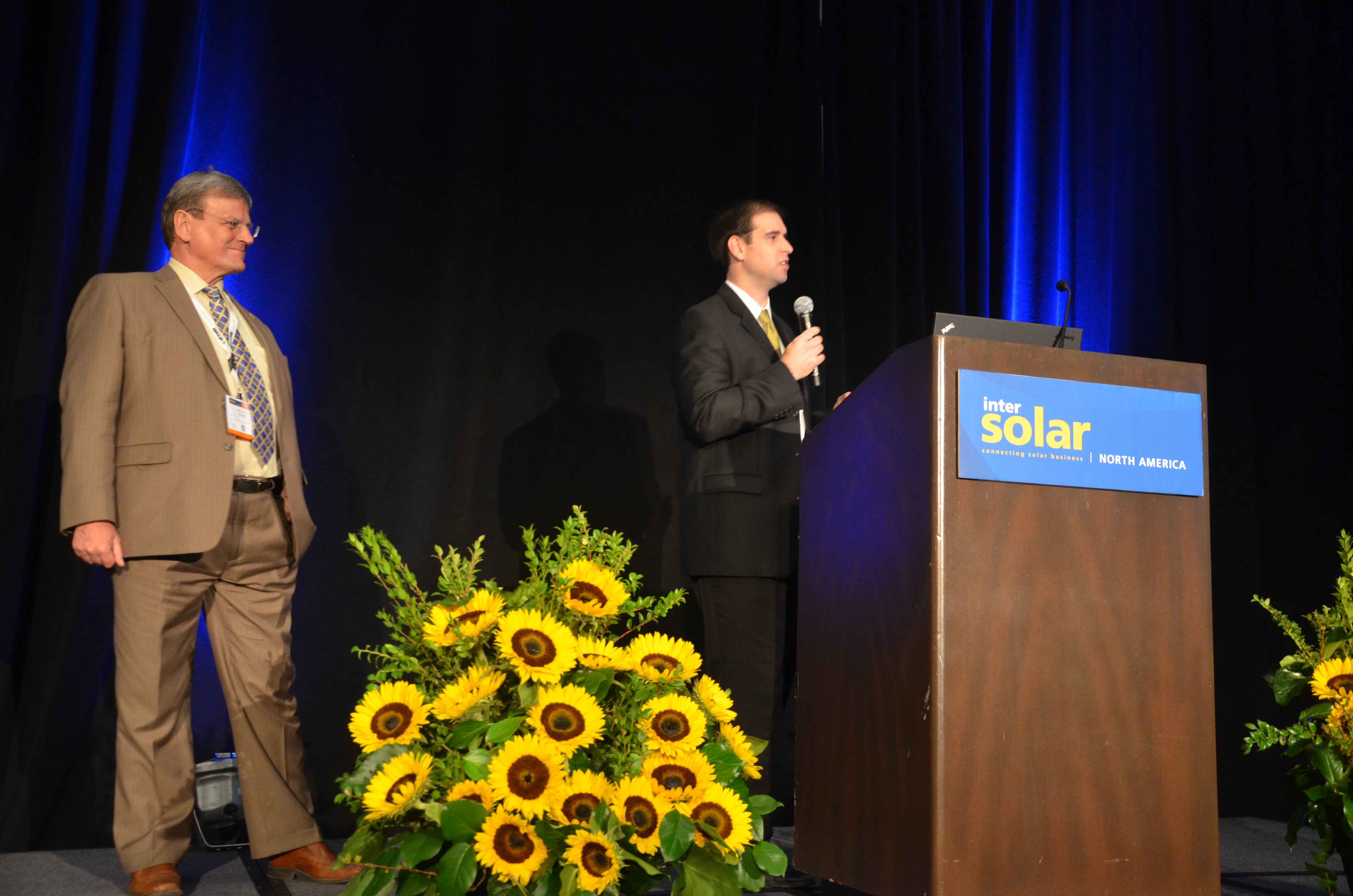
Markus Elsaesser, CEO of Solar Promotion International GmbH, organizer of Intersolar North America, joins Tesla co-founder and CTO JB Straubel onstage at the Opening Ceremony.
Photos by Marcus Siu
SAN FRANCISCO, July 14, 2015 – As the North American solar energy market looks toward another record-breaking year, a standing-room only audience packed the Grand Ballroom at San Francisco’s InterContinental Hotel to hear fresh insights on the challenges and opportunities impacting the industry during the keynote session of Intersolar North America, the solar industry’s most-attended exhibition and conference dedicated to the North American market.
“As the first major industry show in the United States each year, Intersolar North America is where attendees flock to learn about the trends shaping the marketplace,” said Markus Elsaesser, CEO of Solar Promotion International GmbH, organizer of Intersolar North America.
“With the increase in the United States’ installed solar capacity, the growth of energy storage and stellar job creation statistics, it’s an exciting time to be in solar,” added Daniel Strowitzki, CEO of FMMI International, another organizer of Intersolar North America. “We’re encouraged by the possibilities presented by our distinguished lineup of solar industry advocates and technology pioneers, and can’t wait to see what’s in store at this year’s event.”
The U.S. solar market is expected to grow by 30 percent in 2015, reaching a total of 8.5 gigawatts (GW) in installed capacity. Nationally, the solar industry employed more than 173,800 in 2014, which represents a 21.8 percent growth in industry employment over the previous year and outpaces the national average. Solar industry advocates, N.Y. State Sen. Kevin Parker and Bernadette Del Chiaro, executive director of the California Solar Energy Industries Association (CALSEIA), joined Tesla co-founder and CTO JB Straubel onstage to discuss the critical turning points the industry will face in the next year—specifically the growing role of energy storage paired with solar systems, as well as policy initiatives.
Tesla co-founder and CTO JB Straubel.
“The energy industry’s next decade will look different because of the demand for storage technology, and we are working to drive down the price of storage and improve the performance of batteries,” Straubel said. “Storage is a key part of moving us closer to a grid that is 100 percent renewable, and bringing more solar online. We’ve demonstrated that by increasing a battery’s energy capacity, you can fundamentally reduce costs. That moves us closer to realizing our goal of transforming how energy is generated.”
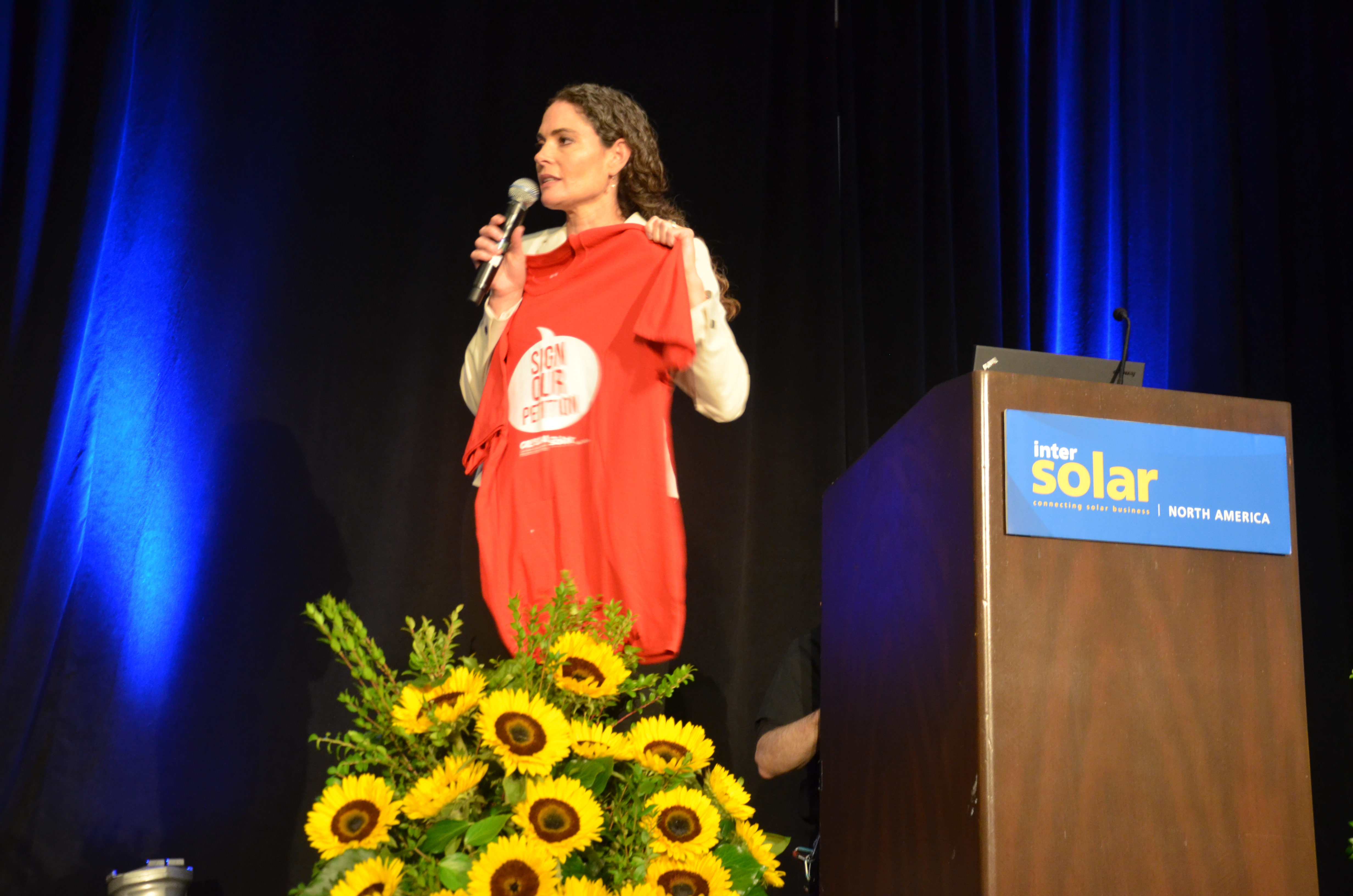
Bernadette Del Chiaro, executive director of the California Solar Energy Industries Association (CALSEIA)
With the expiration of the federal investment tax credit (ITC) top of mind in solar, CALSEIA Executive Director Bernadette Del Chiaro discussed additional upcoming policy challenges, particularly related to net energy metering and renewable portfolio standards, and outlined what it will take to win these critical campaigns.
“Like any growing industry, the next few years are going to be tumultuous in solar, but we can come out stronger by working together and increasing the number and diversity of voices calling for more solar power,” Del Chiaro said.
California leads the United States in terms of solar industry policy and installed capacity, and several East Coast states, such as New York, New Jersey and Massachusetts, have become some of the fastest-growing PV markets in the United States.
New York State Senator Kevin S. Parker returns to this year’s Intersolar’s North America Opening Ceremony.
“The game has changed in 2015—New York’s speed of solar growth has increased 300 percent in the past year, thanks to strong, effective policies and the support of dedicated solar professionals,” said New York State Sen. Kevin S. Parker, a ranking member of the Senate Energy and Telecommunications Committee. “Intersolar North America’s focus on energy storage, financing and installer best practices provides the knowledge necessary to develop the market further. New York is proof that solar makes sense in many markets, and I’m excited to see how the partnerships developed here will further the adoption of renewable energy in the U.S. and beyond.”
The opening ceremony kicked off Intersolar North America, which returned to San Francisco—the heart of the U.S. solar industry and the country’s largest market—for the eighth year in a row. Throughout the course of its three-day exhibition, Intersolar North America expects more than 18,000 attendees to visit approximately 500 exhibitors touting the latest in solar technologies and services. Solar professionals, policymakers and industry advocates travel from across the world to see new innovations in photovoltaics, energy production, balance of system components and solar heating and cooling technologies, and hear about the trends shaping the marketplace.
New to this year’s exhibition is the electrical energy storage™ (ees) North America special exhibition, an extension of the world’s largest industry platform for storage devices used in combination with PV, where nearly 50 companies will exhibit. In partnership with NAATBatt International, Intersolar North America expanded its focus on energy storage to educate the solar industry on this rapidly growing sector. According to a white paper published by GTM Research, and commissioned by Intersolar and CALSEIA, the U.S. solar-plus-storage market will grow to $246 million in 2015, $643 million in 2016 and by 2020 will be a $3.1 billion industry.
“Intersolar and ees North America are the best places for experienced solar PV developers and installers to learn about emerging opportunities in solar-storage technology and the economic and safety challenges that must be overcome in order to see its widespread use in behind-the-meter projects and on the grid,” said NAATBatt President James Greenberger. Additionally, the ees stage will host presentations from exhibitors, along with special events that cover large-scale grid integration of renewable energies, residential-scale PV and storage systems and an overview of electricity storage technologies. The stage will also feature a presentation from GTM Research on Tuesday, July 14 at 4:30 p.m. on its white paper, “Solar-Plus-Storage Market: Market Drivers, Economics, Outlook.” The paper will be available for free download.
With the advent of the 4K UHD revolution that was clearly evident at this years CES show in Las Vegas; Ultra HD has become a widely popular feature in consumer products, such as cameras and smartphones. Back in January, if you wanted to watch something on your new UHD 4K Display, then shooting 4K on these gadgets was pretty much all the 4K content that you would be able to play.
However, that was nearly four months ago.
Things have changed quite rapidly since the CES show as 4K streaming services through Netflix, Ultraflix and Amazon are quickly catching on. Samsung offers much 4K content through their SmartTV’s. Even Youtube is also offering 4K content. However, it comes at a high price and/or mostly proprietary.
The most obvious product that seemed missing in action was the 4K disc player itself; a player that could play a Blu-ray that you could buy at the store and play it at any given time. However, Sony, the inventor of Blu-ray technology decided to manufacture their first 4K disk player, using mainly a boxed unit with a hard drive that is able to download and playback content, instead, much like the PS3, except it doesn’t utilize or play discs.
Well, that’s about to change later this year.
Just a few days ago, the Blu-ray Disc Association (BDA) just announced the Ultra Blu-ray player(4K) specification is now complete and has also revealed the next-gen format’s official logo.
The new disc format promises the incorporation of the latest video standards, and players will also be backward-compatible with existing DVD’s and Blu-ray discs. This will be great news for the consumers who are afraid their movie collections will be obsolete. After all, it wasn’t too long that we all thought Blu-ray’s were going to be the last format that would be in the consumer market for at least another decade.
In addition to the standard 3,840×2,160-pixel resolution, it will include expanded color range support which will make the visuals truly lifelike, along with higher dynamic range (HDR). Also the frame rate content will read 60fps, 100 Mbps, which will make filmmakers like James Cameron happy. UHD Blu-ray will also support “next-generation immersive, object-based sound formats, including Dolby Atmos and DTS: X.
At the Panasonic booth at the 2015 CES Show, it was clearly evident how quickly the 4K revolution was going in early January. Photograph by Marcus Siu
In addition UHD Blu-ray, like Blu-ray, will bring with it the “Ultraviolet”-like “digital bridge” feature that allows consumers to “view their content across a variety of home and mobile devices.”
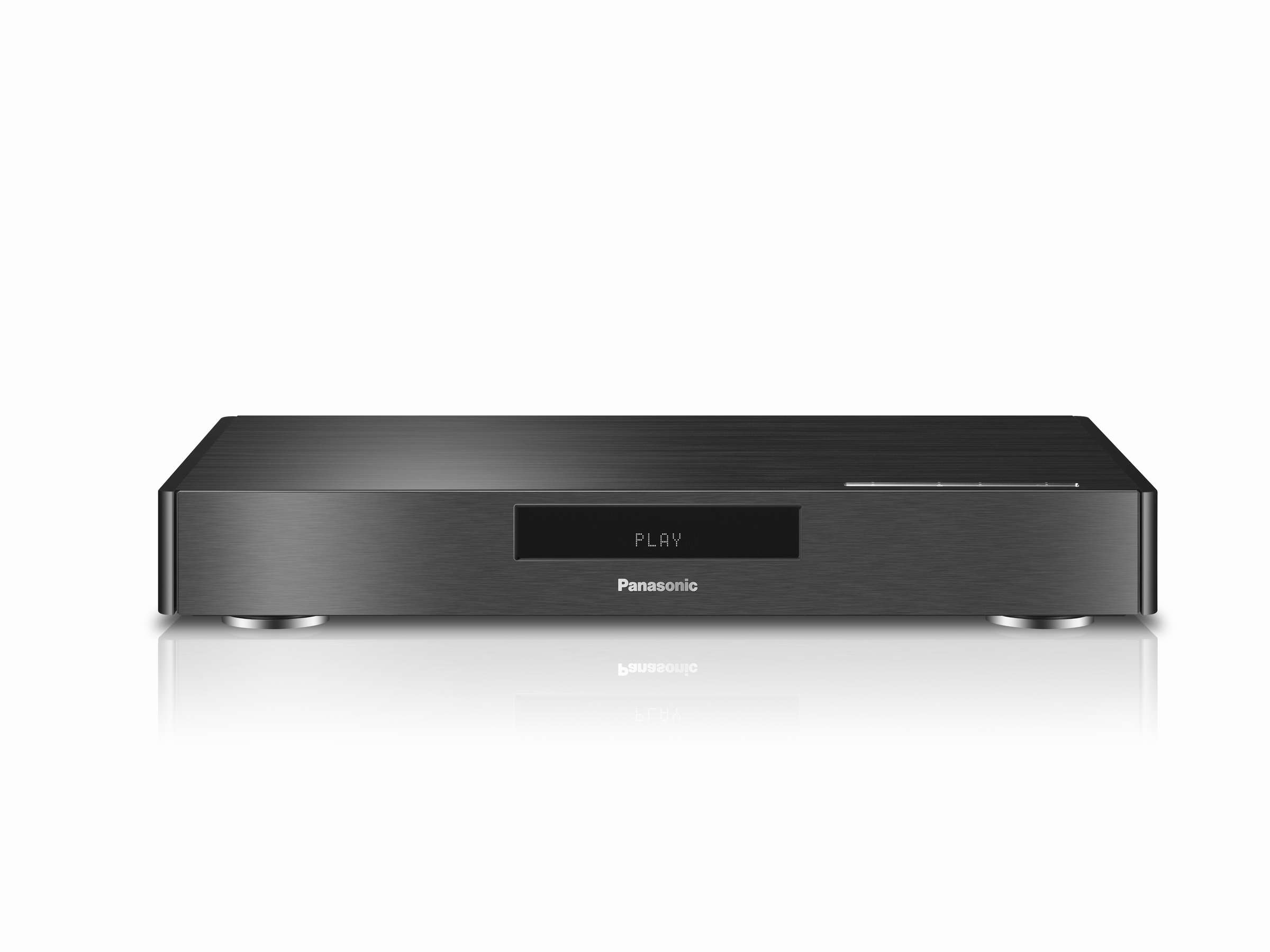
Panasonic’s prototype Ultra Blu-ray player that was displayed at CES.
Panasonic was the first company to announce a prototype Ultra Blu-ray player at this year’s CES. Expect to see players hit the market just in time for the Holiday season.
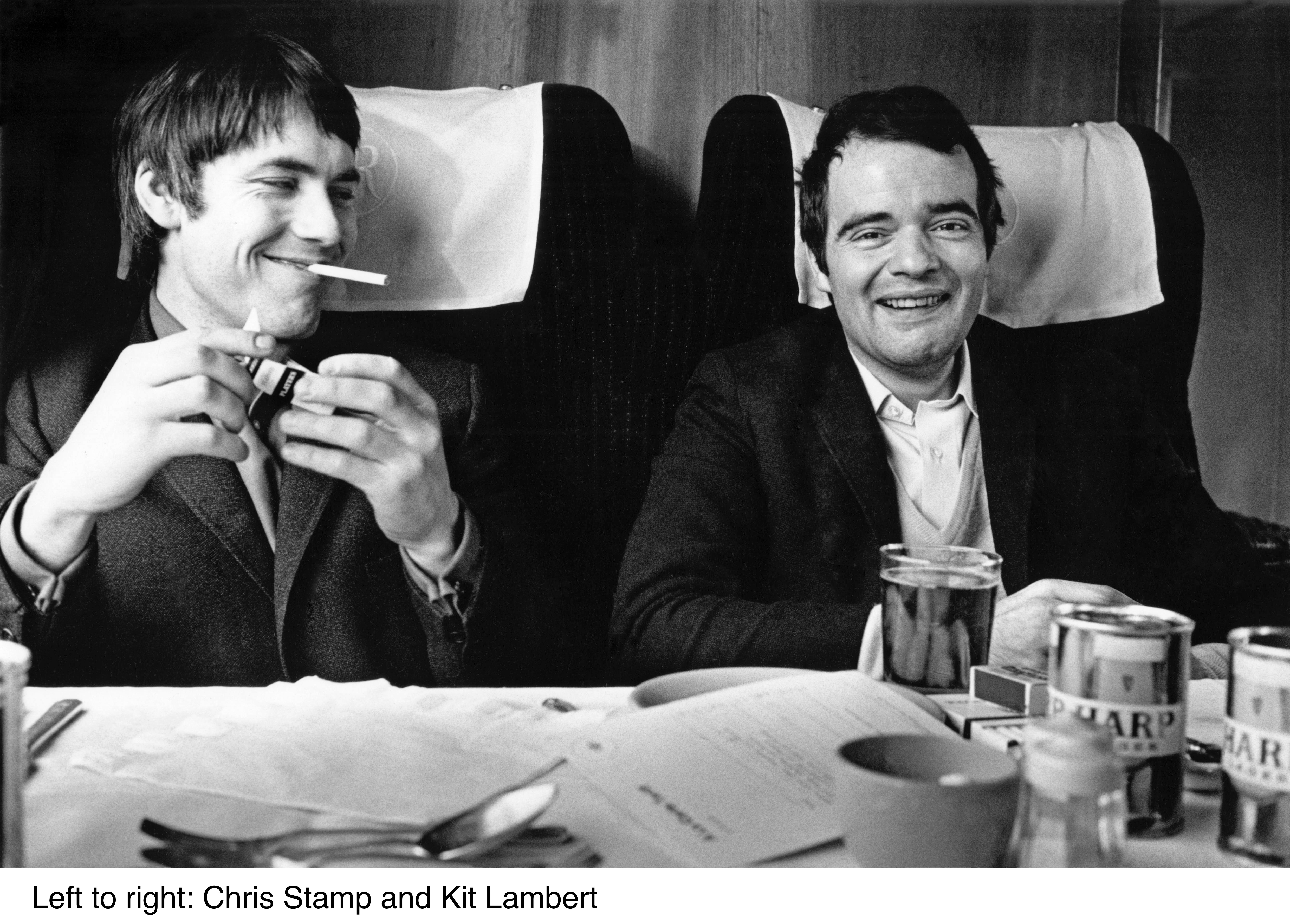
Left to right: Chris Stamp and Kit Lambert Photo by Colin Jones, Courtesy of Imageworks/Sony Pictures Classics
Article by Marcus Siu
Lambert & Stamp were two aspiring filmmakers from London’s postwar generation in the early 60’s, who shared the same taste in jazz music, literature and film, and wanted to make a documentary film about the mod world of rock and roll which was very fresh and new in the British music scene at the time. They were quite an odd and unlikely pair to collaborate together.
You had Chris Stamp, who was the son of a tugboat captain, and worked backstage at the ballet at the advice of his actor brother, actor Terrence Stamp, because his only interest at the time was girls. Kit Lambert, on the other hand, came from a very cultured background from Oxford, whose father was a celebrated symphony conductor. He was quite refined, always wearing tailored suits, and was fluent in several foreign languages. He was gay during a time when it was “illegal” in England.
At the time, they were both working as assistants at Shepperton Studios. It was their goal to become directors. However, in order to to do that, they both knew they had to break ground, since it would be very unlikely they would never break out as directors at the same place where they were working as assistants. They knew that’s all they wanted to do, but in order to get started, they just needed to discover a band that would make it from rags to riches.
“Kit and I looked everywhere at these bands to put in our so-called movie…we didn’t know what we wanted, but we absolutely knew what we didn’t want: if we found the people doing the music to be smart and neat and jumping up and down, they weren’t what we wanted. What we wanted—it was really about us. It was going to be some mad fucking concoction of stuff that looked like Lambert and Stamp.”
Stamp recalls driving through the streets of London, and running across a long line of mods and scooters outside a “sorded and grotty” Railway Hotel. He ran to the back of the building and broke through the hotel’s security, where the venue was multiplied over capacity. He just wanted to have a look inside to see what the scene looked like. The kids were mesmerized with the sound coming from the “not so handsome” foursome of the “High Numbers”, who would later turn out to be “The Who”.
Lambert and Stamp were only a few years older than the members of the Who. At the time, they were even making a name for themselves. People knew who they were and they became more established wherever they went.
After entrusting the group to film them, it wasn’t too long after that they realized they needed management more than a film crew due to the growing success of the band. Instead of filming full time, they needed to managed the group and put away the film cameras, and filmed only when needed. Lambert used tactics such as giving tickets out to the sharpest looking faces that would make a visual impact in their documentary footage, making them part of the “100 Faces” club, making them feel special, building a fan base.
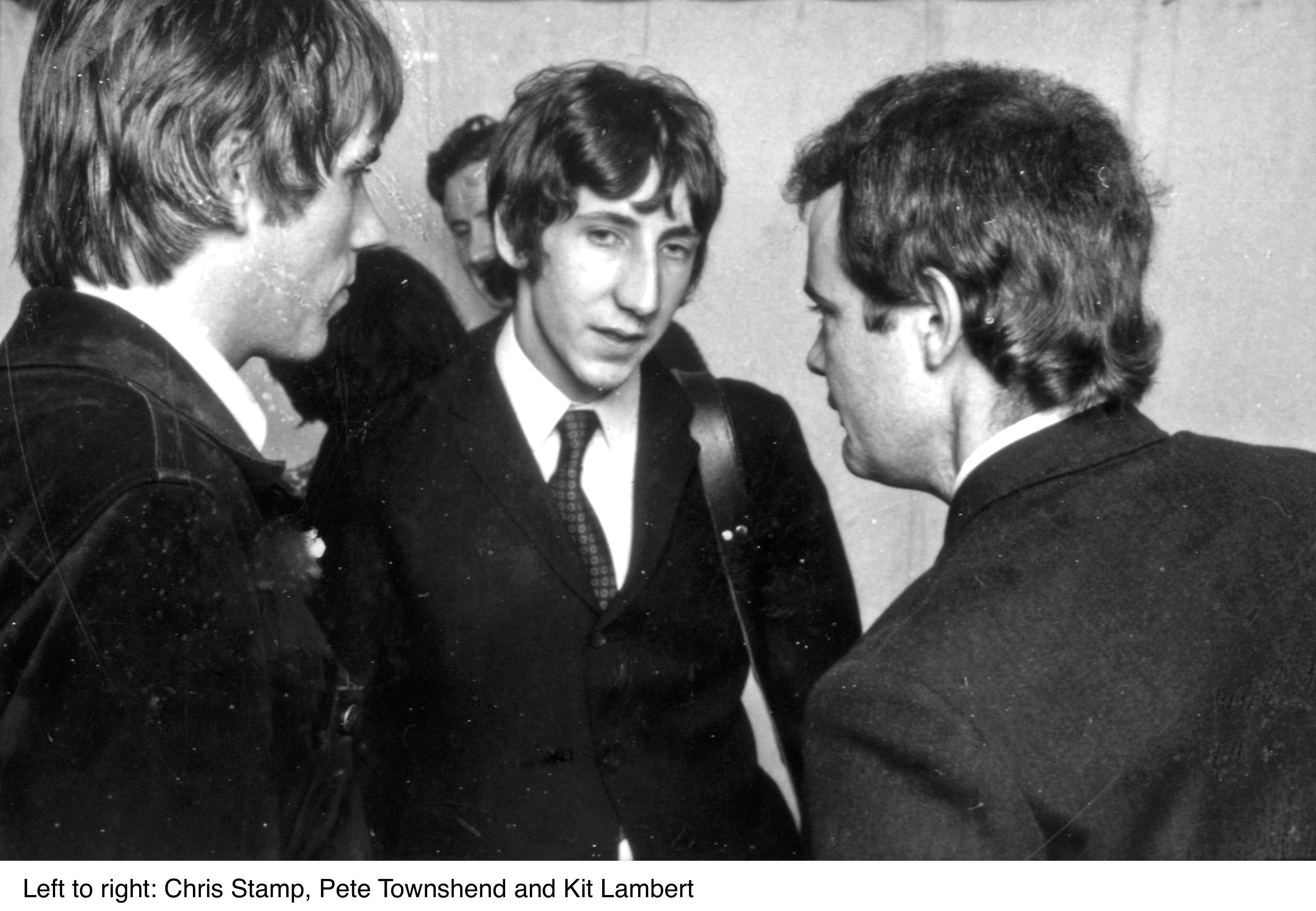
Left to right: Chris Stamp, Pete Townshend and Kit Lambert Photo courtesy of Pictorial Press/Sony Pictures Classics
Lambert also was responsible for taking Pete Townsend’s under his wing. In fact, Townsend asked about his opinion on what types of classical music he should listen to, and Lambert would just toss LP’s at him without saying a word. Townsend later said that this helped him understand chord progression, blending classical and rock together, which influenced the rock opera, “Tommy”, which would be realized into a film, in which Lambert tried to get produced without the bands consent. That is when the band fired their managers and things started to fall apart.
Even though this documentary is more about Lambert and Stamp, you get some insane stories with the entire band, including Keith Moon possibly leaving the group for Led Zeppelin, or just arriving hours late for some gigs because of his addiction to drugs, with Townsend ready to throw him down the stairs.
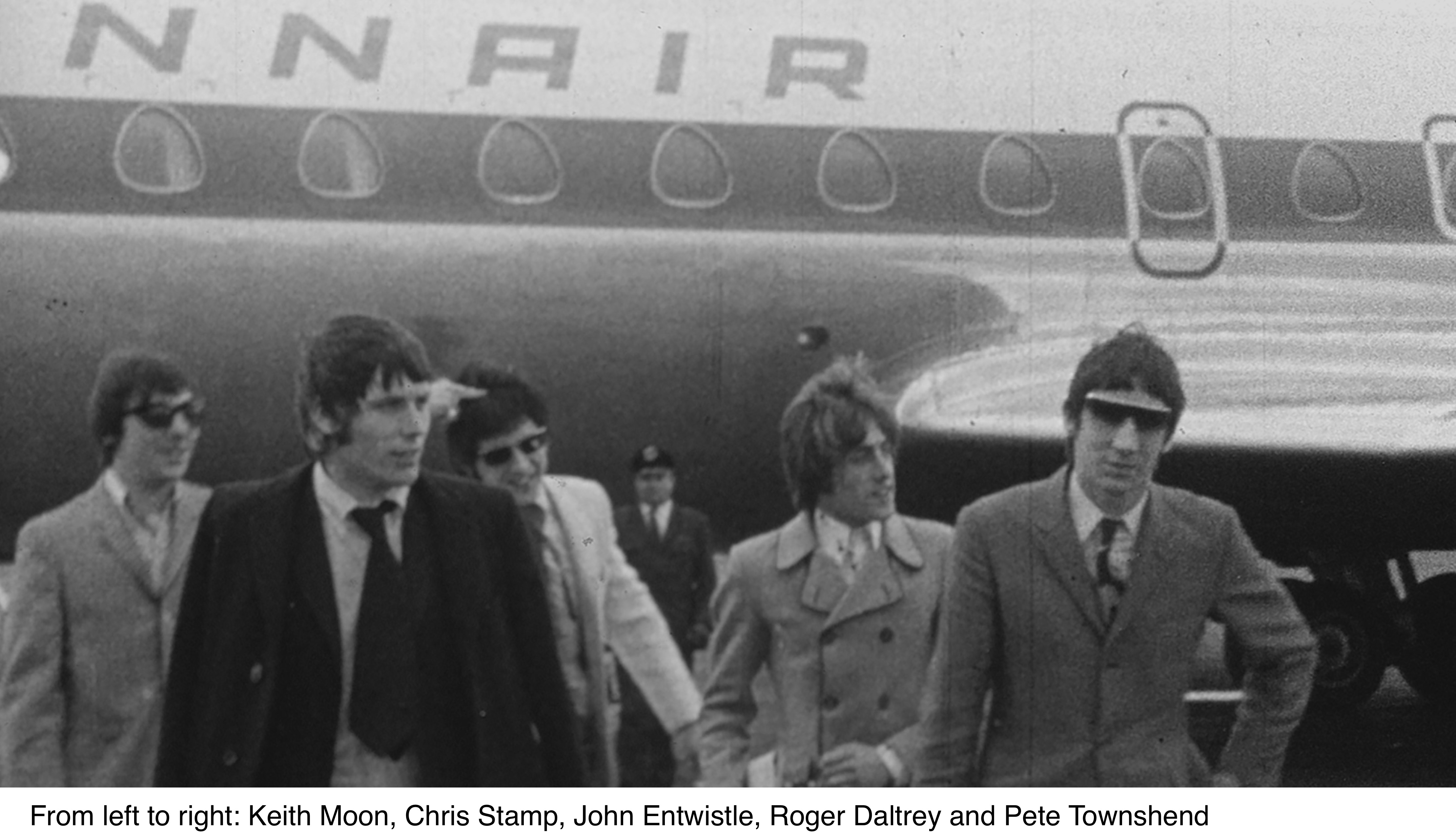
Left to right: Keith Moon, Chris Stamp, John Entwistle, Roger Daltrey and Pete Townshend Photo courtesy of Magic Rabbit, LLC/Sony Pictures Classics
Unfortunately, Lambert and Stamp did not succeed as filmmakers, though, they still had inspirations, even after being successful with the band. It wasn’t until the band gave the rights to Robert Stigwood to produce “Tommy”, did they realized that their film making dreams were shattered.
In any case, they certainly shaped and created the world of rock music by creating and forming one of the greatest rock bands in history, even if that wasn’t part of their plan.
Now playing at a theater near you.
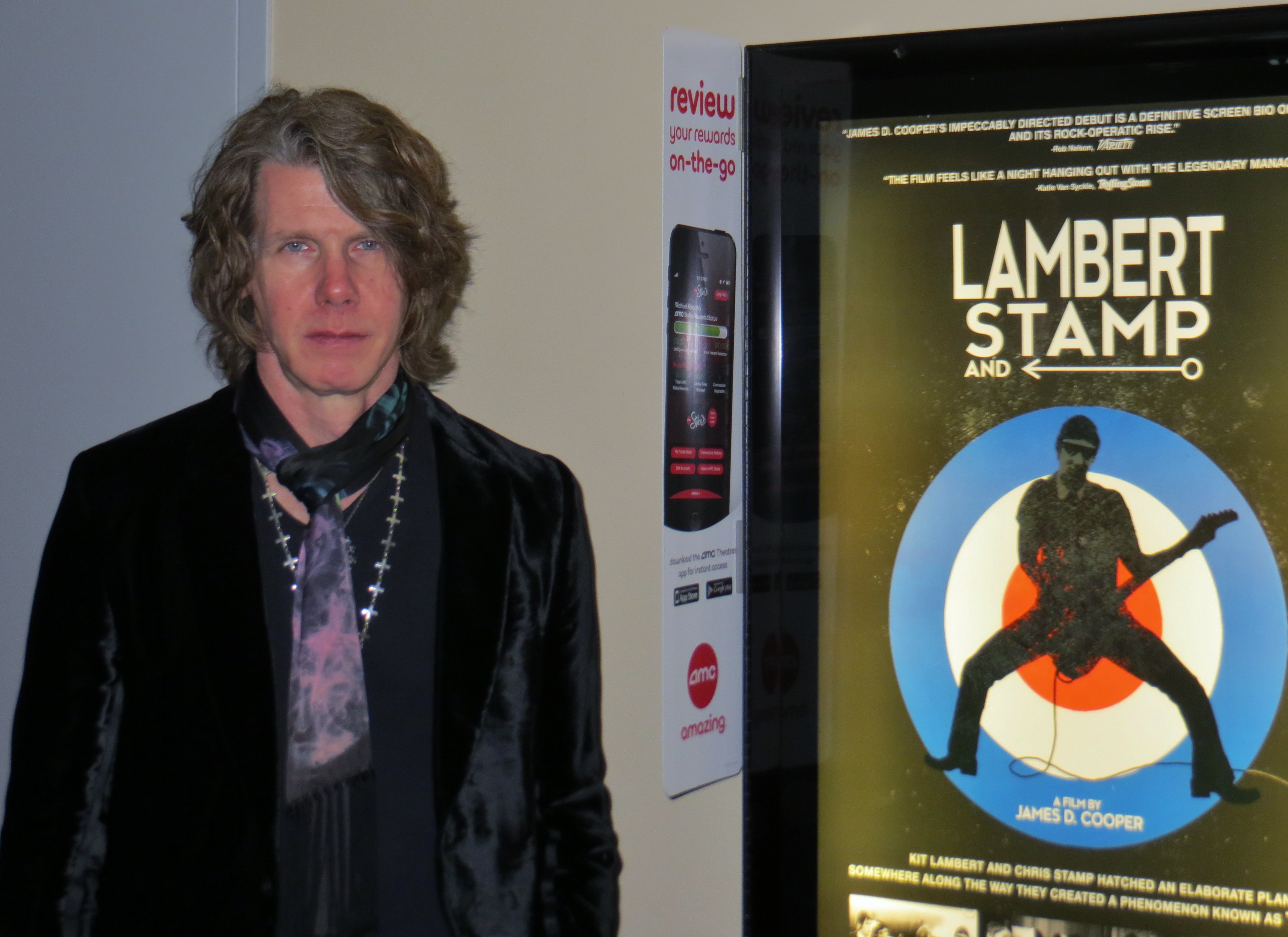
Director James T. Cooper at a screening of “Lambert & Stamp” in San Francisco. 10 years in the making. Photo by Marcus Siu
Most independent filmmakers have a passionate project or a labor of love that they cannot stop working on. This happened to Denny Tedesco, whose father, Tony Tedesco was known as possibly the most recorded guitarist in history (according to “Guitar Player” magazine), and was part of the the legendary “Wrecking Crew”, who were basically 20 to 30 uncredited studio musicians that were hired solely for the recordings by major artists; many which happen to be responsible for some of the most popular recordings of our time.
The Wrecking Crew never received any credit on the record albums or were never even acknowledged by the recording studios. It was part of their contract to remain discreet. They were the “ghost” musicians, usually working 18 hour days, that were around for nearly three decades, but were never recognized except by the most successful recording artists who used them for their own artistic and commercial success. At one point, they were responsible for seven straight Grammy “Record of the Year” awards. They were the behind-the-scenes musicians that the most successful artists wanted to use during for THEIR recordings.
You most likely have heard them on recordings by Jan and Dean, The Beach Boys, Simon and Garfunkle, The Righteous Brothers, Nat King Cole, The Mamas and the Papas, Frank Sinatra, Sonny & Cher, Frank Sinatra, The Carpenters, Herb Alpert, even Elvis what’s his name from the 50’s.
Even the legendary record producer Phil Spector used them for his Wall of Sound.
The Wrecking Crew probably even inspired Milli Vanilli wannabe’s. As long as you looked good on the album cover, you can hire them to play on your album and still be gracing the album cover. It’s really the image that sells records to the general public. Especially for groups like The Monkees, The Association, or believe it or not…The Partridge Family.
They were the musicians who created the soundtracks of our lives, at least if you were around the late 50’s through the mid 70’s. However, the music is timeless. Some of the prominent musicians of the Wrecking Crew, besides Tedesco, included drummers Hal Blaine and Eddie Palmer, bassist Carol Kaye, guitarists Al Kasey and Glen Campbell, Saxophonist Plas Johnson…and Leon Russell.
Who?
It’s notable that the Beach Boy’s, Brian Wilson tried to create an American version of the Beatles “Sgt. Pepper”, but with the help of the Wrecking Crew. Today, it remains one of the greatest Rock albums of our time.
So, why was the movie not distributed until nearly seven years later, after it played at film festivals back in 2008? Simple; it’s about copyright and royalties.
Documentary filmmakers have to pay for music royalties that they use in their films. Unfortunately, Tedesco, would have had to pay for over 100+ of the most famous songs of all time. That’s a LOT of money. Definitely in the millions of dollars.
However, given the subject mater, this documentary needs it. If the music was excluded, it would be taking the life and soul away from film. It was mandatory for the music to co-exist with the film, since that was what the backbone of the movie: the music.
After a successful tour of grass roots money raising, as well as a hugely successful Kick-starter campaign, it finally happened. Denny was able to pay off the music companies.
Though, Denny’s father, Tony Tedesco passed away in 1997, and didn’t get the recognition that he deserved, his musical legacy with the Wrecking Crew will go on, thanks to Denny’s endless effort on working on the film for over 18 years. This is a timeless film and will be recognized as one of the best music documentaries ever.
Rush to see this film, if you are lucky enough to have it shown in your town. Even better yet, rush to the theater to HEAR this film. You’ll definitely feel some “good vibrations”.
NOTE: If you get a chance to to see Denny Tedesco at your screening…drop everything and just GO!
Here is the trailer.
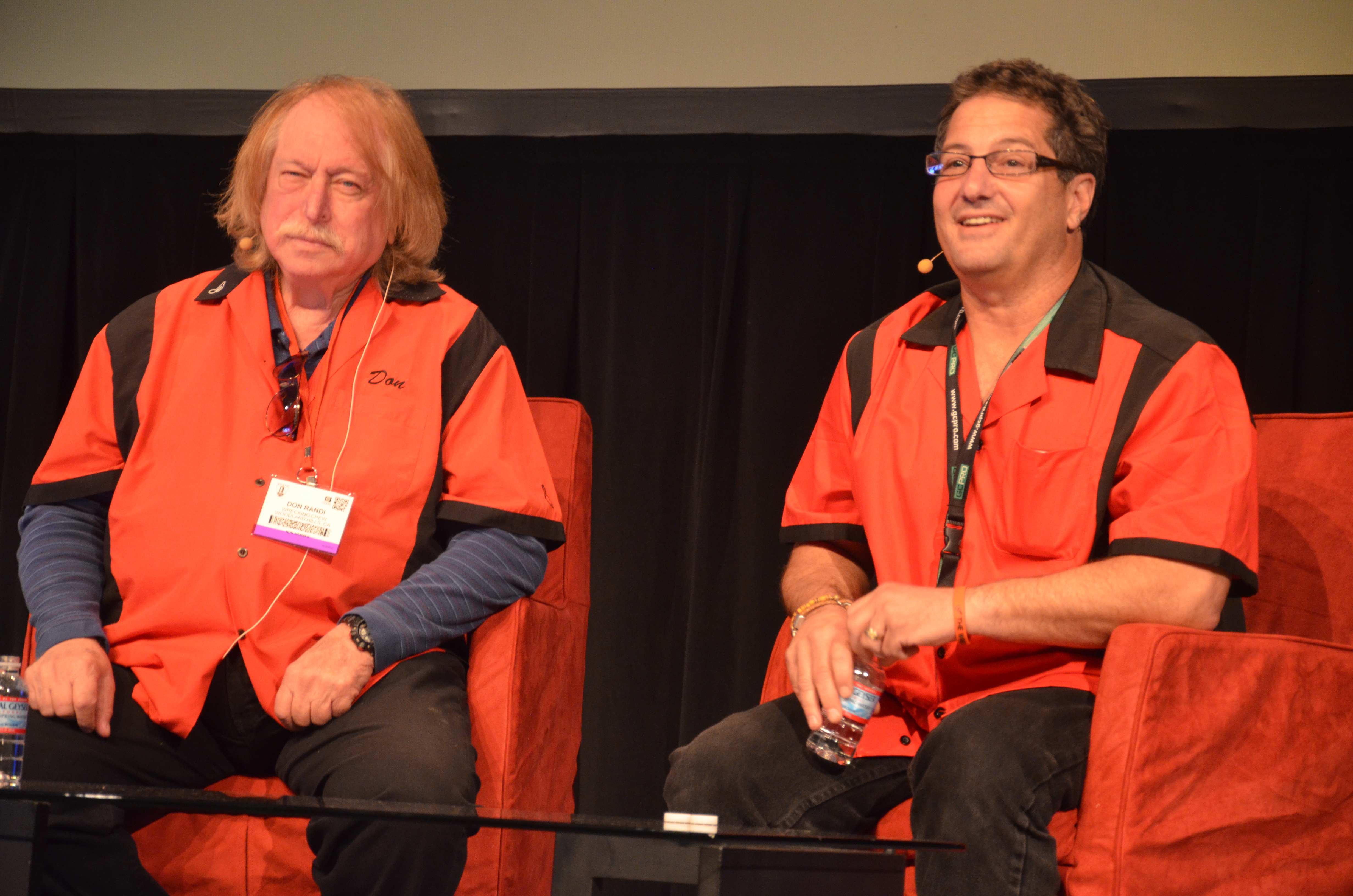
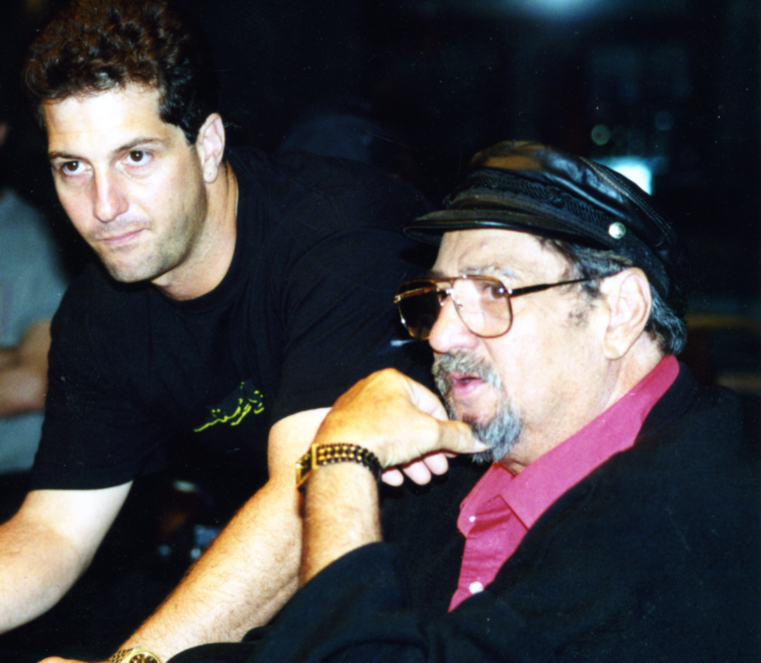
Don Randi and Denny Tedesco at a Q&A at 133rd AES (Audio Engineering Society) at Moscone Center in San Francisco. Photo by Marcus Siu.
The following is from the press kit from Magnolia Pictures.
SYNOPSIS
What the Funk Brothers did for Motown…The Wrecking Crew did, only bigger, for the West Coast Sound. Six years in a row in the 1960’s and early 1970’s, the Grammy for “Record of the Year” went to Wrecking Crew recordings. And now, THE WRECKING CREW tells the story in pictures and that oh, so glorious sound. The favorite songs of a generation are all here, presented by the people who made them for you. THE WRECKING CREW is a documentary film produced and directed by Denny Tedesco, son of legendary late Wrecking Crew guitarist Tommy Tedesco. The film tells the story of the unsung musicians that provided the backbeat, the bottom and the swinging melody that drove many of the number one hits of the 1960’s. It didn’t matter if it was Nat “King” Cole, Frank Sinatra, Nancy Sinatra, The Monkees, The Byrds or The Beach Boys, these dedicated musicians brought the flair and musicianship that made the American “west coast sound” a dominant cultural force around the world. The film is a fun and moving tribute from Denny to his father and to the music, the times and to the secret star-making machine known only as “The Wrecking Crew”.
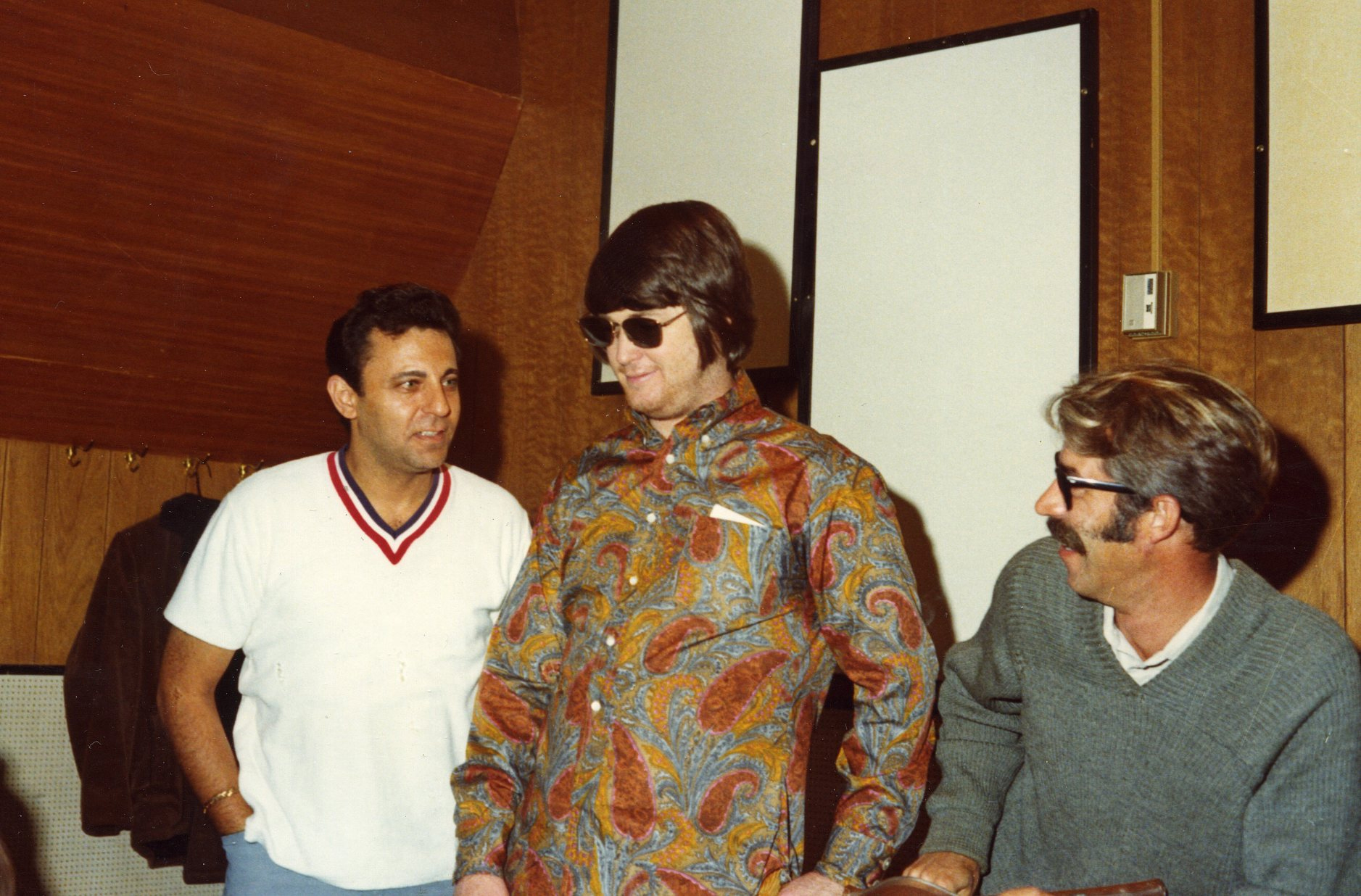
Hal Blaine, Brian Wilson and Ray Pohlman in THE WRECKING CREW, a Magnolia Pictures release. Photo courtesy of Magnolia Pictures.
ABOUT THE MAKING OF ‘THE WRECKING CREW’
They were the studio musicians behind some of the biggest hits in the 1960s and ’70s. From “Be My Baby” to “California Girls;” “Strangers in the Night” to “Mrs. Robinson;” “You’ve Lost that Lovin’ Feelin'” to “Up, Up and Away;” and from “Viva Las Vegas” to “Mr. Tambourine Man,” the group dubbed The Wrecking Crew played on them all. Six years in a row in the late 1960s and early 1970s, the Grammy for “Record of the Year” went to Wrecking Crew member recordings.
THE WRECKING CREW, a documentary film produced and directed by Denny Tedesco, son of legendary late Wrecking Crew guitarist Tommy Tedesco. His father had been diagnosed with terminal cancer and Denny wanted to get as much on film or on tape as possible before his father passed. What transpired over the next few years surprised even Denny.
Director Denny Tedesco with him father Tommy Tedesco in THE WRECKING CREW, a Magnolia Pictures release. Photo courtesy of Magnolia Pictures.
Denny spent several years interviewing producers, engineers, and the musicians themselves to reveal the warmth and humor that allowed their collective talents to turn a simple chord chart into an international phenomenon and give a unique signature to recordings that are now part of the soundtrack of our lives.
The played around the world in the festival circuit with over a dozen awards and rave reviews and other accolades. The film was released into the festival circuit in 2008 and garnered a dozen awards in over 50 festivals around the world. The film includes wonderful interviews with Brian Wilson, Cher, Nancy Sinatra, Herb Alpert, Glen Campbell, Micky Dolenz, Roger McGuinn, Gary Lewis, as well as Crew members themselves.
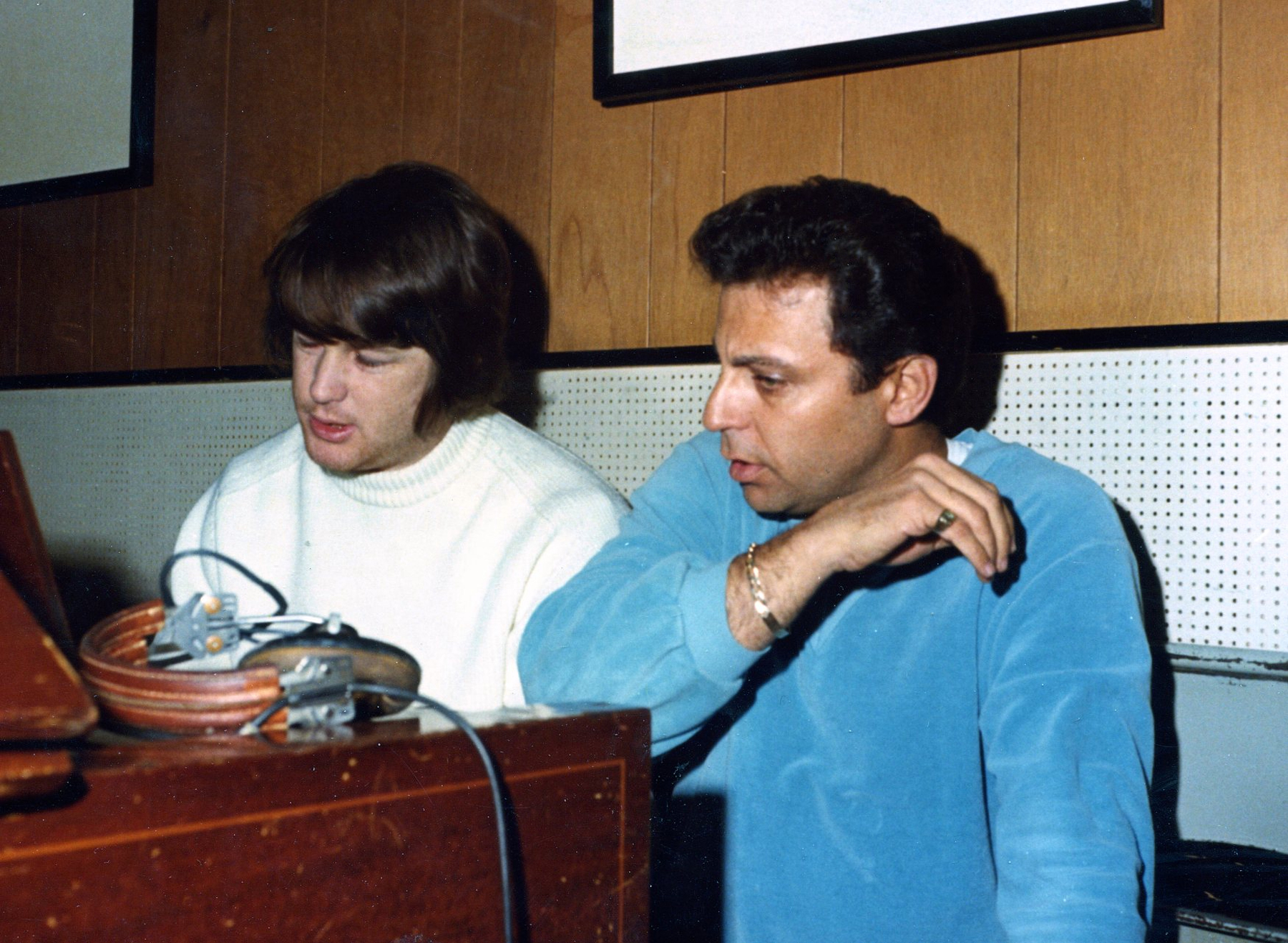
Brian Wilson and Hal Blaine in THE WRECKING CREW, a Magnolia Pictures release. Photo courtesy of Magnolia Pictures.
Why the film hasn’t reached a wider audience, even though it is championed by all who see it, became a bit of lore itself. A labor of love by director Tedesco, the film is also ultimately a love letter to the legacy of his late father and musician friends in the Crew. Documenting the work of musicians on such iconic songs, however, can be cost — and distribution — prohibitive.
With songs by Frank Sinatra, Nancy Sinatra, The Monkees, The Byrds, Mamas and Papas, Sonny and Cher, The Beach Boys and dozens of others, the cost of licensing for this historic film was estimated to be more than $700,000.
The economics of paying for the licensing of over 100 hit songs stopped the film in its tracks, until Tedesco worked at raising the funds needed to pay off the record labels, publishers and the musicians themselves were taken care of.
In 2013, Tedesco finally decided it was time for Crowd Funding through Kickstarter. THE WRECKING CREW surpassed its goal of $250,000 to $312,000. The campaign for THE WRECKING CREW became the 3rd top Documentary in Kickstarter history to reach such an amount.
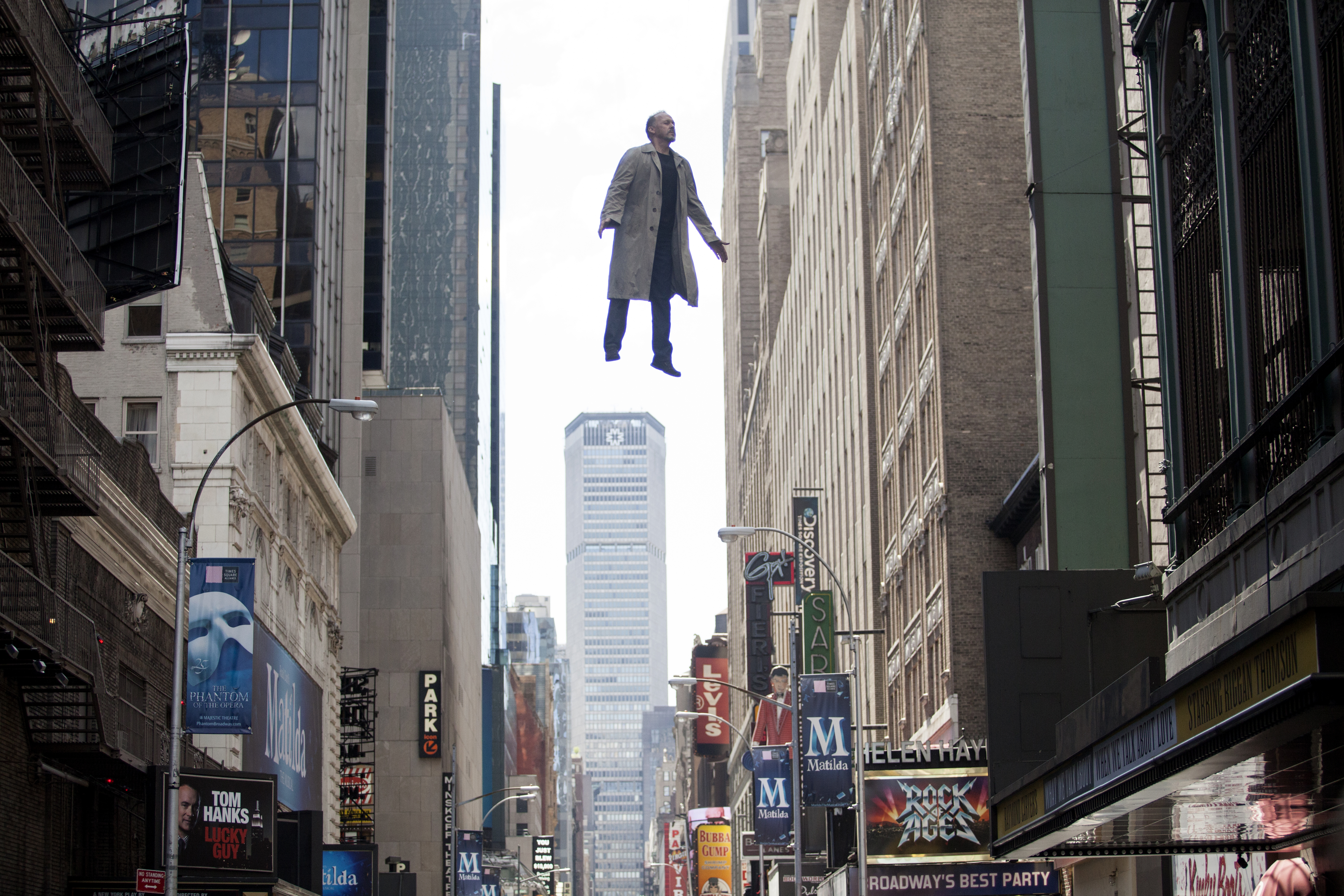
Alejandro González Iñárritu’s, “Birdman” will most likely take home tonight’s Oscar for Best Picture, and edge out Richard Linklater’s 12 years in the making masterpiece, “Boyhood”.
“Birdman” was nominated for nine Academy Awards including original screenplay, director, three acting categories, and more importantly, the “sight and sound” categories; cinematography and sound. Being nominated in all of these categories pretty much sums up a Best Picture compared to the categories that “Boyhood” was nominated for.
“Boyhood” was nominated for six awards, but none of them are really considered in the production category. However, it was nominated for film editing, and it should win just for its intensive twelve years worth of film editing.
“Boyhood” will be remembered as a film masterpiece that cannot be compared to any other traditional film. Linklater has completely redefined cinema out of the box.
Interestingly, besides competing in the Best Picture category, Iñárritu and Linklater will be competing in two other categories; Best Director, and Best Original Screenplay. I predict each will receive one. Linklater will probably receive Best Director and Iñárritu will probably receive the Best Original Screenplay.
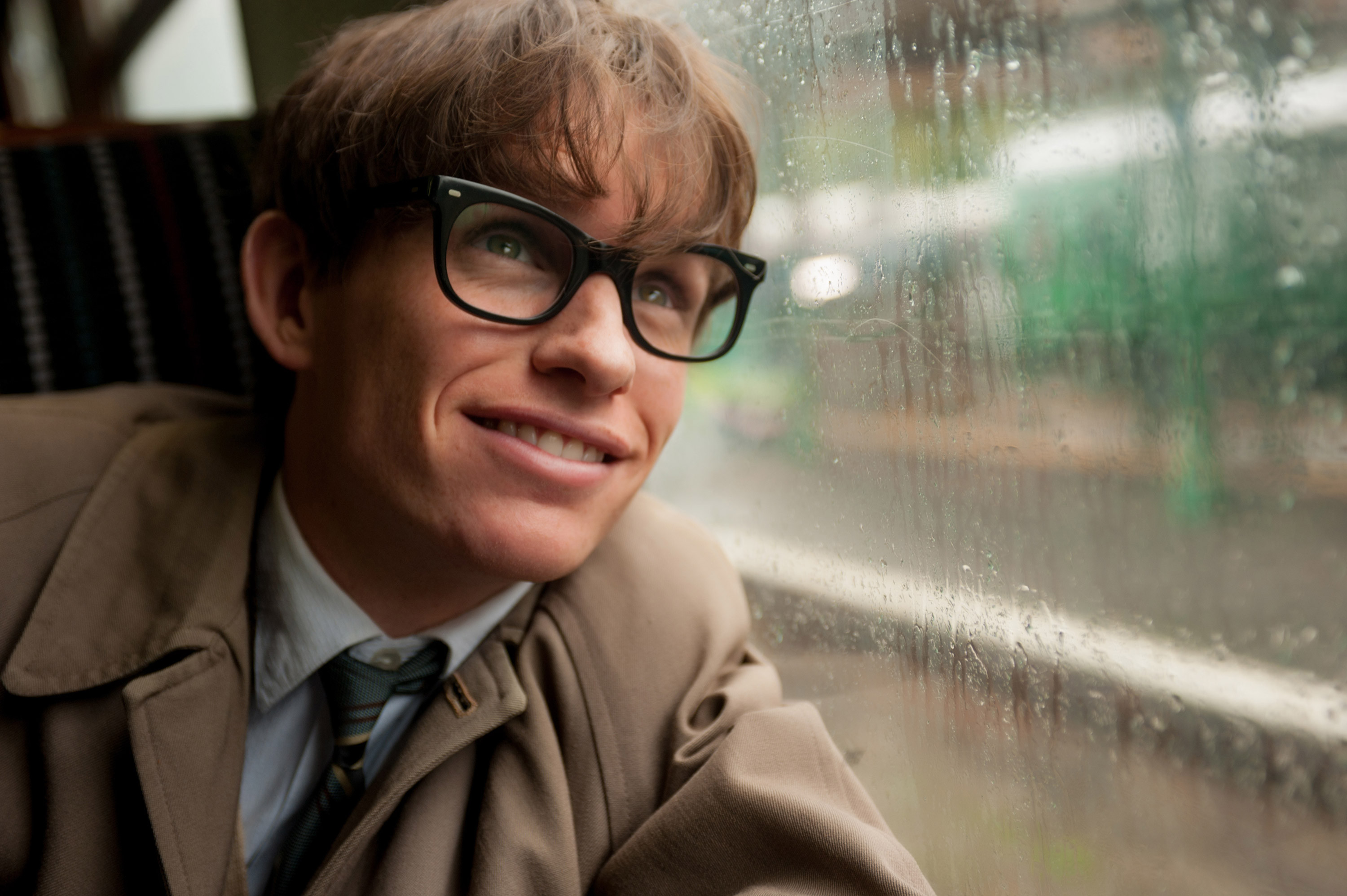
Eddie Redmayne in The Theory of Everything. Photo Credit: Liam Daniel/Focus Features
Even with the amazing performances by all of the acting nominees this year, the acting categories will be very predictable this year. It will go to Eddie Redmayne, who plays Stephen Hawking in “The Theory of Everything”, Julianne Moore, who is fighting against Alzheimer’s in “Still Alice”, J.K. Simmons, the abusive music professor in“Whiplash”, and Patricia Arquette, for her portrayal of Mason’s mother in “Boyhood”.
Julianne Moore as Alice Photo by Linda Kallerus, Courtesy of Sony Pictures Classics
Here are the rest of my predictions for the remaining categories.
Best Motion Picture of the Year – Birdman (2014): Alejandro González Iñárritu, John Lesher, James W. Skotchdopole
Best Performance by an Actor in a Leading Role – Eddie Redmayne for The Theory of Everything (2014)
Best Performance by an Actress in a Leading Role – Julianne Moore for Still Alice (2014)
Best Performance by an Actor in a Supporting Role – J.K. Simmons for Whiplash (2014)
Best Performance by an Actress in a Supporting Role – Patricia Arquette for Boyhood (2014/I)
Best Achievement in Directing – Richard Linklater for Boyhood (2014/I)
Best Writing, Screenplay Written Directly for the Screen – Birdman (2014): Alejandro González Iñárritu, Nicolás Giacobone, Alexander Dinelaris,Armando Bo
Best Writing, Screenplay Based on Material Previously Produced or Published – The Imitation Game (2014): Graham Moore
Best Animated Feature Film of the Year – How to Train Your Dragon 2 (2014)
Best Foreign Language Film of the Year – Ida (2013): Pawel Pawlikowski
Best Achievement in Cinematography – Birdman (2014): Emmanuel Lubezki
Best Achievement in Editing – Boyhood (2014/I): Sandra Adair
Best Achievement in Production Design – The Grand Budapest Hotel (2014): Milena Canonero
Best Achievement in Makeup and Hairstyling – Foxcatcher (2014): Bill Corso, Dennis Liddiard
Best Achievement in Music Written for Motion Pictures, Original Score – The Theory of Everything (2014): Jóhann Jóhannsson
Best Achievement in Music Written for Motion Pictures, Original Song – Selma (2014): Common, John Legend(Glory)
Best Achievement in Sound Mixing – Whiplash (2014): Craig Mann, Ben Wilkins, Thomas Curley
Best Achievement in Sound Editing – American Sniper (2014): Alan Robert Murray, Bub Asman
Best Achievement in Visual Effects – Interstellar (2014): Paul J. Franklin, Andrew Lockley, Ian Hunter, Scott R. Fisher
Best Documentary, Feature – Finding Vivian Maier (2013): John Maloof, Charlie Siskel
Best Documentary, Short Subject – Joanna (2013/I): Aneta Kopacz
Best Short Film, Animated – A Single Life (2014): Joris Oprins
Best Short Film, Live Action – Boogaloo and Graham (2014): Michael Lennox, Ronan Blaney
After a very successful grass roots Kickstarter campaign back in April, musical spokesman and entrepreneur, Neil Young, who on the side, is actually a pretty good musician in his own right, was able to raise the needed $800,000.00 for the survival of his upstart company, Pono. (Pono means “righteous” “the one”, “pureness” in Hawaiian) In addition, he also raised a little more than he anticipated, raising over $6 million from enthusiastic supporters, who helped sell out their first batch of PonoPlayers before the holidays, making it unavailable to the public until the first quarter of next year.
“It’s an indicator of the soul of people that is really a grassroots movement to bring back music that you can feel and get inside of”, Young remarked, while giving his keynote address speech at the Ponos launch at this year’s Dreamforce 2014 conference in San Francisco’s Moscone Center.
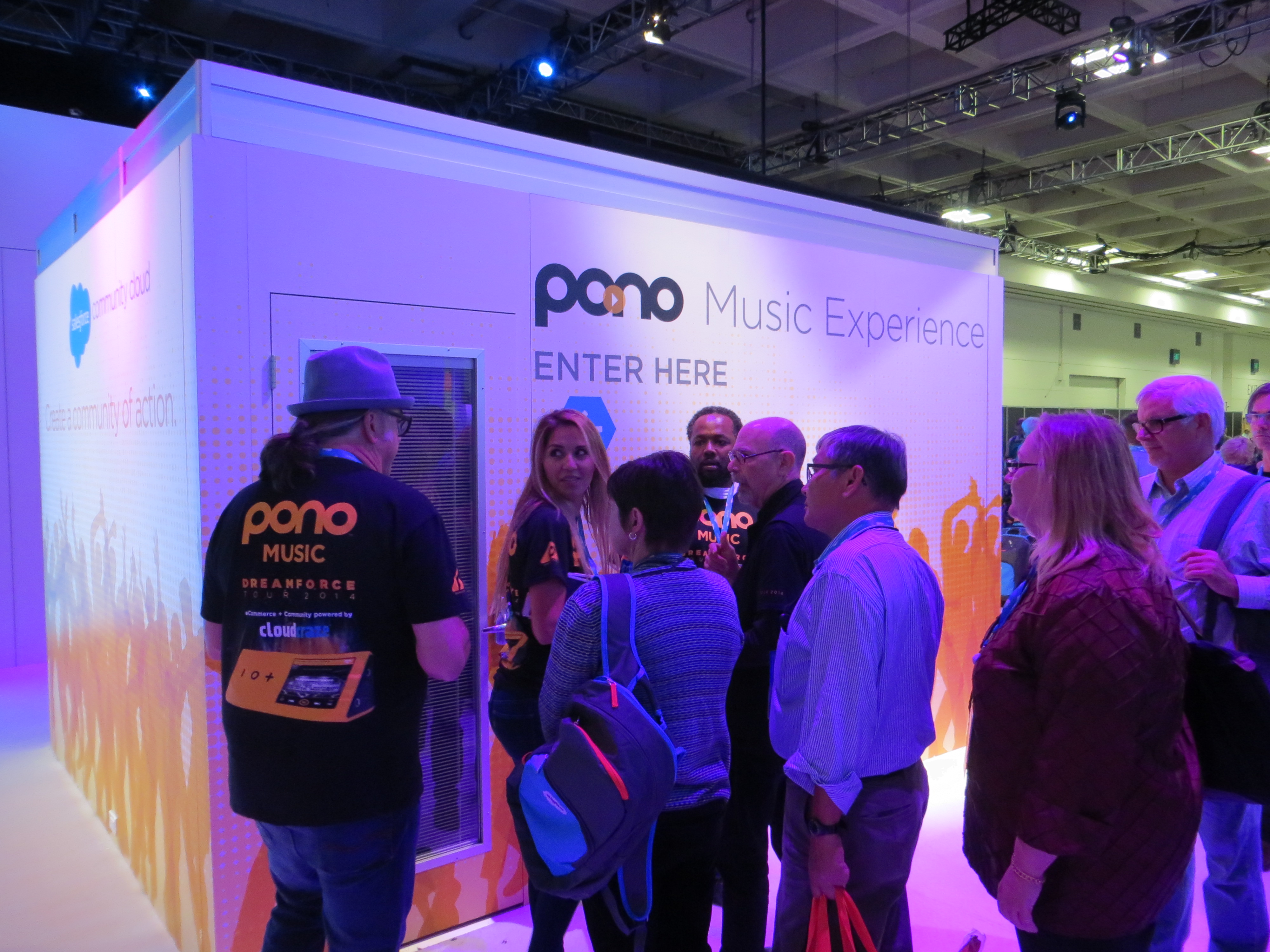
After the introduction from Salesforce Chairman and CEO, Mark Benioff, Young took the cloudlike stage dressed casually, mainly in black with a grey unbuttoned long sleeve shirt exposing his black “Ponos” T-shirt with its orange logo, not unlike the team colors of the local baseball team. His introductory lines to the crowd was explaining why “Ponos” was created.
“We’re trying to bring the feeling back in music. We are trying to bring the goose bumps back. We want you to feel the love in the music and feel all of the emotion that the music was made from. It’s not about bits. It’s not about putting down one format over another. It’s about recreating exactly the artist’s vision and the artist’s dream and what they actually accomplished. So, that was the goal when we started”.
For those not familiar with PonoPlayer, think of it as a dedicated high resolution portable music player that plays high quality FLAC music files (free lossless audio codec files) unlike the ones sold by the “i” product manufacturer. Like their competitor, Ponos also has a downloadable service shop online (PonoMusic) where you can purchase your music, but focuses on high resolution 24-bit 192kHz audio, instead of the popular mp3 format that the “other guys” sell.
“It’s only goal is to explain to your soul what it’s missed, so you can feel the magic in the music”, Young explains.
It took three years of negotiations, but PonoMusic signed with all the major recording companies (Universal, Sony, Warner Bros) and all of the independent distributors. All the files are ingested in their system, and when you listen to them, it will be like you are listening to them direct from the studio, as how the artist and producers envisioned their works in the quality they were made in. (At the time Young was onstage, they had nearly 617,000 songs ingested. They have a few million more to go…)
Young compared Pono’s music files vs mp3…
“You get 95% more data in the file than what you’re used to listening to, and the data is representing quiet and the most dynamic parts of the file, where mp3 is smooth and is all at one level so you can hear it, it takes less data to do that, where you just have a desert with no mountains and no valleys…with Pono, the mountains are all the way up to the top, past Everest, into the sky and the valleys are down in the deepest canyons in the ocean.”
Can we hear the difference? You betcha…
The Pono demonstration booths offered a chance to hear the PonoPlayer through headphones and in a sound booth with speakers. I was able to visit both and was quite impressed with what I heard. I felt that I was listening to the master recording from the recording studio, especially when wearing over the ear headphones. Hearing the Stones in 24 bit glory in the listening booth made me want to rebuy their entire catalogue.
Suddenly, I felt excited about the concept of buying pre-recorded music again. I felt that it would be a brand new listening experience for everything that I have ever heard. I haven’t felt that way since the 20th century when I used to shop for vinyl every Friday as a ritual for $3.99 at Tower Records when I was still in college.
According to Young, all of the musical artists who heard his PonoPlayer are completely supporting him.
“100% of the artists are behind us…because they are crying in their hearts, because everything they’ve done their entire lives…over decades, from Joni Mitchell to Carole King to countless others are sad that no one can hear what they created. If Frank Sinatra was here today he’d feel the same way with his recordings with the Nelson Riddle Orchestra.”
“It’s the history of recorded sound which is in jeopardy, not just this week’s new records. It’s about restoring the quality and preserving it for years and years to come…we’ll still be here and our descendants will still be here…they’ll want to know what the big band era was like in the 20’s and 30’s. People in school will want to study the evolution of music.”
“Why should they be listening of Xeroxes of Picassos? They should be listening and feeling what the music was that moved a generation…it should move several generations in the future. That is what the mission of Pono is.”
“Technology is supposed to provide a better life…that is why we have technology. Pono is an example of how we can make things better with technology because it brings a feeling, it brings input into your body that has been missing – we haven’t had this input…”
The PonoPlayer is shaped like a triangular Toblerone bar, so it’s easy to place on a flat surface. It has two headphone jacks which would be perfect for airplane flights with a companion. It contains 64 gigs of internal memory and ships with a 64 gig micro SD card. The battery life is about 8 hours. The touchscreen is about 2.5 inches. It plays mp3’s, as well as the high resolution files. It retails for $399 and is available in the first quarter next year.
Just like Steve Jobs was a successful pioneer revolutionizing the music industry through technology, taking iPod’s and making music downloadable in an mp3 format, letting consumers carry music libraries in their pockets, legendary rock icon Neil Young, entrepreneur of Pono, will hopefully be able to do build on that and to deliver all of the goods with nothing missing, including what we used to know of as “album art”, that would include pictures, lyrics, credits, and personal notes from the artists. What a concept…
Nothing would be finer to re-hear a rock classic, such as Neil Young’s classic, “A Heart of Gold” with the artist’s soul attached to the actual listening experience.
After 40 years in the making, Neil Young’s vision is finally becoming a reality…and the future looks bright.
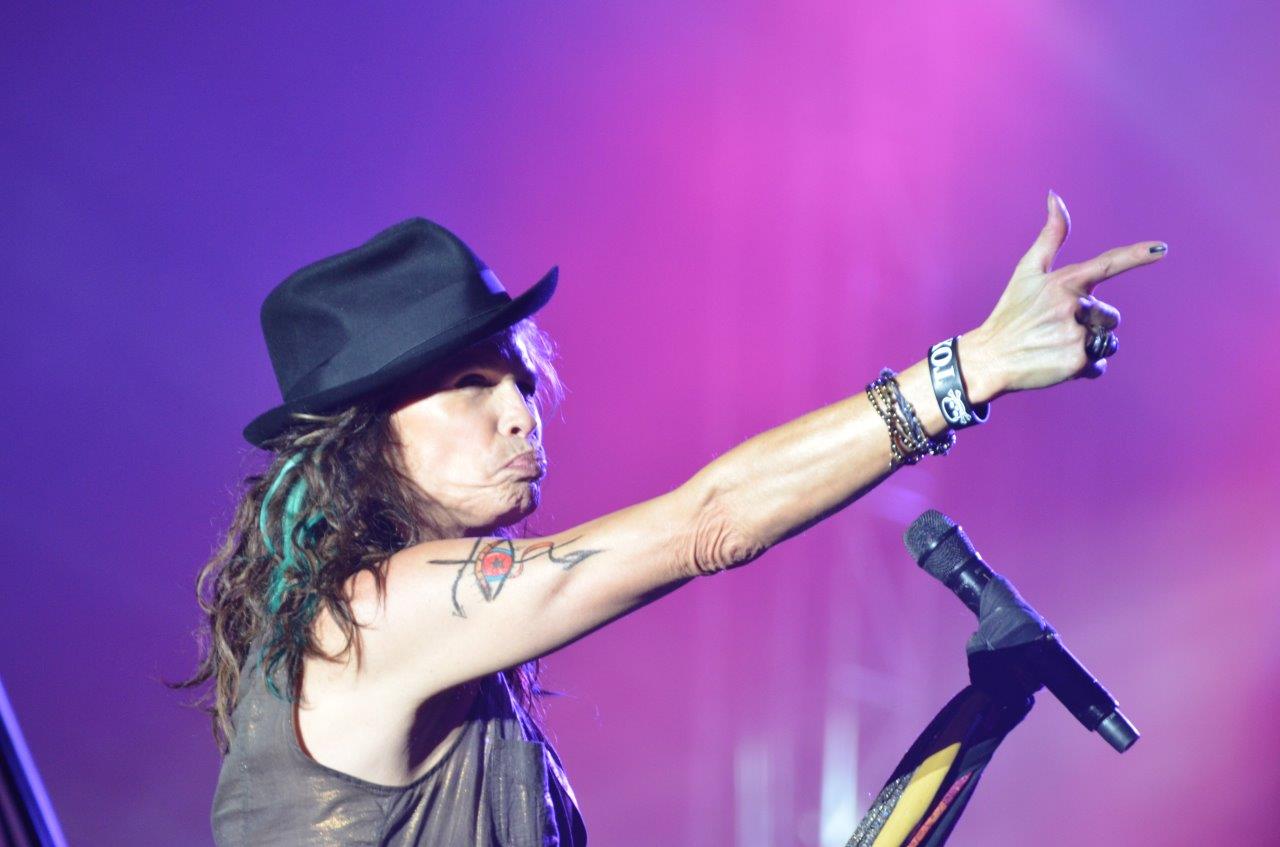
Steven Tyler of Aerosmith shoots at a flying droid hovering above the enthusiastic crowd at Treasure Island at the 2014 Oracle Openworld Appreciation Event.
ARTICLE AND PHOTOS BY MARCUS SIU
SAN FRANCISCO, October 1,2014 – I can imagine the planners for Oracle’s OpenWorld Appreciation event earlier this year, brainstorming in a closed door conference room, discussing a possible musical lineup for this years annual musical event on Treasure Island.
Hmm…”let’s headline a classic rock band from the vinyl era, Rock “n” Roll Hall of Fame inductees, who can still rock out better than anyone else half their age…and combine that with a new contemporary act that even the Grammy committee would find unusual to pair up. What was the name of that critically acclaimed and commercially successful independent hip-hop act that was nominated for seven Grammy’s this year, including “album of the year”? I sure like what they have to say in their raps…”
At this year’s Oracle’s OpenWorld Appreciation event, Aerosmith was the main headliner on the bill, joined along with rappers, Macklemore & Ryan Lewis, who are recipients of four Grammy Awards earlier this year, including “Best New Artist”. Quite an unusual combination, indeed.
Though Aerosmith were considered the headliners of the show, they would perform before Macklemore and Ryan Lewis. Either Oracle knew that most of the attendees of the show were really going there to see Aerosmith and had to leave the party early to wake up the next morning in order to attend the Oracle conference, or perhaps it would have been way past Steven Tyler’s bed time, if Aerosmith were to play after Macklemore & Ryan Lewis’s set. I seriously believe it was the former reason as Tyler has quite a bit of energy for his age as proven on stage.
After great anticipation from the crowd following a few words from the Oracle sponsors with a drone flying above, the crowd immediately roared when Steven Tyler and the boys from Aerosmith took the stage kicking off with “Train Kept A- Rollin”.
This slideshow requires JavaScript.
The rest of the set included “Love in an Elevator”, “Cryin'”, “Living on the Edge”, “King and Queens”, “Toys in the Attic”, “Jaded”, “Rag Doll”, “Stop Messin’ Around”, “Mama Kin”, ” I Don’t Want to Miss a Thing”, “No More, No More”, “Dude Looks Like a Lady”, and ended with “Walk This Way”, leaving the crowd ecstatic. They returned and finished off with encores of their classics songs; “Dream On” and “Sweet Emotion”.
Aerosmith showed the audience why they reigned supreme in the rock world, even after 45 years together. Tyler and Perry were showcased right smack in the middle of the huge frenzied crowd, in an intimate setting, along with the backdrop of dramatic lasers and lights, giant monitors and full blown smoke effects, enhancing the electrified atmosphere on the massive set. Tyler and guitarist, Joe Perry were both in “amazing” form.
Leave it to the organizers of the Oracle Appreciation events. They absolutely know how to throw a great party. Year after year, they continue to book an amazing musical lineup that brings pure excitement to Treasure Island, with a party atmosphere unlike any other. The evening couldn’t have been more pleasant weather wise, as it was a very warm and a summerlike evening. It couldn’t have been any better, with all the free flowing beer, wine, great food, arcades galore, along with a giant Ferris wheel on an island right in the middle of the San Francisco Bay.
Wish this could happen every night…
Dream on…
Macklemore & Ryan Lewis take their independent debut platinum album, “The Heist” to the stage at Treasure Island at the Oracle Appreciation Event.
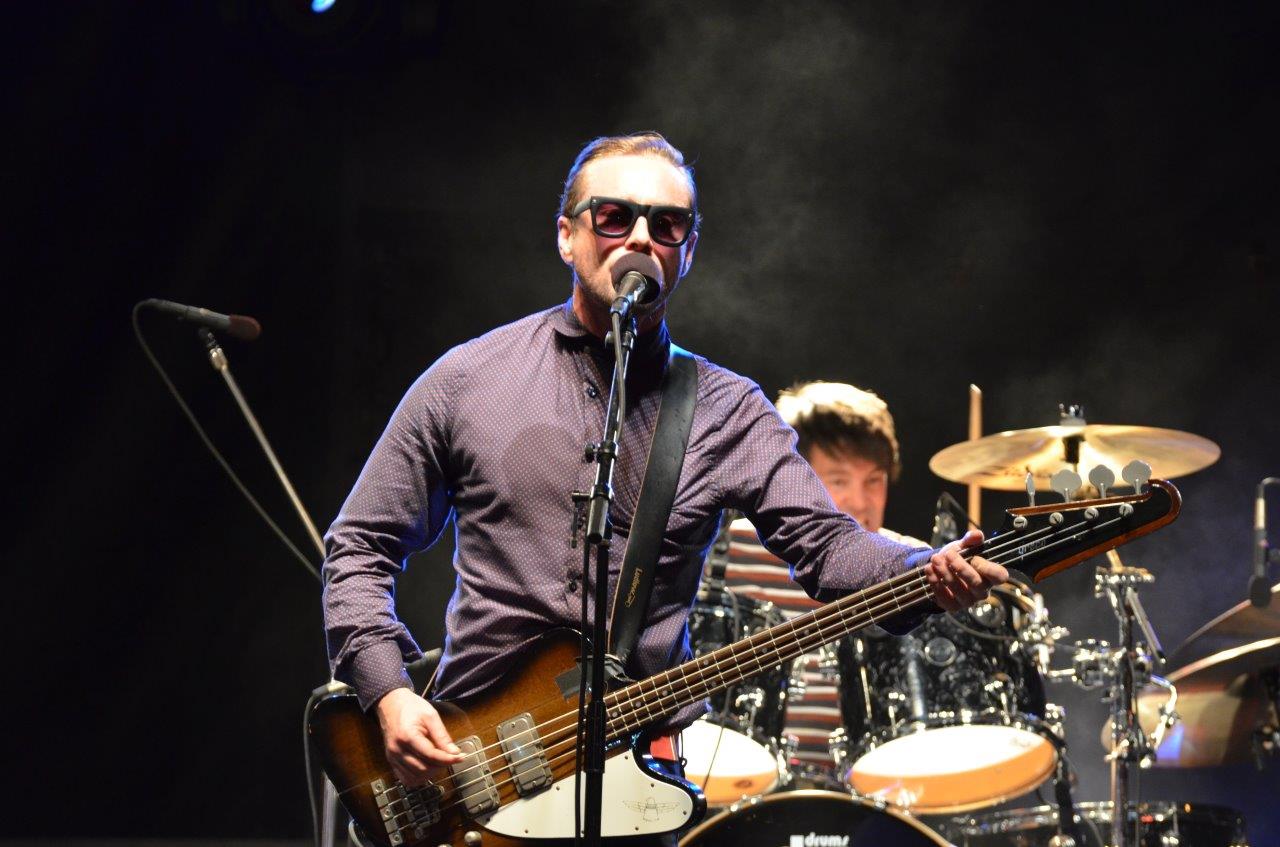
The 90’s band Spacehog (“In the Meantime”), also had played earlier on the second stage.
















 mlsentertainment