
Courtesy Universal Pictures
Article by Marcus Siu
“It was something I wanted to do since I was 16. I first saw documentaries in the Museum of Science and Industry in Chicago, shot in IMAX, and I felt like, wow, this is so much more than movies that are doing right now technically. What if we could tell an entire dramatic feature this way?“
– Christopher Nolan
Universal Studio’s “The Odyssey” broke major pre-sale and box office records, including an unprecedented early launch where select IMAX 70mm tickets went on sale a full year in advance in July 2025. 95% of the seats of the limited 25-theater U.S. network able to show IMAX 70 mm vanished within the first hour.
To those who bought the $35 tickets early, the investment certainly paid off as the ticket prices today have been going through the roof at astronomical prices on e-bay.
It was reported last week that getting a ticket to “The Odyssey” in true IMAX 70 mm has become an epic journey of its own and fans are battling over sold-out showings at the city’s only capable theater as some resellers are demanding over $1,000 for a single seat at the Upper West Side’s AMC Lincoln Square 13 in New York.
Why are these tickets so highly sought after? Once you see the YouTube video below comparing IMAX 70mm (1:43:1) vs Standard (2:39:1), you’ll see why.
THE EPIC MOVIE EXPERIENCE: A LOOK BACK
According to the Library of Congress, as television adoption skyrocketed from 9% to nearly 90% of American households in the 1950s, weekly cinema attendance dropped by almost half—falling from a peak of 83 million in 1946 to 46 million by 1952. The advent of owning televisions caused a historic and precipitous decline in movie theater attendance.
To offer something the small TV screen could not, Hollywood started changing their shooting aspect ratios from full screen (1.37:1) to widescreen (1.85:1) that would get away from the similar aspect ratio as television (1:33:1).
Studios would embrace innovations like 3D movies, widescreen formats like CinemaScope (2.55:1) and Cinerama (2.65:1) to create a larger-than-life, immersive spectacle that would attract audiences all over again.
“Gone with the Wind”, “Ben Hur”, “Lawrence of Arabia”, “Doctor Zhivago”, “Titanic”…these epic movies were intended to be seen on the biggest possible movie screen. Films such as these were shown in theaters pivoted toward “Roadshow” releases back in the 60’s, an exclusive, special, large-scale event where an epic film plays in a few select big city theaters with reserved seats, programs, intro-music overture and intermissions before its wide release.
This era established the standard blueprint for modern tentpole blockbusters that demand a communal, big-screen experience, much like how the IMAX 70 mm blockbusters do today.
After the 2020 Pandemic, movie studios had very little product to offer and were struggling to get moviegoers to return back. After mandatory isolation from the Pandemic was over, people were so used to streaming movies on their 4K HDR Widescreen TV’s in the comfort of their own homes while many movie theaters around them weren’t able to survive and closed their doors.
In a way, it seems history has repeated itself in just 75 years since the 1950’s.
THE NEW GOLD STANDARD FOR EPIC FILMS
If there is any one director who has been pushing the technical boundaries of filmmaking in the last twenty years, it’s Christopher Nolan. He has been the major force getting people back to the “big screen”, whether it’s IMAX or in the regular movie theater. Every one of his movies that have been released have become must-see “events”, whether it’s his Batman films or his 2023 Best Picture winner, “Oppenheimer”.
Nolan has utilized IMAX 70 mm since 2008. No one will ever forget the opening sequence of the bank robbery to “The Dark Knight”, if they experienced it in IMAX 70 mm. Arguably, the most immersive action scene ever filmed in cinematic history. IMAX Audiences immediately felt like they were physically pulled right into the chaos of Gotham City streets.
The next five films that he directed, “The Dark Knight Rises” (2012), “Interstellar” (2014), “Dunkirk”(2017), “Tenet” (2020), and “Oppenheimer” (2023) tallied between 66 and 75 minutes of IMAX footage.
With “The Odyssey”, he has done what no other feature film director has done: made a full feature live action film shot entirely with IMAX cameras.
Courtesy Universal Pictures
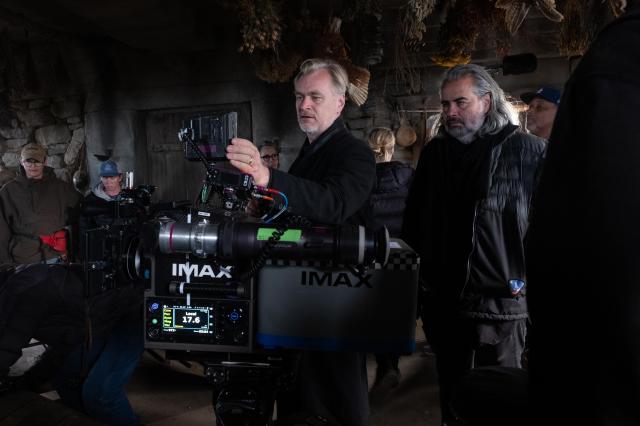
CUSTOM MADE IMAX CAMERAS
IMAX cameras and the underlying 15/70mm film system were developed in 1967. It was primarily utilized for specialized museum films, science centers, and nature documentaries due to the massive weight, loud noise, and short 2.5 to 3 minute runtimes of the analog equipment. Due to these limitations, filmmakers have only used IMAX for specific, large-scale action sequences until now.
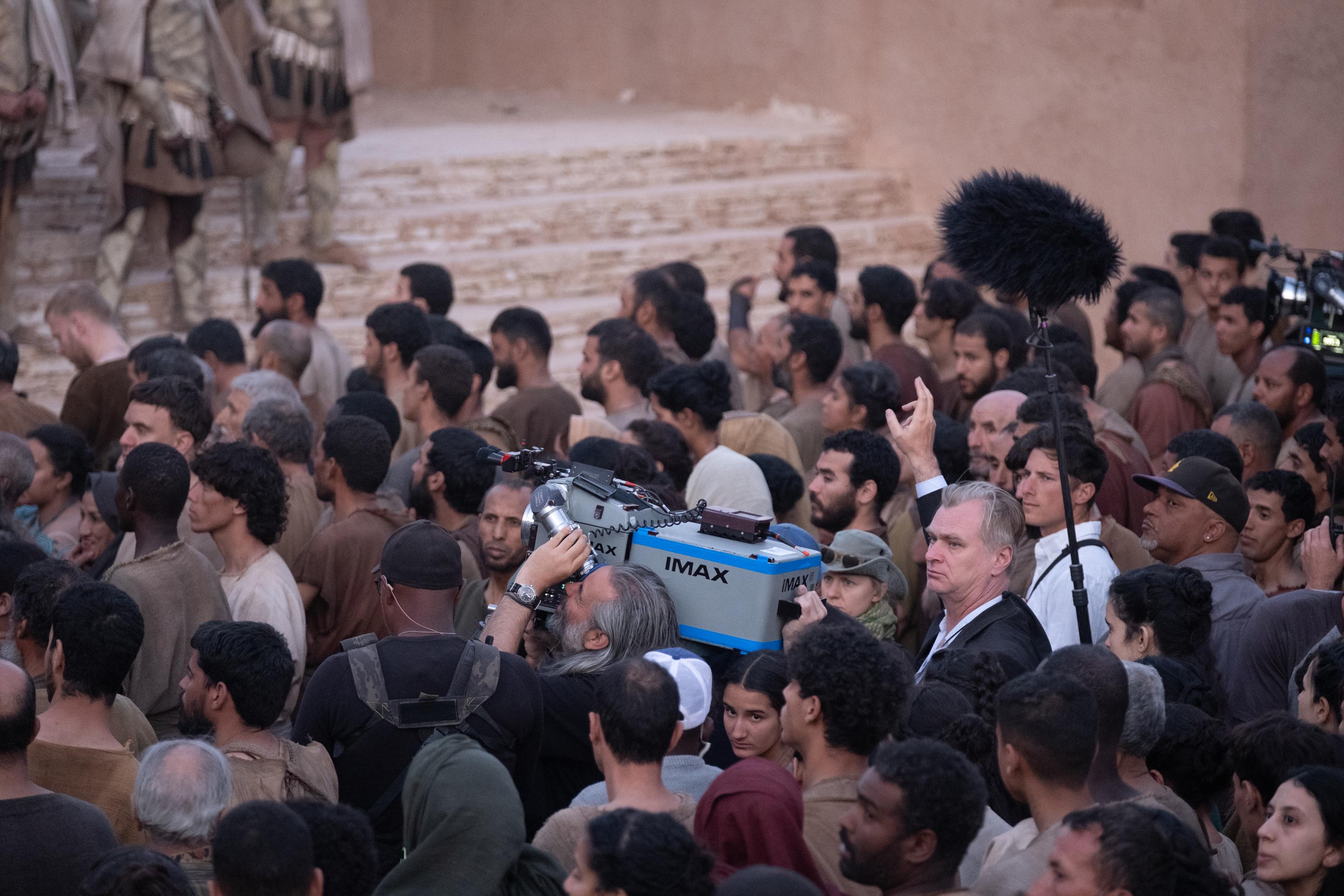
The custom IMAX camera systems used for The Odyssey weighed around 400 pounds (181 kg) fully built. Developed specifically for the film, the camera—named the “Keighley” after longtime IMAX collaborator David Keighley—required a massive sound-dampening blimp to muffle the mechanical noise of the film movement for the dialogue scenes.
These cameras were notably quieter and smaller than the traditional 100+ pound OG IMAX cameras previously utilized. Despite the weight reduction for the new camera body, the massive acoustic enclosure system—described by the crew as being the “size of a coffin”—pushed the total weight of the rig to over 300 to 400 pounds, requiring special steel plating on the dollies to support it.
Now that “The Odyssey” is breaking box-office records at all the movie theaters globally, it’s a little discouraging that not everyone will be seeing the film as it was intended to be seen; in one of the twenty five IMAX theaters that are able to show it in the way Christopher Nolan intended it.
Regardless of how people like to brag about the size of their TV screen at home, it can never compete against movie theater premium formats, such as standard IMAX, 70mm, Dolby Cinema, or even the gimmicky 4DX / Barco HDR, which gives you an option for an immersive motion-seat and multi-projection environment. Moviegoers are returning because they just simply can’t get that experience at home.
Yet, I still continue to hear people saying “I’ll just wait until “The Odyssey” comes to streaming”.
I’m sure it will look spectacular on the latest iPhone…(if you were an ant).

 mlsentertainment