DOCUMENTARY FEATURES SHORTLIST TO BE RELEASED IN THEATERS FOR THE FIRST TIME NATIONWIDE

Free Solo 8

For the first time ever, film audiences will be able to see the entire “short” list of the 15 documentary features that are contending for an Oscar nomination this year, including the extremely “highly” successful and “gripping”, “Free Solo”.    Photo courtesy of National Geographic.

Exciting news for movie-goers who love documentary feature films.

The Academy of Motion Picture Arts and Sciences, led by its Future of Film Committee, will present “Oscars® Spotlight: Documentaries” a new program showcasing the 15 shortlisted documentary feature films in contention for the 91st Oscars. The films will screen theatrically in 13 cities nationwide starting December 31, 2018 through January 21, 2019. Participating theaters include AMC Theatres, Alamo Drafthouse Cinema and Laemmle Theatres.

“The Academy is thrilled to be collaborating with exhibitors and distributors to shine a light on the best documentaries of the year,” said Albert Berger, Academy governor and chair of the Future of Film Committee. “We want to encourage moviegoing and engage audiences across the country in our process as we move through the shortlists, nominations and towards the Oscars.”

Theaters and showtimes are subject to change; check your local listings in the following cities:

Austin Alamo Drafthouse Mueller
Boston AMC Loews Boston Common 19
Chicago Music Box Theatre
Dallas/Fort Worth Alamo Drafthouse Lake Highlands
Denver Alamo Drafthouse Sloans Lake
Los Angeles Area AMC Sunset 5, Laemmle Monica Film Center, Laemmle Playhouse 7 (Pasadena), AMC Promenade 16 (Woodland Hills)
New York IFC Center, Alamo Drafthouse Downtown Brooklyn
Phoenix Harkins Shea 14
Raleigh Alamo Drafthouse Raleigh
San Francisco Area Alamo Drafthouse New Mission, Christopher B. Smith Rafael Film Center
Santa Barbara Santa Barbara International Film Festival Riviera Theatre
Seattle AMC Pacific Place 11
Washington, D.C. Warner Bros. Theater at the Smithsonian’s National Museum of American History

Nominations for the 91st Academy Awards will be announced on Tuesday, January 22, 2019.

The 91st Oscars will be held on Sunday, February 24, 2019, at the Dolby Theatre® at Hollywood & Highland Center® in Hollywood, and will be televised live on the ABC Television Network. The Oscars also will be televised live in more than 225 countries and territories worldwide.

The 15 feature documentaries to be showcased are:

“Charm City”
“Communion”
“Crime + Punishment”
“Dark Money”
“The Distant Barking of Dogs”
“Free Solo”
“Hale County This Morning, This Evening”
“Minding the Gap”
“Of Fathers and Sons”
“On Her Shoulders”
“RBG”
“Shirkers”
“The Silence of Others”
“Three Identical Strangers”
“Won’t You Be My Neighbor?”

Posted in Entertainment | Tagged , , , | Leave a comment

TIME TO UPDATE YOUR BLU-RAY PLAYER TO UHD? TO 4K OR NOT TO 4K?…THAT IS THE QUESTION.

DSC_6244

The Blu-Ray Association of America makes its debut at San Francisco’s Pepcom show. Photo by Marcus Siu

Article and photo by Marcus Siu

Funny how most consumers felt they were future-proofing their DVD player when they replaced it with an HD-DVD or Blu-ray player just ten years ago, just a few years after flat screen HDTV’s were initially introduced to the consumer market, replacing the traditional bulky CRT (cathode ray tube) televisions that hardly ever changed much since it was invented back in the Fifties.  Yet again, it seems history is about to repeat itself thanks to the advent of the latest Ultra HD technology or 4K.

4K “everything”, whether it’s Ultra HDTV’s, computer monitors, projectors, cameras, phones, media streamers, or Ultra HD Blu-ray players has become the hottest consumer trend in the market this holiday season.  It seems everyone wants a piece of the format.

In fact, according to the forecast by ABI research, they have predicted that more than a third of all households globally are anticipated to be 4K UHD TV’s by the end of 2021.  It will be very soon that the Ultra HD TV Market will be the new top-shelf standard of High Definition

Let’s face it, your standard 1080p HDTV that you bought is already looking drabby  compared with the latest technology.  Ultra HD TV’s or 4K televisions with its 3840×2160 lines of resolution has four times the pixels (as opposed to standard HD with 1920×1080 lines of resolution), translating into four times the sharpness. Not to mention, they are a dramatically thinner, lighter, and faster.

You get the picture?

The same obsolescence applies to Blu-Ray technology which has been the de facto standard for the last ten years.  Like Ultra HD TV’s compared to the standard HD TV’s, with the latest Ultra HD Blu-ray, you get double the resolution as standard Blu-ray, but you also get four times the sharpness.

Now with an ever-increasing number of UHD Blu-ray players out on the market today, is it worth upgrading your Blu-ray player to an Ultra HD Blu-ray player?

According to Victor Matsuda, the Promotions Committee Chair, who was here promoting and representing the Blu-Ray Disc Association at the most recent Pepcom showcase in San Francisco; it certainly is and the HDR Side by Side demo at their booth clearly indicates his answer.  It is not just the number of pixels of resolution that makes it a “must own”, but it’s the contrast and color; the HDR (High Dynamic Range) and its WCG (Wide Color Range) that gives a whole gamut and spectrum of colors; from the darkest of darks and the lightest of lights with a higher bit rate which gives much more information. It’s much more immersive and realistic to the viewer.

Matsuda says that today’s consumer can become a “superhero” when they partner their 4K TV with an Ultra HD Blu-ray player. “You’re becoming a superhero for the family, but you’re not a real superhero for the family unless you get that super hero partner.”, Matsuda continued, “You have a Robin for every Batman, there’s a Tanto for every Lone Ranger, and that superhero partner for the 4k UHD TV is Ultra HD Blu-rays.”

uhd-bd-logo-jpg

The UHD Blu-ray player is the “Swiss knife for your entertainment center at home…it plays hard disks and plays all your streaming as well.”, Matsuda continued, “90% of the Ultra Blu-rays have HDR (the mandatory HDR-10 or proprietary premium HDR of Dolby Vision), but just make sure your 4K television supports HDR, as well. Pretty much all the major brands do support it: LG, Sony, Samsung, Panasonic…”

Matsuda explains; “Number, one, it’s the best quality that you can get for the TV, especially now that you have internet-based services and products…the disks are not reliant on any internet speed services.”  In other words, you don’t need a high-speed internet connection.  In order to stream and have a proper 4K experience with HDR you need at least 25mb per seconds as your internet speed to stream Apple or Netflix.

However,  currently only 20% of households have that as an average speed, though it is up from last year from 14%, and only 30% -35% have HDR on their internet-based product. With the future of 5G technology, this percentage is expected to increase dramatically.

In regards to Ultra HD Blu-ray catalog titles, as a general rule of thumb, studio movies that do well at the box office get released on the Ultra 4K format, however, Matsuda sites that there are three more factors that are helping bringing out titles. There is a demand for episodic television, such as “Game of Thrones”, and, older movies, such as the “Twilight” series which Lionsgate will be re-releasing. He also says that even smaller film studios are contributing to the mix.

Sales of Ultra HD Blu-ray players has seen a dramatic increase in year-to-year sales.  According to Matsuda – There has been a 66% increase from 2016 to 2017, as well as an increase in the number of disk releases; from 250 in 2017 to 430 titles in 2018.

“This is going to be the last format for Blu-ray players”, Matsuda remarked, which is itself a pretty surprising and bold statement coming from the Association that represents the technology.

If you do have a 4K TV with HDR, or intend to buy one soon, maybe it’s time to future proof your disk player yet again, but this time, become a superhero for it.

(originally published on 12/21/18 – Bright Blue Innovation)

Posted in Entertainment, Technology | Tagged , , , , , , , , , | Leave a comment

MAKING VR GAMES EXCITING FOR THE MASSES IN THE ESPORTS LEAGUE


XRDC18_Logo_lockup

Article and photos by Marcus Siu

A mere four years ago, at the Games Developers Conference (GDC 2014), VR gaming was going through yet another revival after several decades and had another chance to revolutionize the gaming industry.  During that time, Oculus was just a small little company funded from a Kickstarter campaign that seemed to have appeared out of nowhere before being acquired by Facebook.

Immediately after that, Sony PlayStation decided to jump on the VR bandwagon, joining Oculus Rift and HTC Vive.  Many thought it had the potential to completely disrupt and revolutionize the game industry and that everyone would be abandoning their game controllers in favor of VR headsets. In addition, many assumed Sony would take the PS4 platform into more of an online VR community of VR gamers, much like they have done with the success of their traditional online games.  Sony and Xbox had dominated with over the years allowing you to be put in the same community as your friends no matter where you are in the world.

Instead, VR gaming has mainly been a one-person/player experience, being shut into an environment virtual reality world where you are in isolation.  However, through social media and online communities, things are beginning to change all that.  Especially the devoted community for Survio’s “Sprint Vector” which recently made it’s debut on Esports in the VR League at Oculus Connect 5 this year.

DSC_6285

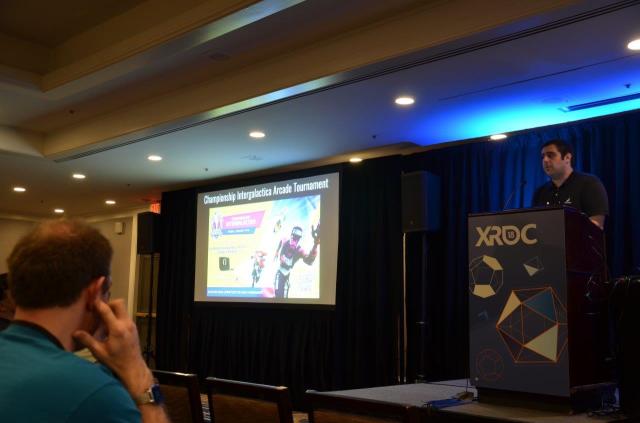
Survio’s Andrew Abedian, Senior game designer speaks at a session “Evolving VR for the eSports Scene” at the XRDC 18 conference in San Francisco. Photo by Marcus Siu.

Andrew Abedian, the Senior game designer at VR game company, Survios, was recently at the 2018 XRDC conference in San Francisco and talked about the grassroots evolution of how their game, “Sprint Vector” was turned from an early speed-running prototype that evolved into a pioneer multiplayer VR title in Esports, thanks mainly through the help of their online community.

“Humanity loves sports…there’s a great drive towards watching it because it’s so physical and athletic and stamina based…there’s a mental game with teamwork and strategy.  When you see a player going down the field you get a sense of what they are going through and the heart they are putting into it”.  Abedian continued, “On the other side of the coin you have Esports…which is really a mental game…highly dexterity based and drives with the mind”. “VR Esports are the middle ground”…”Sprint Vector is built around those concepts”.

He explained that “Sprint Vector” is the “middle gap” of real sports and Esports, where real sports is very physical and gaming is very mental.

In “Sprint Vector”, players achieve speed and mobility by pumping their arms like a runner and turning their heads to steer.  Other controls allow them to jump and climb, drift and fly at tremendous speeds.  It is a very physical game and to be a contender at a high level, contestants really do need to be athletic and fit.

Replacing the more conventional traditional teleport locomotion or joystick for moving around, Survio’s developed and utilized their proprietary “Fluid Locomotion” system in “Sprint Vector” which nearly eliminates nausea.   90-95% of the people have reduced nausea or no nausea”, explains Abedian.  That essentially makes it much easier for the players to stay in the games longer.

For spectators of traditional sports, this makes Esports much more credible compared to watching couch potatoes with close up shots of showing their incredible finger dexterity.

These players are sweating it out with their arms, twisting and turning.  Action in movement creates excitement within a real competition and it’s much more exciting to watch the players getting a real workout.

Prior to its official release this year, “Sprint Vector” was able to gain much exposure through GDC2017 where their booths were gathering crowds and their events were becoming spectacles by themselves with many onlookers cheering and watching above from the guard rails.

They also had tournaments, such as the Alienware VR Cup at CES2018, along with leader boards and prizes, sponsored by partners Alienware, Nvidia and Intel.

After its release in February, despite the game’s exposure throughout GDC and CES, the game was wearing thin after a few months and it was near impossible to find players online to compete with.  Many were already losing interest in playing the game and the numbers were dropping rapidly.

That all changed when Survios reviving the small but passionate community by organizing Happy Hours on Saturday nights, along with Speed Running Tournaments, facilitating game rooms and ensuring game play for those that were interested.   In addition, they also offered prizes for online competition.

Suddenly the community started getting bigger and bigger.

Even ESL started to take note of the devoted community and they eventually chose “Sprint Vector” to participate in this year’s Oculus Connect 5 show and into the VR League making their major debut on Esports.  $12,000 was awarded in prizes for the “Sprint Vector” competition.

“Not bad for a game that originally had no intention of being an Esport.” Abedian noted.

It was just last year’s Oculus Connect 4 Conference where Mark Zuckerberg announced his lofty ambition goals for VR:

“We’re setting a goal: we want to get a billion people in virtual reality.”

According to CCS Insight, there are approximately 22 million VR headsets that were sold this year and the number is expected to grow four fold to 121 million next year.  If that’s the case, then Zuckerberg will certainly hit his goal soon.

Maybe in the future we can have a VR League marathon involving thousands of participants.

DSC_6276

An attendee at the XRDC 18 conference at the Partner Showcase floor enjoying a VR Game in San Francisco. Photo by Marcus Siu.


Posted in Entertainment, Technology | Tagged , , , , , , , , , , , , | Leave a comment

THE WORDS OF WHITE BOY RICK: MEET THE BAY AREA FILMMAKERS, WRITERS OF WHITE BOY RICK, TWINS LOGAN AND NOAH MILLER

IMG_7156

Screenwriters of “White Boy Rick”, Logan and Noah Miller.  Photo by Marcus Siu.

Article by Marcus Siu

It’s been ten years since identical twins Noah and Logan Miller did the implausible by “literally” breaking into Hollywood.  The Fairfax natives snuck past the tight security during the San Francisco International Film Festival to pursue Academy Award winner, Ed Harris, where he just received an acting award at the Castro Theater.  Immediately after the standing ovation and Harris’ exit, the twins darted onstage on a mission and followed Harris behind the red curtains with an open laptop and their script.

When the twins got Harris’ attention backstage, the excited fast-talking duo persuaded the amused Harris to go out into the alley by the side of the theatre so he could hear what they desperately wanted to say and to also have him watch their two-minute trailer on their laptop atop a dumpster to pitch him the script of “Touching Home”; their autobiographical coming of age drama about their alcoholic father who attempts to reconcile with his two sons as they pursue their dreams of professional baseball.

white-boy-rick-dom-DF-20390_r

Richie Merritt (White Boy Rick, right) and Matthew McConaughey (Richard Wershe Sr.) star in Columbia Pictures’ and Studio 8’s WHITE BOY RICK.

Their mission was to make good on an eternal promise to their father; to make and dedicate a movie about him and show, despite his struggles with alcohol, that he was a good father who did his absolute best to keep his family together.

Along the same lines, it is with this same understanding about family that brought the twins their third writing credit with Sony Pictures, “White Boy Rick”, based on the true story about Richard Wershe Jr., a teenager who became an undercover informant for the FBI in Detroit during the 1980s and was ultimately arrested for drug-trafficking and sentenced to life in prison.

Before production, there were two different scripts floating around from two different production companies of the life of Richard Wershe Jr.  However, it was the Miller’s script that won each of the production companies over as both teams were drawn more to the emotional familial elements of the tale over the “gangster” themes.

Logan Miller explains, “I think just trying to look at each character as a fully formed human being in a two hour setting is very forced and restricted, but if you try to go through each person and figure out a little bit about them and not judge them morally, …they’re living their lives, they’re struggling, they’re just trying to get through the day like everybody else”.  Miller pauses, “That’s some of the great challenges but also one of the great privileges of writing…trying to understand people better.”.

Regardless if a character is a self-abusive father or a teenage kingpin crack dealer, or even the father of “White Boy” Rick played by Matthew McConaughey, who sells guns for a living, it’s hard to feel empathy for them if you are only looking from the outside in.  With the Noah and Logan Miller’s script, it shows the characters as real people who have real dreams but are struggling to make it in life in an ever-changing world.

(Originally printed in the November 2018 issue of CC Magazine)

Posted in Entertainment | Tagged , , , , , | 1 Comment

A WHALE OF A TALE – THE OTHER SIDE OF THE “COVE”

AWhaleOfATale_Poster


Article by Marcus Siu

If you’ve seen the 2009 Oscar winning documentary, “The Cove”, the film that brought international and attention to the masses regarding the slaughtering of dolphins and whales in Japan, led by renowned dolphin trainer Ric O’Barry and his team of activists and espionage filmmakers infiltrating the cove near Taijii, then you may wonder what has been going on since then.

Megumi Sasaki’s latest film, “A Whale of a Tale” covers many of those questions and follows up where “The Cove” ends.

Nearly ten years later, after Taijii become a major destination place to hoards of global activists, things have settled down quite a bit.  However, rather than focusing on the angst of the activists, director Sasaki mainly lets the town villagers from Taijii speak out instead, giving them a voice and a sense of more balance and humanity into the delicate subject.

09

Whale Statue at the Entranceof the Town/ Taijiin Megumi Sasaki’s A WHALE OF A TALE (Photo Credit: FINE LINE MEDIA)

Since traditional whaling has been around for over 400 years, Sasaki also gives us a intimate portrayal and a glimpse into the many generations of the people and village of Taijii.  We hear from families who have no other skills, except to hunt for dolphins and whales.  We even hear from the people who run the esteemed “Whale Museum”, which is the main attraction in Taijii.   We even hear from activists and political figures views, including “The Cove’s activist”, Ric O’Barry, who gets “arrested” in Japan, because he has no passport.

While “The Cove”, with all its wonderful intentions to save the dolphins and whales, and exposing the truth of inhumanity to the western world;  it was told mainly from an activists point of view.  It unfortunately didn’t represent and capture the real voices of the people who actually live around the cove in Taijii.

That is where the strength of “A Whale of a Tale” comes in.

After all, there are at least two sides to every story.

03

Taiji Whalers / Taiji in Megumi Sasaki’s A WHALE OF A TALE (Photo Credit: FINE LINE MEDIA)

The documentary A WHALE OF A TALE is opening at the Alamo Drafthouse Cinema – New Mission Theater this weekend. Filmmaker Megumi Sasaki will be in attendance for a post-screening Q&A on Friday, September 7th and Saturday, September 8th at 6:30PM. Read the recent Washington Post review here and get tickets here.


Posted in Entertainment | Tagged , , , , , , | Leave a comment

DOUG JONES RECEIVES LIFETIME ACHIEVEMENT AWARD AT THE CALIFORNIA INDEPENDENT FILM FESTIVAL

IMG_6946

Doug Jones, recipient of the California Independent Film Festival Lifetime Achievement Award presented by CAIFF founder, Derek Zemrak at the Orinda Theater. Photo by Marcus Siu.

Article and photos by Marcus Siu

ORINDA, CA, August 25, 2018 –  After pulling off an all-nighter on the set of the popular TV series “Star Trek – Discovery” in his role as Commander Saru, actor Doug Jones was scheduled to fly the next morning from Toronto to San Francisco to be honored and presented onstage with a “Lifetime Achievement Award” at the California Independent Film Festival.

Not bad for an guy who has been unrecognizable to most of the public since he is usually behind  layers and layers of prosthetic makeup in the majority of his roles, but has become a Hollywood icon for over his thirty-year career by playing some of the most unforgettable characters ever created on screen.  The latest being “Amphibian Man”, the sea creature who falls in love with a mute woman, played by Sally Hawkins in last year’s Best Picture winner, “The Shape of Water”.

As soon as he arrived in the theater, he was sincerely apologetic to the cheering crowd for being late.   He certainly didn’t disappoint his legion of fans, including the many Trekkie’s, as some actors in this position might have taken a different approach, such as cancelling all together, but Jones seemed to care more about his fans than about himself and it definitely showed.

EARLY DAYS

Interviewed by CAIFF founder and President, Derek Zemrak , Jones recalled growing up as a “a very tall, goofy, skinny kid” in a small town in Indiana.  He was made fun of and picked on by all the other kids over the years.  To survive all that, he went on to become the class clown, inspired by the likes of Dick Van Dyke, Jerry Lewis, Danny Kaye…Carol Burnett, Mary Tyler Moore, just to name a few.  Those were “his” people.

“I’m inspired by that TV, so I should be on it one day”, Jones reminisced.  “All my friends are on there, so I want to join them, right?”.

While going to school at Ball State University in Indiana, in addition to being the team mascot, Charlie Cardinal (with the red bird suit) he was learning mime as part of the mime troupe, “Mime over Matter”.  His first job after graduating was as a street mime and contortionist at King’s Island, an amusement park in Cincinnati.

Jones explained that his “excuse” job to move to Los Angeles was to apply for a bank management training position for nine months, but was fired after eight months.

“As they should have!…Banking?  You don’t want to trust me with your money.” Jones exclaims. 

THE SHAPE OF WATER

Doug Jones and Sally Hawkins in Guillermo del Toro’s “The Shape of Water”. Photo courtesy of Fox Searchlight.

COMMERCIALS & MOVIES

Then he got involved in TV commercial acting classes in Los Angeles, and within six months he was a dancing mummy on a Southwest Airline spot, and the three years following that, did 27 commercial TV spots for MacDonald’s “Mac tonight” campaign that allowed him to buy his first house.

With his contortionist skills and his “flexible” reputation as “a tall, skinny goofy guy, who moves well; wears a lot of crud on his head and doesn’t complain about it”, his attitude, along with his affable personality helped Jones make that successful transition from TV commercials to the film industry; more specifically the creature effects makeup industry”.

Jones reminisced how he was referred to by a well-known stunt friend, who was well aware Jones could put his legs behind his head, which eventually led him into his first gig on his first major motion picture.

 “I got a call from the Stunt department…”, Jones explains.  “We want to you to come and meet us”.  After Burton demonstrates his skills, the stunt writer says “hang on a second, I’d like you to meet somebody… and he comes back with Tim “freaking” Burton.  So, after I wet myself…”, Jones demonstrated his skills again.  Jones got the part in “Batman Returns”, without even having any head shots.

In addition to playing the Thin Clown in “Batman Returns”, his other highlights include playing Billy Butcherson in the perennial favorite Halloween movie, “Hocus Pocus” starring Bette Midler; and the title role in “Fantastic Four – Rise of the Silver Surfer”.  However, he has become Guillermo del Toro’s “go to man”, in which he no longer needs to read the script for his films to accept the role.  He has worked in seven of his films, including roles of Abe Sapien in the Hellboy series, the Faun and Pale Man in Pan’s Labyrinth, and Amphibian Man in the Oscar winning Best Picture, “The Shape of Water”.

IMG_6956

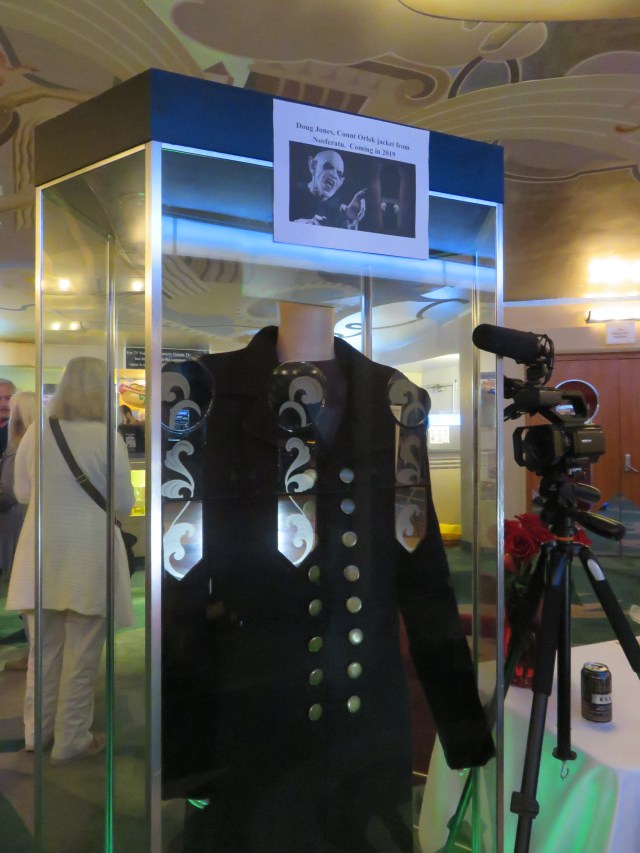
The original costume worn by Doug Jones as Orlok from the forthcoming movie, Nosferatu,, scheduled to be released in 2019. Photo taken at the lobby of the Orinda Theatre. Photo by Marcus Siu.

DREAM ROLE & UPCOMING FILM

After having played so many monsters and creatures, Jones had just one dream role left…

“If you asked me ten years ago, what’s the one role you haven’t played yet you really would love to?”  My answer was “I haven’t played a proper vampire yet…I want fangs…I want to be a classic vampire…I’m too old and gross to play a young sparkly vampire.  Jones continued.  “Who’s old and gross? “Nosferatu!”.”

As chance would have it, Jones would get a call from Director David Lee Fisher, who did a 2005 remake of one of the first original German horror silent films, “The Cabinet of Dr. Caligari” that was shot over a hundred years ago; in which the remake updates the silent film with sound and dialogue.  He called to see if Jones wanted to play the lead role in his upcoming project, “Nosferatu”.  Little did Fisher know this was Jones’ absolute dream role was to play Count Orlok in “Nosferatu”.

“What’s really special…is the film in the background is all shot in green screen and the original footage from shot nearly 100 years ago will be all in the background.” Zemrak added, who came on board as one of the producers of the film, as well.

Jones also added, “not only did I get to play that character that I longed to play, but I got to play in the environment that Max Schreck got to play in.”

Something tells me with the enthusiasm and amazing talent of Doug Jones, this new and upcoming “Nosferatu” won’t suck.

The California Independent Film Festival continues this week:  https://www.caiff.org/


Posted in Entertainment | Tagged , , , , , , , , , , | Leave a comment

SHURE SOUNDS LIKE HEAVEN: THE KSE1200 ELECTROSTATIC EARPHONE SYSTEM

DSC_5644

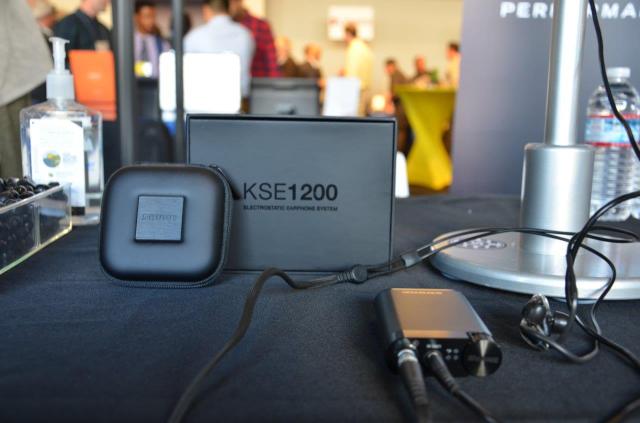
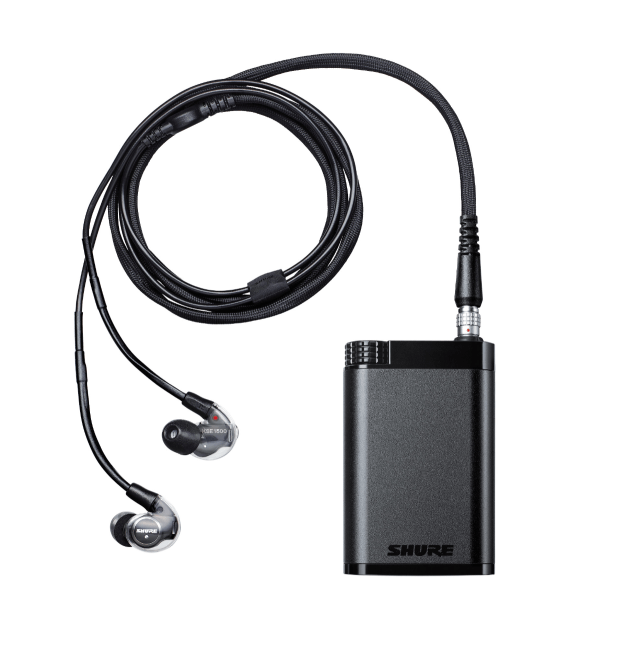
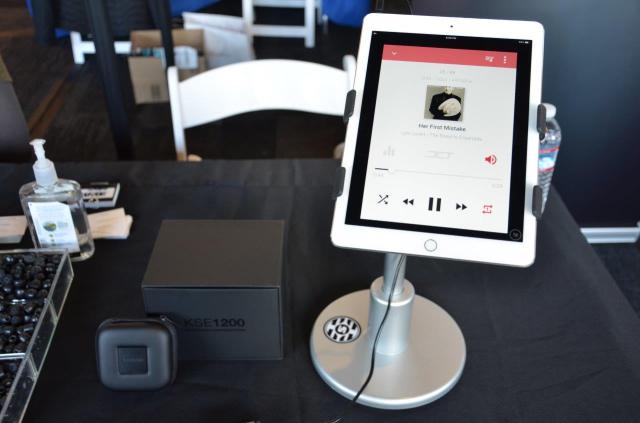
Shure’s KSE1200 portable Electrostatic Earphone System shown at the Pepcom Show in San Francisco. Photo by Marcus Siu

Article and photos by Marcus Siu

Most consumers who listen to music through their personal devices don’t hear much of the nuance and detail that was meticulously crafted and constructed during the recording process in the studios.  Sure, they “listen” to their music through their headsets and enjoy it enough to sing and keep listening to it, but they really don’t “hear” the highly detailed and immersive sounds which recording engineers have meticulously captured.

There is quite a lot lost during the journey from that was faithfully recorded initially in the music studio to the path of the consumer’s ears.

At the most recent Pepcom Digital Experience show in San Francisco, some of the most cutting edge companies displayed their latest mobility wares, and featured a few audiophile manufacturers thrown into the mix, which was a refreshing change. Problem was that some of the companies couldn’t instantaneously demonstrate how good their audio products were since the surrounding booths would drown each other out and no one would be able to hear anything in the room.

Luckily, at the Shure booth, they didn’t have that issue.  Their audio demo was quite minimalist with a table that included an iPad attached to their KSE1200 analog Electrostatic Earphone System.

DSC_5646

Lyle Lovett’s “Her First Mistake” was the first demo from the Shure booth. Photo by Marcus Siu

When I put those little earphones on, the sound was so pure and lifelike that I felt I was put right in the actual recording studio alongside with singer Lyle Lovett and his band.  I could hear every little acoustic detail from his band, along with every breath that Lyle took while singing.  This demonstrated to me that this is as honest as music is going to get.  Even coming from the mainstream iPad, it was still unbelievable that the sound could sound so true.

My initial impression was how could something so light and small put out such detailed and realistic lifelike sound coming from these tiny little 5.8 ounce earphones?  It was disbelief for me for the first few minutes, and then I just surrendered to the music and just could not stop listening.

Not only that, but these lightweight earphones were extremely comfortable.  There was never an issue with “headphone fatigue” like other headphones I have tried on before.  After the first minute or so, I almost forgot I had them in my ears all together once I started hearing the music.

I really got into the music while I was moving and a grooving.  I was gettin’ down like James Brown and I’m sure the other fellow journalists around me probably thought I was a nut or just overreacting around the Shure booth to get some attention, but I was most certainly not.

I was so immersed with the music making that was produced through this system and was listening carefully to hear if I could discover any imperfections at all, which never happened.  This is as close to hear what the sound engineers hear in the studio.  Nothing to obstruct between your ears and the music.  It was just me and the music.  Pure and simple.

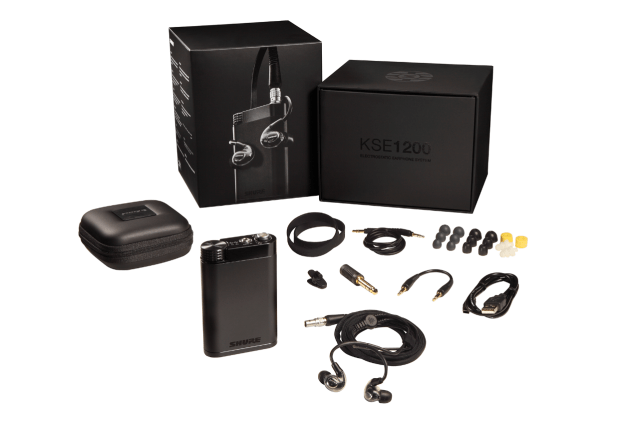
Actually, the KSE1200 Electrostatic Earphone Systems aren’t new with Shure.  According to Sean Sullivan, who gave me the demo in the booth, he explained that the Shure KSE1200 is the second product in Shure’s lineup of the Electrostatic Earphone Systems, but is the same system as the Shure KSE1500 (list price $2999) that included the same electrostatic amplifier and earphones, except that the KSE1500’s amplifier included a digital front end (a DAC; a screen on it, and also a DSP built into it).

KSE1200_System_On-White

Photo courtesy of Shure

“So many people starting using the KSE1500 ($2999 list) with the analog input, but the price was still a hurdle for that.  The KSE1500, and now the KSE1200 both have an analogue input and the same circuity, literally the exact same electrostatic earphones for $1,000 less. Takes all of the digital front end and stream additional components out of the mix that people really already have in their players these days,”  Sullivan noted.

Nowadays, most people don’t need the additional components that were built into the KSE1500 system, since many media devices already have these components built in.  Bypassing these items, Shure was able to release the KSE1200 for $1000 less.  Especially that more than ever, common everyday media players have started sending digital audio out from their devices.  More and more of these players that have been coming out allows you to store massive lossless files already have great components, such as DACs,  already built right into them.

At $1,000 less, it becomes a pretty good deal.  Especially, if you happened to have heard the KSE1500’s when they first came out a few years ago.

But what makes these earphones extremely special compared to all the other ones out there is the electrostatic circuitry technology.  This is why these headphones sound like no other.

“The earphone themselves are driven differently than a standard speaker…so, in your dynamic speaker; you have your magnet, you have your coil, you have your diaphragm…all of that has a relative mass to it…and as fast as it could move, we’re so used to using these speakers…they produce really good sound, don’t get me wrong…”, Sullivan explains

KSE1200_LIFESTYLE_HERO

At 5.8 ounces, music will never be “lightweight” ever again. Photo courtesy of Shure.

“however, the electrostatic driver is compiled of a massless diaphragm that literally weighs nothing.  It has a DC charge on it, and there are two plates that hold the audio signals at plus or minus 200 volts.  Those plates are placed right next to each other, but not touching and they create the electrostatic energy field between them.  The diaphragm is suspended between those, and because it’s massless, it moves as fast as that energy field can move, so there is no magnet or coil that has to force back and forth.,, the result is the fastest diaphragm, best transient response, clarity in detail…out of this world.”

I couldn’t agree more.  It sounded out of this world…and I felt like I was transported to heaven, but went back to earth after taking the earphones off.

Once you go to heaven, it’s tough going back.

KSE1200_SKU

Photo courtesy of Shure

Posted in Entertainment, Technology | Tagged , , , , , , | Leave a comment

11TH ANNUAL INTERSOLAR EVENT OPENS AND HONORS GOV BROWN WITH THE CHAMPION OF CHANGE LIFETIME ACHIEVEMENT AWARD

DSC_6084

California Gov. Edmund G. Brown Jr. was honored with the Champion of Change Lifetime Achievement AWARD, presented in partnership with the California Solar and Storage Association.  Photo by Marcus Siu.

Photos by Marcus Siu

SAN FRANCISCO, July 10, 2018 – Intersolar and ees North America, the premier solar and energy storage exhibition and conference in North America, today welcomed an expected 15,000 attendees to San Francisco’s Moscone Center. Located in the heart of the U.S. solar and storage markets, the event offers more than 40 conference sessions and workshops, exhibitor presentations on two stages, and numerous networking opportunities that connect leaders in the solar, storage and smart renewable energy industries.

A packed room was on hand for this morning’s Opening Ceremony, which featured keynote speakers Dr. Elaine Ulrich, senior advisor to the U.S. Department of Energy, and Tony Seba, author and Silicon Valley entrepreneur.

The keynote speakers reflected on the continued growth across the solar and storage industries, spurred by technology developments and groundbreaking policies. Dr. Ulrich also reminded attendees of how collaboration accelerates efforts to bring valuable technologies and services to the new energy economy.

“This industry is incredibly innovative and we’re excited about the future we’ll see together,” noted Dr. Ulrich. “We know that industry partnerships are the cornerstone of our success. Without broad industry-wide participation, we would not be where we are today.”

Mr. Seba focused on how smart energy technologies are enabling a major shift in the automotive industry, drawing parallels between the evolution of telecommunications and the electrification of the transportation sector.

DSC_6126

Tony Seba, author and Silicon Valley entrepreneur at Intersolar Press Conference.  Photo by Marcus Siu.

“By 2030, because of pure economics, every building, house, device, will have a battery,” he said. “That is going to enable another disruption: the electric vehicle disruption. By 2025, if this cost curve persists, essentially every new vehicle will be electric.”

During the Opening Ceremony, California Gov. Edmund G. Brown Jr. was honored with the Champion of Change Lifetime Achievement AWARD, presented in partnership with the California Solar and Storage Association  (CALSSA), for his unwavering commitment to solar industry advocacy over the past three decades. Bernadette Del Chiaro, executive director of CALSSA, presented the award, and commended Gov. Brown for his dedication to the advancement of solar throughout California.

“Many of you remember [Gov. Brown’s] first foray into solar back in the 1980s. He was supporting our technology way before anyone else saw the potential for it,” said Del Chiaro. “During his first term in 2011, we had 2 GW of solar in California. Today, we have 10 times that.”

Gov. Brown described Intersolar as a “gathering that can re-inspire so many innovators” before thanking organizers for the award. He went on to note: “It is California that is setting the pace. And yet we ourselves have so much more to do. Recognize, celebrate what we’ve done, but never for a moment think we are close to the goal – we have miles and miles to go.”

The Intersolar and ees North America exhibitions will showcase the latest trends in solar PV, energy storage, and smart renewable energy in six exhibition segments. With approximately 450 international companies present on the exhibition floor, attendees will gain early access to some of the most innovative solar and energy storage technologies being brought to market from across the industry value chain. The co-located conferences will feature over 170 influential speakers who will share their insights into market dynamics and opportunities for growth in 2018.

Solar and energy storage installations in the United States continue to set records and demonstrate their economic viability. According to GTM Research, 55 percent of all new electric generating capacity brought online in the U.S. in Q1 2018 came from solar. Solar installations are forecasted to reach 104 GW this year – moving forward, annual installations in the U.S. are expected to exceed the 100 GW threshold through at least 2022. The U.S. energy storage market is estimated to grow 17 times from 2017 to 2023, while the solar-plus-storage annual market is expected to reach 2.2 GW by 2023.

Focus on Smart Renewable Energy Previews Next Major Industry Development  

Increasingly, utilities worldwide are looking for smarter ways to manage renewable assets, including solar, energy storage technologies, and rising energy demand from electric vehicles (EVs). A recent report from the Rocky Mountain Institute projected that 2.9 million EVs will hit the roads by 2022, adding over 11,000 gigawatt-hours of electricity demand to electric grids across the globe.

Reflecting its commitment to anticipating industry trends, ees North America debuted the Power2Drive conference track, which features four sessions on managing the storage and infrastructure demands of the electrification of transportation. An exclusive white paper from GTM Research, “Grid Edge Innovation – Technologies, Business Models and the Future of Demand Flexibility,” offered further discussion on these trends, as well as the market potential for solar-plus-storage. The paper is available for download at http://www.intersolar.us> News & Press > White Paper.

DSC_6109

Governor Brown addresses the crowd at the 11th Annual Intersolar Conference. Photo by Marcus Siu


Posted in Technology, Uncategorized | Tagged , , , , | Leave a comment

The IRIScan Wireless Mouse Scanner; the New Mighty Mouse

Product review by Marcus Siu

Just like Superman who disguises himself as a mild-mannered spectacled newspaper reporter from “The Daily Planet” newspaper, easily blending in with the citizens of Metropolis as Clark Kent, the IRIScan Mouse Wifi  in comparison seems to be a typical mouse blended in among an all too overcrowded world of accessories.

Clark Kent may “look” somewhat awkward and unintimidating at times to the people around him, but that is just him masquerading as Superman, just like this seven-ounce IRIScan Mouse does well, acting as an all-in-one scanner and wireless mouse with super powers.

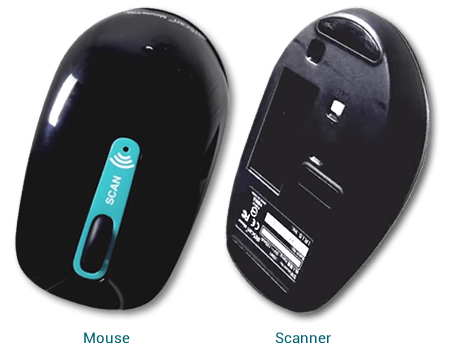
When observing the IRIScan mouse side by side next to a laptop, there is nothing extraordinary about it when comparing other wireless mice.  It scrolls, like a mouse, it, clicks like a mouse, and moves every which way just like a typical midsize mouse should.  With its standard three mouse buttons and dialing wheel, it’s quite mild-mannered, just like Clark Kent, and it functions quite well for an everyday mouse.

Like Superman’s “x-ray vision”, the IRIScan mouse, has similar super powers and can suddenly transform itself to become a scanner within seconds from the touch of a button.  Located on the bottom interior, its glass plate is free to roam and glide anywhere due to its wireless capability. It features a 1,500-dpi optical sensor which can create a scan with a resolution of up to 400 dpi for crisp, sharp documents using Slam Scan Technology, which is designed to allow users to scan documents up to A3 (11.7 x 16.5″) in size in a single bound.  This IRIScan mouse has super powers that are “out of this world.  
INSTALLING THE SOFTWARE

Without the software, this mouse would have no super powers.  It’s the IRIScan and CardIris software and the hardware that makes this lithium chargeable mouse mighty unlike no other.

The first thing you need to do is to insert the dongle into the USB port of your computer and then install the IRIScan Mouse Wi-Fi software.  Once the software is installed, you will have some very powerful tools that will make it easy to make to convert and edit into different files.  By the touch of the button on the top of the mouse, the software loads the program onto your screen and immediately you are ready to scan.

THE SCANNING PROCESS: FREEHAND VS SCANPAD

To test the initial scanning of the IRIScan mouse, I grabbed a few items around the office; a credit card and credit card receipt, a business card, a film festival program, a political campaign mailer measuring 8.5”x11, as well as a CD jacket cover.  I even took a bound music book to see if I could copy a page of music without having to crease the spine.

As I was scanning each of these items by hand, I began to realize that I didn’t have a smooth flat surface to work with, making it difficult to get a good initial scan from my documents.  In addition, it was a tricky process, as I had to secure the documents using one hand and scan with the other.  If the document was larger than my hand, than it would be difficult to get a good scan because of the documents not being securely held down.  

As it turned out, I was still able to create perfect scans of the credit card receipt, business card, and CD jacket cover.  I also was able to take capture a portion of the the film festival program containing a picture from the movie and the corresponding text description of it.  However, I found myself having to rescan or “repaint” the spots that I initially missed.  Luckily, they were small enough, so it wasn’t too troublesome.

Larger documents, especially if it contained both text and a photo on them, were more involving and definitely tested my patience, though I finally got the results I needed after several attempts keeping the document flat and still.  I managed to scan a whole page of piano music from a bounded book perfectly, but that also took some practice to get to get it right.

As with the 8 ½“x 11” campaign flyer that included a slogan in the picture, I had absolutely no luck in scanning it in successfully.  IRIScan even attempted to correct it through its OCR recognition, but as I rescanned the spots I had missed, it ran out of memory before completion of the image.  It’s as though I was re-painting over the painted picture over and over without ever getting it just right.

Even with IRIScan’s capability to scan up to A3, it was very difficult to get the output to perfection, even with its OCR capability.   My initial impression after freehand scanning was that this was way too much trouble for what it is worth, even for small documents, but that was before I realized that IRIScan included a ScanPad in the packaging.

IRIScan ScanPad
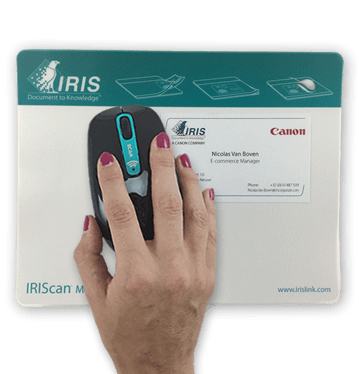
The 4”x7” ScanPad includes a clear plastic cover that you can use to place over your document before scanning, allowing the mouse to scan over the documents with ease while holding the documents securely.  This was the perfect solution making scanning very simple and quick for smaller documents.  The ScanPad was a pure “life saver” and was a joy to re-scan all of those documents that I previously did freehand, which was finished in seconds.

I suggest this ScanPad should always be used with the IRIScan mouse scanner.

It even scanned a credit card that wasn’t completely flat because of the numbers protruding, which made the scan a little bumpy.  The results were still perfect as it just took two swipes. Impressive indeed.

For larger documents that do not fit in the ScanPad, I was curious to know if a larger size ScanPad would have taken care of this issue had IRIScan included it in their package.  If so, I gladly would have paid for the extra cost.

THE CONVERSION, EDIT, AND SHARING PROCESS

Once you have captured what you needed to have scanned with the touch of the button, it will automatically capture it and convert it by straightening it and applying a suggested crop that you can resize.  It does a wonderful job allowing you to crop off the excess that you don’t need.  Usually there is no need to rotate the document, as well. The software is very intuitive and user friendly during the editing process.

As soon as you are ready to save the editable document, it uses an embedded OCR (Optical Character Recognition) solution that supports well over 130 different languages that will identify text and allow users to easily copy and paste it into their most used applications, such as Microsoft Office, Adobe Acrobat, or even Apple.  You can convert your scanned document into a TXT, XLS, or even an PDF, and since OCR is being utilized by the software, you can fully edit your text, whether it’s a Word, Notepad, Excel, or an Acrobat reader document. 

Also, if you are scanning business cards, through CardIris, it will convert into digital contacts filling out the regular fields through OCR.  Though not 100% perfect, you will still save a massive amount of time, since they are all editable fields.  From there, you can save them into your Outlook, Gmail, etc.

If you are scanning a picture, you have your choice of choosing a JPG, TIFF, or even BMP format you can export it as a fully editable PDF or text file compatible with popular text and spreadsheet editors. Once saved, you can also have it backed easily on to your personal cloud hosting service (Dropbox, Evernote, Google Translate.) with just a click. This mouse scanner also lets you share pictures or drawings from your children with friends and families on Facebook and/or Twitter.

This must be one of the most ingenious innovative ideas in quite a while and this mouse has some super powers that no other mouse has ever seen.


While the IRIScan Mouse WiFi may not replace your scanning equipment, it will supplement them by being able to scan documents that would not normally be used by a typical flatbed or feedable scanner, such as pages from bound magazines, books or music scores, due to its bulkiness.  It will also make scanning smaller documents much easier and convenient, especially when on the road with your MousePad.  However, if you have two-sided scanning to do, I would recommend a portable scanner.

A wonderful selling point of this mouse is its’ mobility features.  This will appeal to those who travel for work and who collects many business cards and needs to update his contacts frequently onto his computer, as well as scanning receipts for his expense reports for a timely reimbursement from his employer.  If you bring your MousePad with you to scan documents, everything will scan perfectly and it will be much quicker to edit, if needed.  No longer will you need to type in text from a document.

If you have items larger than 4”x7”, you may have probably issues with it by not being able to scan perfectly the first time, though it might help to find a a completely smooth non-glare surface such as a clear deskpad that you can put documents under to scan so there wouldn’t be any movement.  One of the challenges that I face is that paper moves, and it is difficult for the scanner to “paint” the document.  It is best if the documents don’t move and stay as flat on the surface as possible.  It also helps if the surface holds the paper down and is on a blank white neutral background.

This is simply not just a regular mouse, but supplemented by its useful software is a powerful all-in-one wireless mighty mouse scanner.

Faster than a speeding bullet, stronger than a locomotive, able to jump tall buildings in A single bound

… It’s a mouse…Its a scanner, It’s “IRIScan Mouse!

Though, I’m not sure why they didn’t provide the IRIScan Mouse with a cape.

Article by Marcus Siu 

 

Posted in Technology, Uncategorized | Tagged , , , , , | Leave a comment

NEED MEMORY IN A FLASH? KINGSTON INTRODUCES THE CANVAS FLASH SERIES


canvasfamily_preview

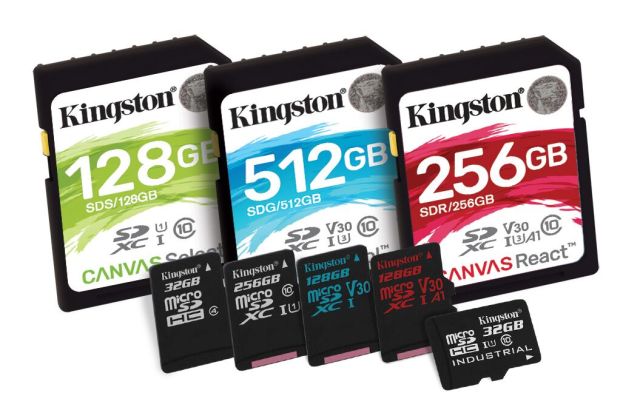
The Canvas line of Flash Cards, available in SD & Micro SD formats.    Courtesy of Kingston Technologies.

Article by Marcus Siu
Before the days of HD video becoming popular and when point and shoot cameras were the main reason why consumers bought SD cards, memory card companies designated speed classes with numbers 1-10 on them.  If a card was rated a “4”, then it meant 4 MB per second.  If it was rated a “10”, then it meant 10 MB per second.

At that time, “ten” was the absolute best.

Then hi-speed camera, HD video, and smartphones came into the picture and the speed class system seemed to be somewhat outdated since it is now very difficult to find a card that is less than a “ten”.  It seems like they have been extinct, except those sold at the Dollar Store.  Therefore another type of classification was introduced onto the flash cards; the UHS-I Speed class, which stands for “Ultra High Speed”.

Now that pretty much all the SD cards are rated a “ten” and “HD” has gone mainstream,  the question comes up… how much speed do you need from an SD card for your device?

Currently there is a UHS-I Speed 1, which is perfect for full HD videos and 3D video, and UHS-I Speed 3, which is for 4K, full 1080p HD video and burst-mode action photography.

With so many different brands and product lines, it has always been confusing to know which card to choose and to know how fast an SD card you really need.   Now with their “Canvas” line that was just introduced in March, Kingston Technology has made it so much easier for the average consumer to buy SD cards in the marketplace.

DSC_5639

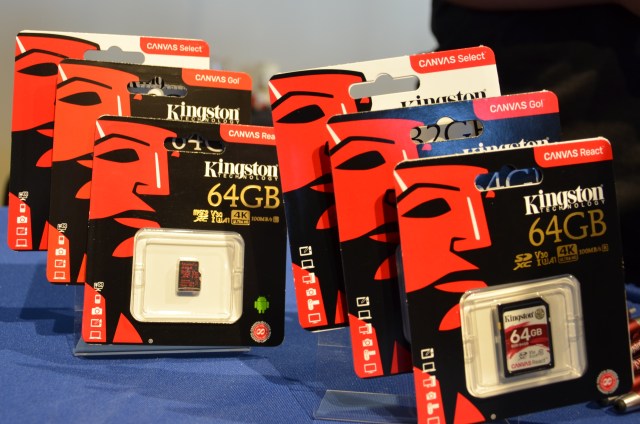
The Canvas series comes in SD or Micro SD formats with the “React”, “Go!”, and “Select” on display at Pepcom’s “Digital Experience” in San Francisco.   Photo by Marcus Siu.

The new “Canvas” line (from top to bottom) is “Canvas React” (in gold lettering), “Canvas Go” (in silver lettering), and “Canvas Select” (in black lettering).

In other words, “great”, “even greater” and “absolute best”.

As a photographer and videographer, it is absolutely crucial to choose the right SD card for your camera equipment.  As I’m shooting in HD video and bursting photo shots at a moving subject with my camera, I need to find an appropriate card that writes as fast as my camera shoots, so I would be ensured of getting all the footage that I intended without any unpleasant surprises.

If your SD card doesn’t have a high enough speed, it will stop recording video since the camera will pause and the video clip will abruptly end due to the slower speed of the SD card and the faster speed of the camera.  This has happened to me on many occasions and I was blaming the camera for it at the time.  Now I know better about the technical limitations of SD cards.

For people like me, who use high end DSLR’s, mirrorless cameras and 4K video, then Patriot’s “Canvas React” is optimum, with it’s amazing 100 mb read speed, and even more impressive 80 mb write speed.   It’s amazing that it almost writes as fast as it reads.

However, if I am shopping for an SD card just for my mom, who just takes pictures from her Kodak point and shoot camera, so there is no need to get the absolute best for her $59 economy camera.  In her case, the “Canvas Select” would be the appropriate choice.

For specifications click on the link below:

https://www.kingston.com/us/flash/sd_cards


Posted in Technology | Tagged , , , , | Leave a comment