
THERE’S NO SNUBBING IN HOLLYWOOD! OR IS THERE?

Article by Marcus Siu

Ryan Gosling, Margot Robbie and Greta Gerwig on the set of “Barbie”. Courtesy of Warner Bros.

“It’s definitely not a good look that the Academy members left out Greta Gerwig and Margot Robbie for directing and starring in a movie that’s largely about how impressive women are often marginalized,” says Dave Karger, Turner Classic Movies host and author of 50 Oscar Nights.

That quote was taken from an article from People Magazine. Karger, along with many others were very surprised about the recent Barbie “snubs” after the Academy Award nominations were announced; mainly the exclusion of director, Greta Gerwig not receiving a Best Director nomination and its star, Margot Robbie, not getting a Best Actress nomination, playing the title role in “Barbie”.

Even co-star Ryan Gosling who played Ken spoke out, as one of the two supporting actors who received nominations in the supporting categories for the movie, “To say that I’m disappointed that they are not nominated in their respective categories would be an understatement,” he said about the pair. Gosling added that he was “extremely honored to be nominated”, the three time Oscar nominee concluded, “there is no Ken without Barbie. And there is no Barbie movie without Greta Gerwig and Margot Robbie.”

Though, I certainly agree Gerwig is worthy of a nomination in the Best Director category, it’s very difficult to argue that any of the other five were less deserving, as the Academy has gotten to be very “global”. In fact, out of the five nominated, only one of them is American; ten time Oscar nominated, Martin Scorsese for “Killers of the Flower Moon”. The other four are European.

One can certainly make an argument in saying that all of the following American directors were “snubbed”: Alexander Payne for “The Holdovers”, Bradley Cooper for “Maestro”, Cord Jefferson for “American Fiction”, first timer, Celine Song for “Past Lives”, and Ava duVernay for “Origins”.

However, just like the Olympics, we are not just competing exclusively in domestic waters anymore. The Academy has become very global in the last ten years ever since the #OscarsSoWhite movement that promoted diversity. International films and filmmakers are becoming more recognized more than ever.

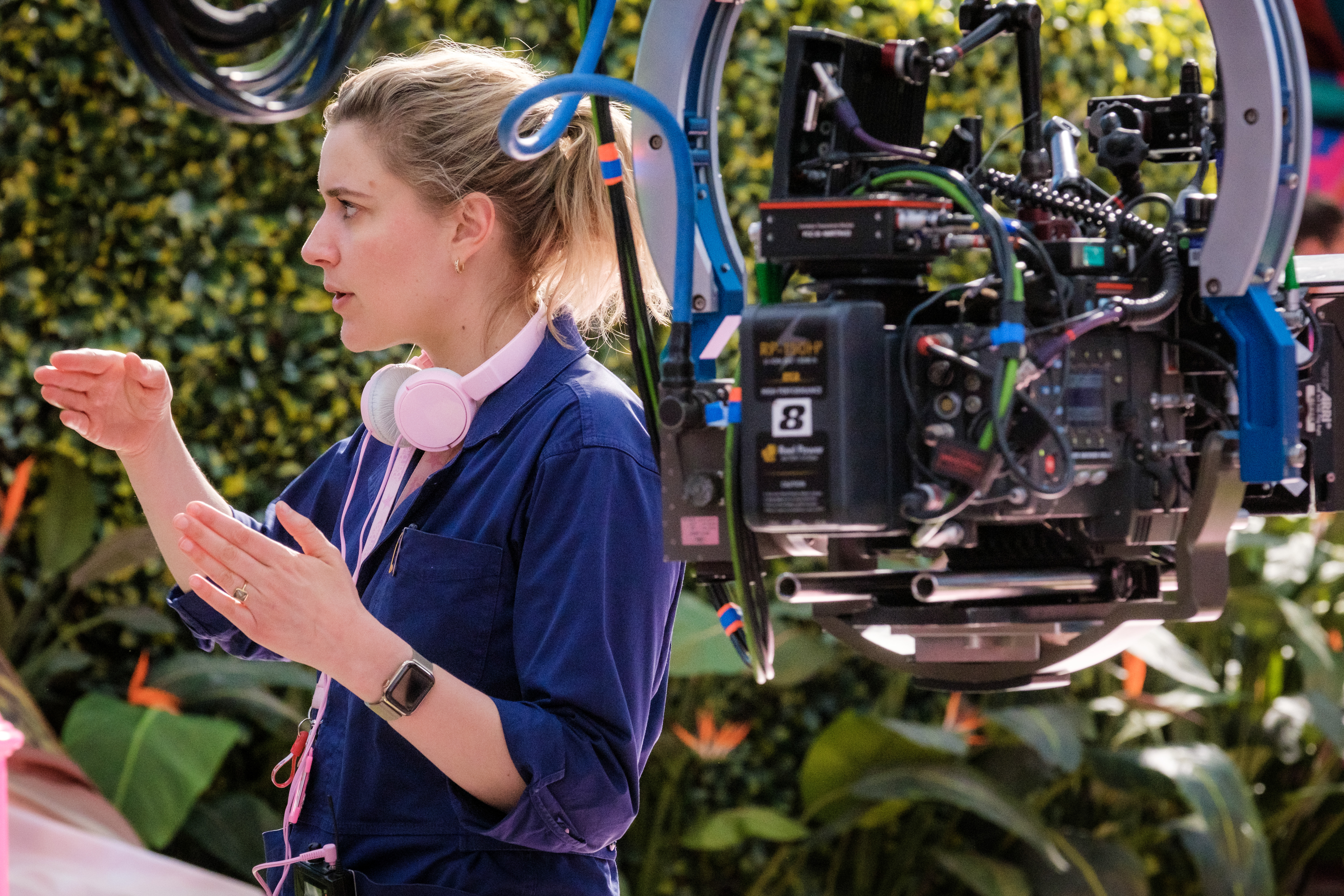
Director Greta Gerwig on the set of “Barbie”. Courtesy of Warner Bros.

There are 587 directors in the Academy Branch. If you look over the nominated directors over the years and the films they have been nominated for, they tend to be more dramatic and less comedic, with scripts whose characters inspire and move them and keeping their audiences at the edge of their seats.

“Barbie” doesn’t quite fit in that category. 

Despite being a pop culture phenomenon that swept the box office by storm, taking in nearly 1.5 billion dollars globally, making it the highest grossing film of 2023, and the 14th of all time, “Barbie” is still bravura filmmaking from Greta Gerwig’s creative vision sending a “positive” message to all girls and women alike around the world. It’s a modern day women’s lib movie. It’s also the kind of movie that the public needs and wants to see.

The only other box office smash of recent times in comparison that comes to mind with having such a huge inspirational social impact like “Barbie” was Marvel’s “Black Panther” which empowered both black men and women alike. That film made 1.4 billion dollars globally and is in the Top 20 all-time list, but even director, Ryan Coogler wasn’t up for a nomination either.

In response to Margot Robbie not getting the nomination for Best Actress,..it’s not “snubbery” at all.

The Actor’s branch tend to nominate actors who takes risks and challenges with scripts that require a full range of human emotions that plastic doll characters cannot possibly possess. The Actor’s branch know Robbie can act in biopics, such as Tonya Harding (I, Tonya) or even a caricature of one, such as Kayla Pospisil (Bombshell) in which she received Academy Award nominations for, but they don’t generally recognize actors who don’t need to transform themselves much. What is the challenge in that?

Margot Robbie personifies “Barbie”. She looks and sounds like “Barbie”, so you don’t need to be a brain surgeon to have cast her in the title role, since she is “Barbie” in real life. She was made for “Barbie”…or should I say “Barbie” was made for her.

Which is why, Ryan Gosling got the nomination. He overshadowed Robbie in just about every scene they were in together. Before the movie was in production, everyone questioned and even doubted the casting of Gosling to portray Ken. It just seemed like a bad choice. No one questioned the casting of Margot Robbie. When the movie was finally released those doubts were thrown out the window. Pure casting genius.

Ryan Gosling, Margot Robbie and Greta Gerwig on the set of “Barbie”. Courtesy of Warner Bros.

If you still want to play the “snub” game, you don’t have to look far at all to notice the other incredible performances who were left out of this year’s race. For the Best Actress category, it wasn’t just Margot Robbie who didn’t make the cut, but Greta Lee (Past Lives), Fantasia Barrino (The Color Purple), Julianne Moore and Natalie Portman (May December). 

If there are any snubs in Hollywood, it would be for actors who have the portray “bad people”. For example, Leonard diCaprio, in another unforgettable role plays “the white man” who plots to kill his Native American wife, Molly (Lily Gladstone), in “Killer’s of the Flower Moon”.

Julianne Moore and Natalie Portman from “May December” didn’t get nominations either. Is it because Moore plays a pedaphile and Portman, who plays an actress in the movie, wants to portray her in her own movie?

Still, with Barbie’s astounding eight Oscar nominations, including Best Picture, Gerwig and Robbie deservedly still got Oscar nominations, since they were both producers of the film, so they weren’t totally snubbed by the Academy as a whole…and they certainly were not snubbed by the movie going public who made it the most popular movie of 2023.

As far as the word “snub”. It’s just a four-letter word and should be used sparingly. 90% of the time, I feel it is used inappapropriately, especially when it comes to the Oscar season.

If I had to choose the “perfect snub”, I would have to choose Paul Giamatti’s snub for Best Actor for his performance in the 2003 film “Sideways”. The film was nominated for five Academy Awards, including two for Best Supporting Actor and Actress, screenplay, and Director, Alexander Payne.

Perhaps the Academy thought he was playing himself? Perhaps he will get payback for “The Holdovers”.

Posted in Entertainment | Tagged , , , , , , , , , , , , , , , , , , , , , , , , , , , , , , , , , , | Leave a comment

THE DOCUMENTARY OF THE YEAR THAT MIGHT NOT HAVE BEEN MADE: 20 DAYS OF MARIUPOL

20 DAYS IN MARIUPOL
directed, produced and filmed by MSTYSLAV CHERNOV. Courtesy of PBS

Article by Marcus Siu

When watching the evening news every night on television with its almost repetitive nature of headlines covering yet another senseless mass killing somewhere in the U.S, I often hear criticism from others claiming there is hardly any media coverage in other parts of the world whose acts are even more tragic and horrific. 

This is true, especially in those countries that do not represent human rights and whose brutal leaders do not want the “truth” to be exposed, especially when they are hiding possible war crimes. Such is the case in Ukraine, with the Russian invasion of the city of Mariupol.

The public takes it for granted that media covers just about everything with the utmost detail in the free world, but in reality, they have very little knowledge of what types of obstacles that journalists are up against in many corners of the world. Media certainly has its limitations with communications and can possibly spread misinformation or even disinformation that follows a propaganda agenda.

This is why director Mstyslav Chernov made “20 Days of Mariupol”.

“20 Days of Mariupol” is one of those rare films that shows the challenges that war-journalists have to face. Chernov, who also produced and shot the film, gives us a humanistic, yet non-sympathetic first person perspective of the ongoing crisis span during the first twenty days of the Russia-Ukraine war that your nightly news cannot possibly summarize, even if they had all of the footage sent to them on a timely basis each night for the broadcast.

Chernov had forty minutes of his footage published on television, but still had a good thirty hours of unused footage that would be used for the source of his documentary, which won the Audience Award for World Cinema Documentary at the Sundance Film Festival nearly a year ago.

“I wanted to do more with that because the scale was so huge and you can’t really show that with news pieces”, Chernov continues, “We live in age of not just misinformation but misinterpretation…to persist that misinterpretation we need much more context for better understanding in the audience.”

“That’s where documentary films are becoming to be so important that they they give more than just one or two minute news pieces which can be overwhelming, but still you see them and you forget”, Cerno explained. “I kept meeting people who escaped from Mariupol who carried this city within them, but the city was did not exist anymore, so the city was just there in in their hearts. Making this film was also a way to to preserve it as it was being bombed and destroyed, but still existed. It was the way to preserve Mariupol in history, as well”.

Along with Chernov, the film documents his AP (Associated Press) team of Ukrainian journalists trapped in the besieged city of Mariupol as they struggle to continue their work documenting atrocities of the Russian invasion. As the only international reporters who remain in the city, they capture what later become defining images of the war: dying children, mass graves, the bombing of a maternity hospital, and more. 

The film also draws on Chernov’s daily news dispatches and personal footage of his own country at war. It offers a vivid, harrowing account of civilians caught in the siege, as well as a window into what it’s like to report from a conflict zone, and the impact of such journalism around the globe.

Chernov also serves as the narrator of the film and in spite of its subject matter, he does so in a calm fashionable manner. This was done after he realized he was imposing his emotions to the audience on the first take. His team agreed that his narration should sound like he would in a normal conversation, regardless of what was on screen. His narration reminds me of how Werner Herzog would narrate as an effective storyteller in his films, and it worked extremely well for this documentary.

Courtesy of PBS

Chernov initially emerged in 2008 as a fine arts photographer shooting in as many as forty different countries and winning awards all around the world. In 2013, he became the President of the Ukrainian Association of Professional Photographers (UAPF) and eventually started documentary multi-format (photo/video/text) working in journalism for the Associated Press, as well as being a war correspondent covering international conflicts and novelist known for his coverage of the Revolution of Dignity, War in Donbas, the downing of flight MH17, Syrian civil war, and the Battle of Mosul in Iraq.

He recently received the Pulitzer Prize for his work, shared with Evgeniy Maloletka, Vasilisa Stepanenko, and Lori Hinnant, for the Ukraine coverage. In addition, “20 Days of Mariupol” had just been selected last week as one of the fifteen shortlisted films to be elgible for the Academy Award for Documentary Feature film, as well as being shortlisted for International Feature film representing the country of Ukraine.

Unlike most documentaries, it is free to stream and accessible to everyone on YouTube above. It is also available on the PBS app. and is also available on DVD. Regardless of its bleak nature, this is essential viewing for everyone.

(L-R) Rick Goldsmith interviews Director Mstyslav Chernov at a screening of “20 Days of Mariupol” in San Francisco. Photo by Marcus Siu.

Posted in Entertainment | Tagged , , , , , , , , , , , , | Leave a comment

THE ONGOING BATTLE BETWEEN MOVIE STUDIOS AND STREAMING COMPANIES

Epic movies such as Napoleon needs the big screen experience. Courtesy of Apple TV+

Article by Marcus Siu

Does anyone remember the good old days when families would gather together at the dinner table and interact with each other in meaningful conversations? The same days when we get our news through printed newspapers that were delivered to people’s homes everyday, along with watching real news broadcasts on local TV? The same days when newly released movies were exclusively only shown in movie theaters?

Times have certainly changed.

The difference between the past and the present is that is we were all connected through human interaction instead of connected through a user interface of a computer device. Back then, there was no internet, no cell phones, no computers, and no tablets to distract our plain and simple lives.

Who would have thought that before PC’s became mainstream that the classic Eagles song lyrics to “Hotel California” would be even more meaningful than it was when it was originally released over forty years ago – “we are just all prisoners of our own device”. Certainly that sure rings true more than ever before.

As technology changed, so did the way we consumed our movies. You can see it with each brand new generation over the years. No one would have ever thought thirty years ago, that kids these days would prefer to watch movies on their iPhones than have an immersive personal and social experience at a movie theater with their friends.

Certainly, the great epic cinematic directors of the past, like David Lean and Stanley Kubrick never would have imagined that people would be able to watch their classic films, “Lawrence of Arabia” or “2001: A Space Odyssey” on a small device, such as a smartphone, but I would think they would be turning over their grave if they overheard someone saying that they watched their entire film while waiting at the DMV, but due to the movie’s length, had to recharge their smartphone battery in the middle of it…because it was too long.

Both “2001: A Space Odyssey”and “Lawrence of Arabia” was shot in Panavision in 70mm. Movies like that were made to be socially experienced on the big screen. The great movie theaters that displayed them, like the legendary iconic Cinerama Dome in Hollywood were the “chosen” few where the masses would wait in line for hours for the total larger than life experience. That’s how epic filmmakers initally intended to present it.

Unfortunately for movie theaters, which are becoming more extinct each day, the majority of the movie going audience shifted toward streaming services. You can partially blame it on the studios lack of original content and focusing on movies based on the Marvel Comic Universe, studio franchises (Mission Impossible, Fast and the Furious), and remakes that have been done numerous times. There is just not much offering to a demographic that wants originality.

I mean, really, do we really need another “Willy Wonka” movie?

Barbie became Warner Brothers highest grossing movie ever. Courtesy of Warner Bros.

However, there is hope as witnessed by last summer. Moviegoers flocked back to the movie theaters, thanks to the “Barbenheimer” nationwide phenomena that saved movie theaters from a potentially dreadful year at the box office.

Barbie became Warner Brother’s highest grossing movie ever both domestically and globally raking in over $1.4 billion. It is also became number 11 in the all-time top ten box office, passing the “Avenger’s End Game” and helped boost the R-rated “Oppenheimer” box office ticket sales as the campaign encouraged a much younger demographic audience to want to see it.

Now with the serious fall movie offerings finally upon us, the studios are finally showing some of their aces to hopefully grab some Oscar nominations. Many of these are from” streaming studios that normally don’t have limited or wide release theatrical showings.

Netflix’s “Maestro”, “May December” and “Nyad”, Amazon’s “American Fiction” and “Rustin”, and Apple’s “Flower and the Killer Moon”, and “Napoleon”, just to name a few, will most likely get nominations for numerous awards, as well as for Best Picture.

However, it looks like out of all the streaming services, Apple is the only company that is capitalizing on nationwide theatrical releases. “Killers of the Flower Moon” has already raked in over $150 million at the box office. “Napoleon” is it’s second week and has already made $78.8 million. Both films have greatly benefited through large film formats, such as IMAX.

With both films costing $200 million to make, it is not necessary for their box office revenue numbers to surpass it. Ironically, Apple never really intended their movies to generate as much as it did. Hopefully, they will continue showing their films in theaters before streaming in onto their platform, but only time will tell.

As a side note, director Ridley Scott who used 11 to 14 cameras and shot “Napoleon” in just 62 days, is currently editing a four hour version cut that focuses more on Josephine Bonaparte, played by Vanessa Kirby. It will be streamed on AppleTV+ at a later date and you can bet fans of Scott will want to see both versions.

Overall, it doesn’t really seem like much of a risk for Apple to throw in gigantic production budgets to bonafide caliber directors with a great track record. We, as an audience, can experience a more accurate portrayal of their true vision on screen. Along with $200 million dollar budgets to play with along with and total creative control, you can bet the world’s greatest directors, such as Scorcese or Scott, will give you your moneys worth on the big screen at your local theater…

…but maybe not so much on a smartphone, though.

Posted in Entertainment, Technology | Tagged , , , , , , , , , , , , , , , , , | Leave a comment

META’S LATEST NEXT-GEN RAY BAN SMART-GLASSES CAN MAKE ANYONE A SMART-PERSON

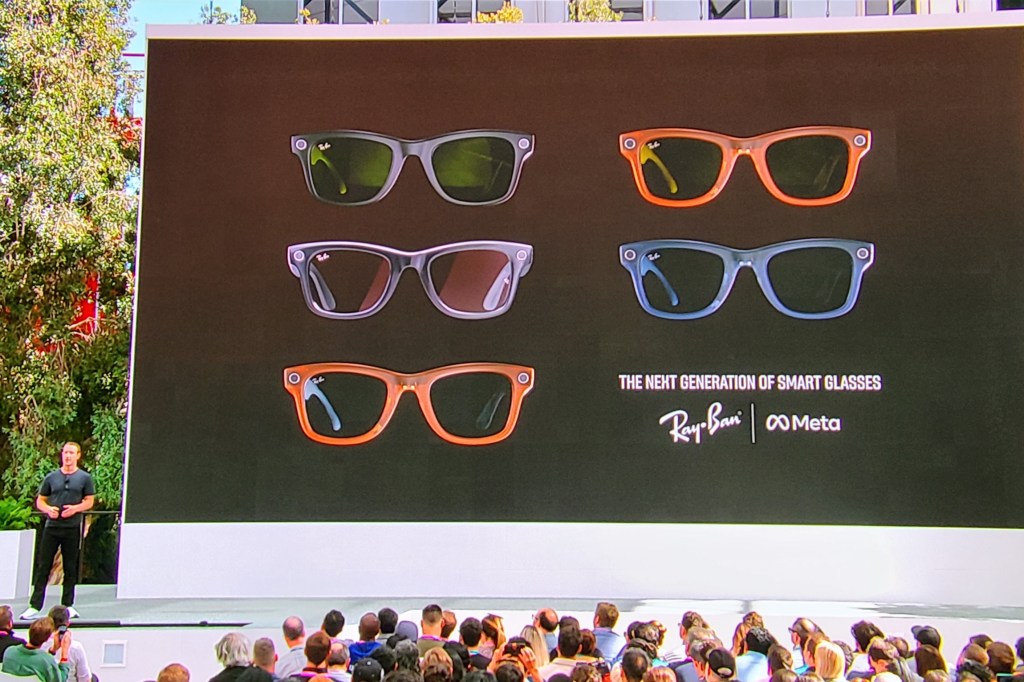
Meta’s CEO Mark Zuckerberg addresses the crowd at the Meta Connect Keynote on 9/27/23. Photo by Marcus Siu.

Article by Marcus Siu

Do you remember the scene in the classic 1999 science fiction thriller film “The Matrix”, when Neo (Keanu Reeves) asks Trinity (Carrie Anne Moss) if she could fly the “B-21 2” helicopter, and she responds “not yet” and makes a phone call to Tank, the operator. and says, “Tank, I need a pilot program for a B-21/2 helicopter. … Hurry!” As Tank searches the program and uploads it into Trinity’s mind, Trinity re-opens her eyes, and says to Neo, “let’s go!”.

Don’t we all wish we could do something magical like that?

As Neo and Trinity fly in the helicopter to save their friend Morpheus, wouldn’t it be great to be able to experience first hand to what they are experiencing with their own eyes and ears? Maybe, even in real time?

Well, Meta’s latest Ray Ban smart-glasses seem to be heading in that direction with their latest next-gen Meta Ray Ban smart-glasses but instead of using “Tank” as the operator, the operator is “Meta”…and yes, you can now experience someone else’s POV experience with the new smart-glasses through live streaming with the help of Meta A.I.

Though, you might not be able to fly a helicopter immediately like Trinity did in “The Matrix” with Meta’s smart-glasses, you might be able to do simpler things that you might not have been able to do in the past. For example, you will be soon be able to fix a leaky faucet…but more on that later.

Compared to the first generation of Meta smart-glasses, “Ray Ban Stories”, which Meta introduced two years ago, it’s latest model is quite a huge leap forward in technological specs and design.

The next-gen model has a superior 12MP camera that produces superior images with its 1080p HD video, powered by a Qualcomm Snapdragon AR1 Gen1 Platform, all-new custom designed speakers with extended bass two times more powerful than the original, 50% higher maximum volume, and improved directional audio that provides reduced audio leakage for improved calls, music, and podcasts — even in noisy or windy environments.

The new design of the microphone has a five microphone array, which captures the sound exactly how it was experienced, so you can relive your experience anytime you want. They are a lot lighter in weight, so they are much more comfortable then its predecessor.

Amidst the much improved physical and technical specifications, the real selling point, though is its Meta A.I. These next-gen smart-glasses are the very first Meta smart-glasses to include Meta A.I. in them.

I think that’s smart glasses are gonna be an important platform for the future, not only because they’re the natural way to put holograms in the world and put digital objects in our physical space but also because smart glasses are the ideal form factor for you to let an A.I. see what you’re seeing and hear what you’re hearing…” Mark Zuckerberg

Presently, in its present form – right out of the box, Meta smart-glasses users are able to ask basic A.I. questions, recommendations or even translations, just as Google or Alexa would answer, except you would address the name as “Meta”. However, because the glasses are much more portable with you while wearing them where ever you go, as opposed to having to be near a Google Home or Amazon Alexa device, it will always be much more convenient to utilize Meta A.I. because you can always be connected where ever you go…

But that’s just the beginning of Meta A.I.

Next year, according to Meta’s co-founder and CEO, Mark Zuckerberg, Meta is planning on issuing a freeware update which will make the Meta smart-glasses multimodal, which means the Meta A.I. assistant will understand what you are looking at while you are asking your question. Examples include having Meta A.I. identify a building, landmark or monument that you are looking at and giving you a brief history or description of it, just like a personal tour guide would, or translating an international sign not in English and translating it for you, and of course that I mentioned earlier, looking at a leaky faucet and asking how to fix it.

Continuous updates will just only make it smarter and smarter.

“Multimodal” will be the latest word for next years update for the Meta/Ray Ban glasses. Photo by Marcus Siu

Even after seventy five years, the classic Ray-Ban Wayfarer glasses never seemed to go out of style. They were made famous by iconic Hollywood stars such as James Dean in “Rebel Without a Cause”, Audrey Hepburn in “Breakfast at Tiffany”, Tom Cruise in “Risky Business”, and not to mention Will Smith and Tommy Lee Jones from the “Men in Black” movie franchise.

Meta added Ray-Ban’s “Headliner” line glasses to their new lineup smart-glasses, for those who prefer a more retro-style design. They even come with prescription glasses, for those who already wear glasses. Overall, there are at least 150 different combination/options you can choose from that Ray Ban has to offer.

I was lucky enough to experience a full demo of the the Ray Ban/Meta glasses at Meta Connect last month. I was quite impressed and believe Zuckerberg will probably be correct in predicting that Meta A.I. smart-glasses will be the next big platform for the masses.

It’s incredible what we can do with it in its compact form: listening to music, podcasts or just taking phone calls. Considering the smart-glasses weigh only 1.7 ounces, the speakers, even when outside, sound surprisingly clear and accurate. Also, the sound doesn’t drown out the physical environment noise around you. It seems to blend naturally into the physical soundscape.

With five microphones, it will seamlessly record what you are experiencing as realistically, as possible. The multichannel surround is not just coming from the left-right side, but in front and from behind, and to the sides, adding to its immersive realism during playback. I was able to playback my recorded experience and felt that I was reliving it all over again. Talk about deja vu.

Without even touching a button on the smart-glasses, all the user has to say now is, “Meta, shoot photo” or “Meta, shoot video”, or even “Meta, send photo to mom” while wearing Meta’s smart-glasses. It shoots exactly what you see through your glasses (POV) and captures and sends the experience on command. As an option, you can also live-stream it in real time to your friends or audience on Instagram or Facebook.

Gone are the days of abruptly fumbling with ones smartphone and trying to locate the camera (or video) app for that quick photo that they don’t want to miss.

Sharing an experiencing going down a ski slope, or hiking trip, or on top of a mountain will bring brand new immersive experiences to others. Other experiences that might be great to document would be meeting a person for the first time, or going through a petting zoo, or just walking through a crowd of people in the street. The possibilities are endless…though, we are limited to up to 60 seconds of HD video. Of course, birthday parties, weddings, graduations or any traditional gatherings of any kind are always welcome, as well.

Up to 32GB of storage can be saved. which is equivalent to 500 photos or one hundred 30 second HD video clips. The camera shoots in portrait mode, and has video stabilization built in.

Thanks to Meta A.I., exciting times are ahead of us for wannabe helicopter pilots and plumbers.

The many selections that you can choose from on display at Meta Connect 2023. Photo by Marcus Siu.
Posted in Entertainment, Technology | Tagged , , , , , , , , , , , , , , , , , , , , | Leave a comment

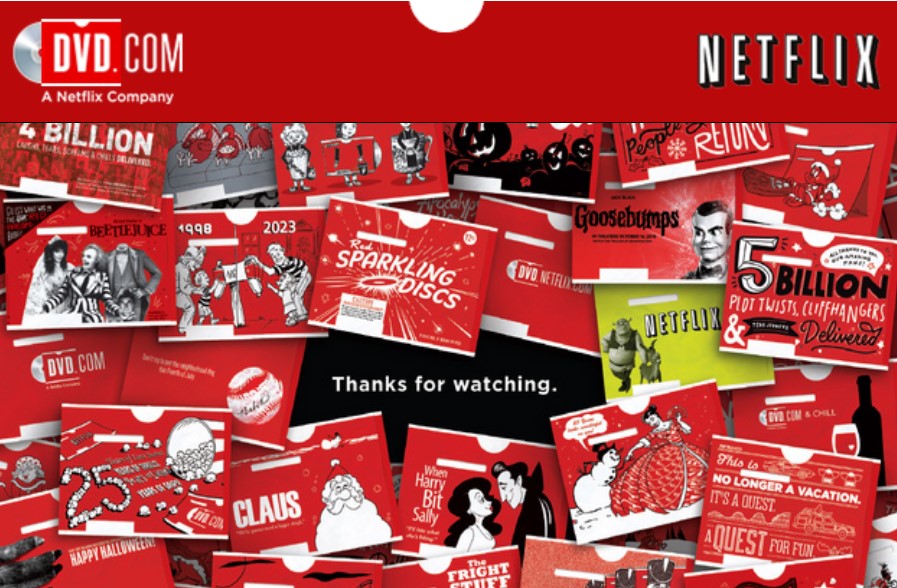
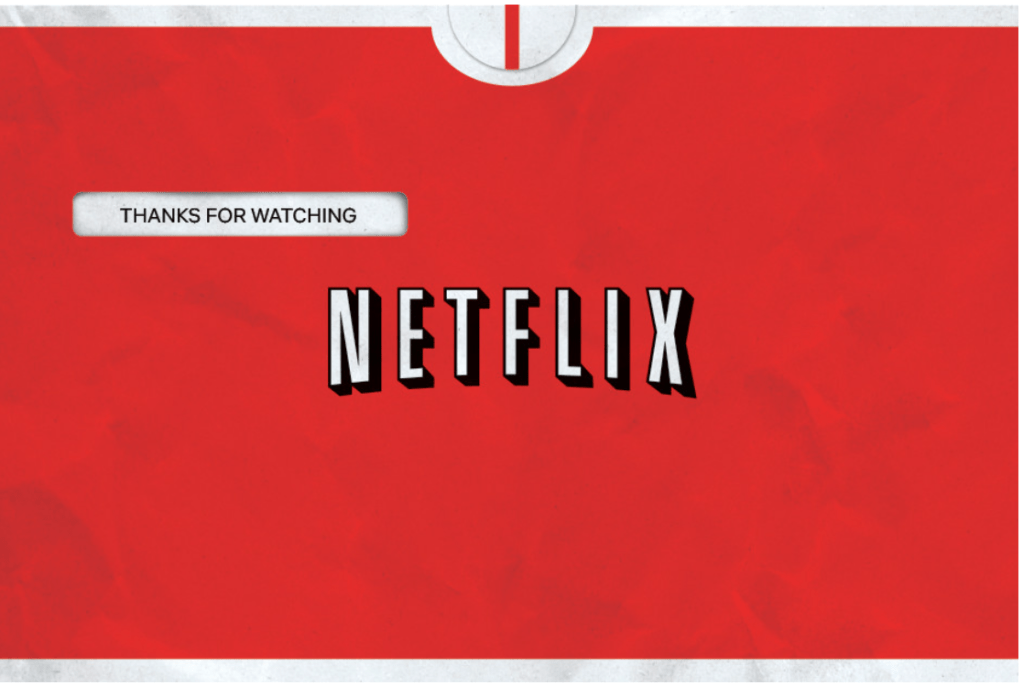
FAREWELL TO 25 YEARS OF RED ENVELOPES MAILBOXES WILL NEVER BE THE SAME

Netflix ends its DVD rental business

Article by Marcus Siu

September 29th marks a very sad day for the remaining one million loyal Netflix DVD subscribers including myself. Unfortunately, but not surprisingly, the company announced earlier this year to pull the plug and close its DVD rental operations.

Needless to say, the DVD rental business for the company had been dwindling down ever since its streaming services became the primary choice for its subscribers all over the world and disrupted the video and movie industry.

To give you an idea, Netflix’s DVD revenue totaled $60 million for the first six months of 2023. In comparison, Netflix’s streaming revenue in the United States for the same period reached $6.5 billion. In 2022, the DVD business generated $145.7 million, down 20% year-over-year, which represented just 0.5% of its total revenue. That’s just half of one percent!

In their early beginnings in 1998, they couldn’t have chosen a more opportune time to get into the DVD rental business. DVD’s were at the beginning of their popularity. It also was the perfect format to ship and mail off to millions of customers due to its light weight and size. They wouldn’t have been very profitable during the days of VHS and Beta. Could you imagine Netflix stuffings bulky VHS or Beta tapes in the mail to make it in the video rental business to try to make a profit?

Instead of wasting time and gas and driving back and forth to rent and return the movies to brick and mortar video stores, customers only had to deal with their mailboxes with Netflix. They also had the luxury of returning it anytime, without any late fee to any mailbox. To many customers who are habitually late in returning their DVD rentals, it was a blessing.

Netflix was the primary reason why Blockbuster Video went out of business in 2010, along with the many independent mom and pop video stores that was virtually in nearly every neighborhood.

Nowadays, it’s unfathomable to even think that people actually made special trips back and forth to a video store just to rent and return a video.

As a Netflix subscriber, I had two gripes. There was no way to filter down movie titles that were only available in blu-ray when searching thru their inventory. The other issue that I had was trying to figure out what version of the movie that I would get if there was a title that had been released multiple times, I wouldn’t be able to tell which version of the movie I would get. Customer service was useless with those issues.

But, overall, I will miss this wonderful service.

Netflix not only changed our lives forever with the good old “red envelope” rental subscription for a good ten to fifteen years, but also with the introduction of their streaming services in 2007 it changed the world and the way we watched movies.

But is that a good thing?

Sure there are lots of great popular shows that are currently streaming on Netflix, but unfortunately the number of streaming titles in their catalog are very limited and cannot compete with the number of titles in the Netflix DVD catalog. Netflix streams about 4,000 titles at any given time, but during the peak of DVD rentals ten years ago, there were as many as 100,000 titles to choose from when DVD rental subscription peaked with over 20 million subscribers before streaming was even an option.

With their former DVD subscription, it was great to be able to search their vast inventory ranging from not just blockbuster feature films, but TV shows, documentaries, foreign films, and even music performances and videos. In addition, I loved being able to watch the extras and bonus features that were included on the DVD’s.

After mailing over five billion DVD’s and Blu-ray’s envelopes since 1998, Netflix has come to the end of an era for DVD rentals, but it certainly has been a great twenty five year run for Netflix and its appreciative customers, such as myself. It was a major part of my life.

In the future, I hope Netflix will realize that there is a demand for their own titles that should be released to home media. I do see some hope as “The Irishman” did get a release on the Criterion label, but would love to see more Netflix releases, such as “Squid Game” get a release, as well.

If they decide against releasing their movies to retail, they could at least compromise and have more special supplements streamable, like they did for “The Irishman”, with a Q&A session. I still want to know how certain movies were made along with a behind the scenes featurette, and watch interviews and commentaries with the filmmakers.

Now with my Netflix DVD subscription coming to an end, I may be forced to change my viewing habits and subscribe to their streaming services, but I know I will absolutely miss seeing Netflix’s red envelope in my mailbox every few days.

It’s like losing a good friend…

Posted in Entertainment, Technology | Tagged , , , , , , , | 1 Comment

COMING SOON TO A 2024 TV NEAR YOU – INTRODUCING DOLBY ATMOS FLEXCONNECT


Dolby Atmos FlexConnect, a first coming to TCL TVs in 2024, is setting a new benchmark for TV sound
.
Courtesy of Dolby Laboratories.

Article by Marcus Siu

Exciting news from Dolby Laboratories this week, as they just announced their latest innovation in immersive audio – Dolby Atmos FlexConnect. Dolby has partnered TCL, who will be the first to implement Dolby Atmos FlexConnect into its 2024 TV lineup.

This would mean that consumers will actually have the option of not having to buy a sound bar with their new TV’s, which have become almost mandatory since flat panel screens were introduced twenty five years ago, as these TV’s rarely had great sound systems built into them to begin with.

Dolby Atmos FlexConnect is a new feature that seamlessly pairs together a TV’s sound system, with accessory wireless speakers to unlock a more extensive and immersive Dolby Atmos sound experience. It then intelligently optimizes the sound for any room layout and speaker setup, transforming any seat into the best seat in the house. TCL will also launch a line of accessory wireless speakers designed to complement its upcoming lineup of TVs with Dolby Atmos FlexConnect.

What does this mean to your average consumer? To many housewives who prefer a living room, rather than a living room surrounded by mammoth speakers, cables and wires, it means not having to bitch to their home-theater husbands, “it’s either you or your home theater” ultimatum. That can be quite consoling to the average family household.

Consumers no longer need to trade aesthetic appeal for sound performance. Thanks to Dolby Atmos FlexConnect ‘s calibration technology, there is no need to reconfigure existing living spaces. Once calibrated, the system combines each accessory device with the TV’s speakers to unlock the best sound performance and deliver a great Dolby Atmos sound experience tailored to the listener’s home. Sound systems will assume the speakers are set in reference locations.

There will also be no need to move the surrounding furniture equidistant to where your living room sofa, coffee table and TV are located, that your typical home theater setup requires. The freedom of keeping that perfectly designed space before the very thought of adding a home theater, strategically having to deal with speaker placement of the rear speakers or surrounds is no longer an issue.

Also, imagine the luxury of not having to deal with speaker wires or HDMI cables going across the floor that A/V receivers need to deal with. Accidents will be prevented. No more tripping over the speaker wires that you thought were concealed enough not to be noticed. Even the location of power outlets will no longer be an issue.

“Consumers shouldn’t have to move their furniture to experience better audio, but rather audio should adapt to them,” said John Couling, Senior Vice President, Entertainment, Dolby Laboratories. “Dolby Atmos FlexConnect is an entirely new category of experience that offers consumers the freedom and flexibility to choose how they want to arrange their devices while still getting a great immersive Dolby Atmos experience.”

“We are very proud to take a significant step forward on the future of immersive audio with our latest partnership with Dolby. Delivering great experiences for our customers is at the forefront of what we do,” said Frédéric Langin, Chief Commercial Officer, TCL Europe. “With Dolby Atmos FlexConnect, users can unlock incredible immersive sound no matter how they arrange their audio devices. We can’t wait to introduce the world to this new tailored sound experience with our upcoming lineup of TVs and accessory wireless speakers.”

According to Dolby, FlexConnect will be able to adapt to various different types of speakers, even if they’re made by different brands. It gives speaker makers lots of freedom to come up with different device combinations and form factors, Dolby added, so we could see some interesting new audio devices appear in support of the technology. 

With Dolby Atmos FlexConnect, listeners will be drawn deeper into their favorite entertainment, fully immersing them in sound through the simplicity of their TV’s sound system and complementing speakers.

Posted in Entertainment, Technology | Tagged , , , , | Leave a comment

THE BEST WAY TO EXPERIENCE OPPENHEIMER IS ON IMAX 70MM – IT’S DA BOMB!

Article by Marcus Siu

Christopher Nolan on the set of “Oppenheimer” Photo courtesy of Universal Pictures

“IMAX film brings images to life. From resolution and color to sharpness and overall quality, there is nothing compared to using IMAX film cameras. The IMAX film format is the Gold Standard of motion picture photography. Christopher Nolan

If you just saw “Oppenheimer” during it’s opening weekend, but haven’t seen “Oppenheimer” in one of the thirty theaters in the world equipped to play IMAX 70mm, then you haven’t seen “Oppenheimer” the way it was meant to be seen.

Director, Christopher Nolan, first started utilizing IMAX 70mm film cameras with his 2008 blockbuster film, “Batman – The Dark Knight”. It was the first major motion picture to utilize this technology. There was an additional 28 minutes of IMAX footage beginning with the intense opening bank robbery scene that wowed movie audiences. The movie went on to break box-office records, including sold out IMAX screenings many weeks in advance.

Since then, he has continued to favor IMAX cameras and went on to shoot “Batman – The Dark Night Rises”, “Interstellar”, “Dunkirk”, “Tenet”, and his latest, “Oppenheimer”, which also led to the development of the first ever black and white IMAX film stock, which Kodak made and Fotokem developed.

Nolan has become IMAX’s auteur director and ambassador for the technology, pushing boundaries of movie going experiences to brand new levels. He has redefined the word, “immersion” for moviegoers everywhere.

Photo courtesy of Universal Pictures

WHAT IS IMAX 70mm?

IMAX 70mm is basically a large format film used in 65mm film cameras, with its extra 5mm allocated to the soundtrack. 70mm film was popular back in the day with epic movies like 2001: A Space Odyssey and Lawrence of Arabia. The only difference is that the celluloid has been turned sideways. While typical 70mm motion picture film runs vertically and takes up 5 perforations on the film strip, IMAX runs horizontally and takes up 15 perforations. Which means IMAX 70mm standard is three times bigger than normal 70mm and nine times bigger than 35mm film.

The film reel for the three hour “Oppenheimer”, film is massive. It is over 11 miles long and weighs 600 pounds, which is near the maximum capacity an IMAX 70mm projector could possibly hold. These projectors have what’s referred to as a platter, which is the mechanism used in projectors to hold and feed the large-format film reels during projection. It consists of a circular plate that holds the film reel securely and rotates it as the film is projected onto the screen.

“It’s the highest-quality of imaging format ever devised. It gives you an incredible sense of immersion in the image. The clarity, the crispness…it is the gold standard”, Nolan continued, “It’s the closest reproduction of the world the way that your eye sees it”.

Photo courtesy of Universal Pictures

In IMAX theaters, for example, you will probably notice at any time there are no black bars at the top and bottom of the screen. More than likely, that will be an IMAX scene that was shot with an IMAX film camera which will expand vertically filling the screen with more information on a massive square screen with the screen disappearing right in front of you. The ratio changes to 1.43:1, which is just a little wider than an old fashioned TV set before widescreen TV’s were around.

Nowadays, when we visit the multiplex, we have the option of seeing the latest blockbuster film in an IMAX auditorium. As for the movie going public, many don’t really know what IMAX is, but they assume that by paying for very expensive premium ticket prices and the larger theater auditoriums, they figure they are getting the best possible presentation possible. However, many of the Hollywood movies that play in IMAX venues doesn’t even come close to what the IMAX experience should be about, since no IMAX cameras or film stock was even used.

Even Tom Cruise’s latest “Mission Impossible – Dead Reckoning – Part One“, that played nine days on IMAX screens prior to the “Oppenheimer” opening, used no IMAX film or cameras at all during the production, just a Sony certified IMAX camera for some of the action sequences. In addition, the entire film is framed in a 2:39:1 ratio, which means the IMAX screen never is fully utilized.

It’s arguable that some the studio films that play in IMAX theaters shouldn’t even play there, even if they transferred the film onto an IMAX format. It’s even arguable that some of the reformatted IMAX theaters should even exist.

However, with the release of any Christopher Nolan movie, it is pretty much guaranteed that they will get the best possible presentation that you can possibly offer.

“Oppenheimer” playing on IMAX 70mm, will be da bomb.

Below is a listing of all the U.S. theatres with the IMAX 70mm format. If you have one in your state, consider yourself very lucky, but good luck getting a good seat, as most of these screenings are just about sold out.

US theatres:

  1. Harkins Arizona Mills 25 & IMAX – Tempe, AZ
  2. AMC Metreon 16 & IMAX – San Francisco, CA
  3. Universal Cinema AMC at CityWalk Hollywood & IMAX – Universal City, CA
  4. TCL Chinese Theater IMAX – Hollywood CA
  5. Regal Edwards Ontario Palace & IMAX – Ontario, CA
  6. Regal Irvine Spectrum 21 + IMAX – Irvine CA
  7. Esquire IMAX – Sacramento, CA
  8. Regal Hacienda Crossings & IMAX – Dublin, CA
  9. AutoNation IMAX, Museum of Discovery & Science – Fort Lauderdale, FL
  10. Regal Mall of Georgia & IMAX – Buford, GA
  11. IMAX Theatre at Indiana State Museum – Indianapolis, IN
  12. Chrysler IMAX Dome Theatre, Michigan Science Center – Detroit, MI
  13. Celebration! Cinema Grand Rapids North & IMAX – Grand Rapids, MI
  14. AMC Lincoln Square 13 & IMAX – New York, NY
  15. Regal UA King of Prussia & IMAX – King of Prussia, PA
  16. Providence Place Cinemas 16 and IMAX – Providence,  RI
  17. AMC Rivercenter 11 & IMAX – San Antonio, TX
  18. Cinemark 17 & IMAX – Dallas, TX
  19. Regal Opry Mills & IMAX – Nashville, TN
Posted in Entertainment, Technology | Tagged , , , , , , , | Leave a comment

THE LATEST NETFLIX TRAILER HAS NOTHING TO DO WITH MOVIES – GAMES PEOPLE PLAY

Article by Marcus Siu

Now that Netflix officially announced they are retiring their iconic DVD red envelope mailing service this September after twenty five years, cementing “streaming” as the number one choice from their 250 million subscriber base from around the world, it seems they are striving other ways to “stretch the envelope” and continue to venture into a new directions.

Most of us think of Netflix as just a company that streams movies, but they are a lot more than that. They have been developing their own programming globally and are the envy of all traditional movie and TV studios since they produce their own content, as well as distribute them, as well.

In 2021, Netflix had an astounding 36 Academy Award nominations and won seven of them, which was most than any other movie studio. Netflix also won more Emmys than any other network or studio with 44 in 2021, tying CBS back in 1974. They have totally changed the way we watch TV and movies everywhere.

With all this success, most people didn’t even know that they had launched Netflix Games back in November 2021. There was not much of a marketing campaign or any fanfare to alert the public.

At this year’s Games Developer’s Conference (GDC 2023), Netflix announced that they had more games in their pipeline. They were planning to release even more games to their subscribers, though the content would still continue to only be played on mobile devices, such as smartphones and tablets. They have followed the likes of Google Play Pass and Apple Arcade.

As of late June, Netflix had released 60 games, with about 30 more slated for later this year and many more in development with their partners, as well as games currently being developed by their in-house game studios.

Netflix’s goal is to develop a broad portfolio of games for everyone’s tastes in different genres and formats. Their motto is they believe that “everyone can find joy in games if they discover the one (or many!) that is right for them.” 

Subscribers will discover indie darlings, award-winning hits, RPGs, narrative adventures, puzzle games, chess wizzes to LEGO aficionados and everything in between, and Netflix continue to work with the world’s leading studios.

One of their most-played games to date is from, Too Hot to Handle: Love is a Game, which is based on their popular unscripted dating show, Too Hot to Handle. It was a popular game when it was released alongside Season 4 of the series and stay engaged through the weekly drops of in-game episodes. A follow-up Too Hot to Handle game is expected to be released later this year.

COMING THIS SUMMER:

OXENFREE II: Lost Signals (July 12): 

From Night School, a Netflix Game Studio, OXENFREE II: Lost Signals is the mind-bending follow-up to the critically-acclaimed supernatural thriller OXENFREE. Set five years after the events of the first game, the game will take players on a gripping narrative-driven adventure featuring an all-new cast of characters and original story. OXENFREE II: Lost Signals is set to launch on July 12 on the Nintendo Switch, PlayStation 5 & 4, PC and Mac via STEAM, and exclusively for Netflix members on mobile.

The Queen’s Gambit Chess (July 25)

Welcome to Beth Harmon’s world. Take lessons, play puzzles and matches or compete against friends in this stunning love letter to the award-winning drama. Beyond the chess board, players can meet familiar faces like Mr. Shaibel and Borgov, visit iconic locations including Beth’s house, the Methuen orphanage, the Las Vegas tournament, and more. From new beginners to chess masters, this immersive experience appeals to every type of fan. Available exclusively for Netflix members. 

Cut the Rope Daily (August 1):

The legendary Om Nom is back — and craving candy! In this new twist on the classic Cut the Rope game that has been downloaded more than 1.6 billion times, players will cut rope, collect stars and pop balloons to feed the beloved green monster with a sweet tooth in this puzzle game featuring physics-based gameplay. For the first time ever, Cut the Rope Daily offers a new puzzle to solve every day. Available exclusively for Netflix members.


LEGO® Legacy: Heroes Unboxed (Coming Soon):

LEGO Legacy: Heroes Unboxed lets players collect and playfully battle with more than 50 characters from over 40 years of LEGO minifigure history. Bringing together characters old and new, this game gives LEGO fans a new way to play with the characters that they know and love. Build imaginative sets and assemble a team of familiar faces — from Hot Dog Man to Princess Argenta and more — to immerse yourself in a world full of action in this strategic battle RPG. Available exclusively for Netflix members.

Paper Trail (Coming Soon):

Paper Trail is a top-down puzzle adventure about leaving home, set in a paper world. Players must fold their way through a diverse, populated paper universe. As players progress, new gameplay opportunities emerge, enhanced by the folding mechanics. Featuring fun and engaging characters and beautiful worlds to explore, this indie gem has already won more than 10 awards. Available exclusively on mobile for Netflix members. Also coming to Nintendo Switch, PlayStation 5 & 4, PC, and Xbox Series X|S. 

Maybe one day, we will be able to see their games along with their TV shows and movies on their streaming platform. However, it might take awhile for that to happen.

Posted in Entertainment, Technology | Tagged , , , , , , , , , , , , | Leave a comment

THE SHADOWS AND LIGHT OF A.I. – THE LATEST SECURITY CHALLENGES AT RSA 2023

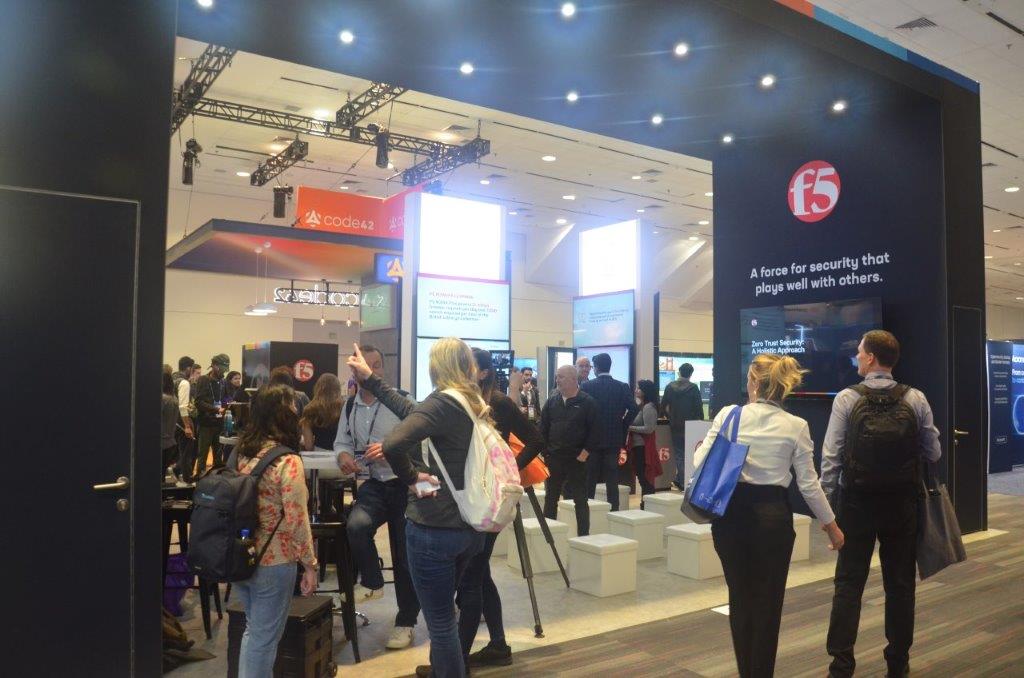
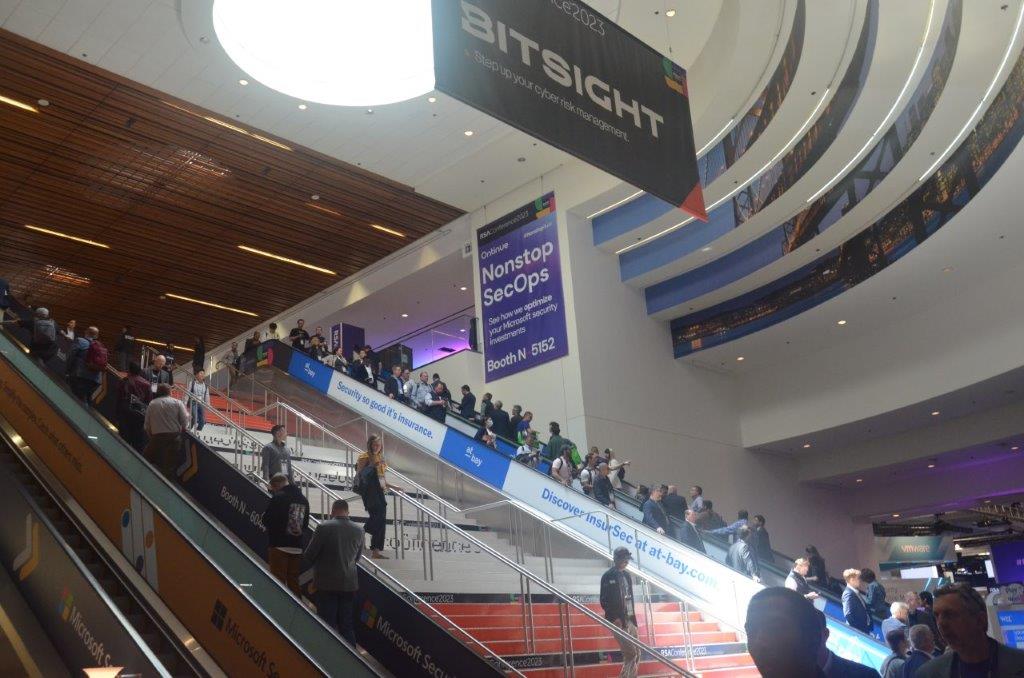
RSA 2023 Conference attendees walking to and from the shadows and light at Moscone North and South. Photo by Marcus Siu.

 Article by Marcus Siu

One doesn’t need to look far at all to see how A.I. has grown, especially generative A.I. Just within five days of its November 2022 launch, one million users downloaded ChatGPT, a natural language processing tool driven by A.I. technology that allows one to chat or interact and have human-like conversations with their computer devices and smartphones. In addition, it is able to design, produce new content and even create synthetic data, or deepfakes through machine learning. There are now an estimated 100 million active users using ChatGPT, making it the fastest growing app ever and making. A.I. accessible to the masses and will certainly change the world as we know it.

It was also the recurring principal theme at the RSA Conference last month. At this stage, A.I. is just “the beginning of the beginning of the beginning” as many of the RSA panelists describe it. It will not only play an integral principal role in world of cybersecurity, but all facets of science and technology in our environment. Though, A.I. has been around for awhile, this year looks like when it will suddenly emerge as the most disruptive technology creating an A.I. revolution.

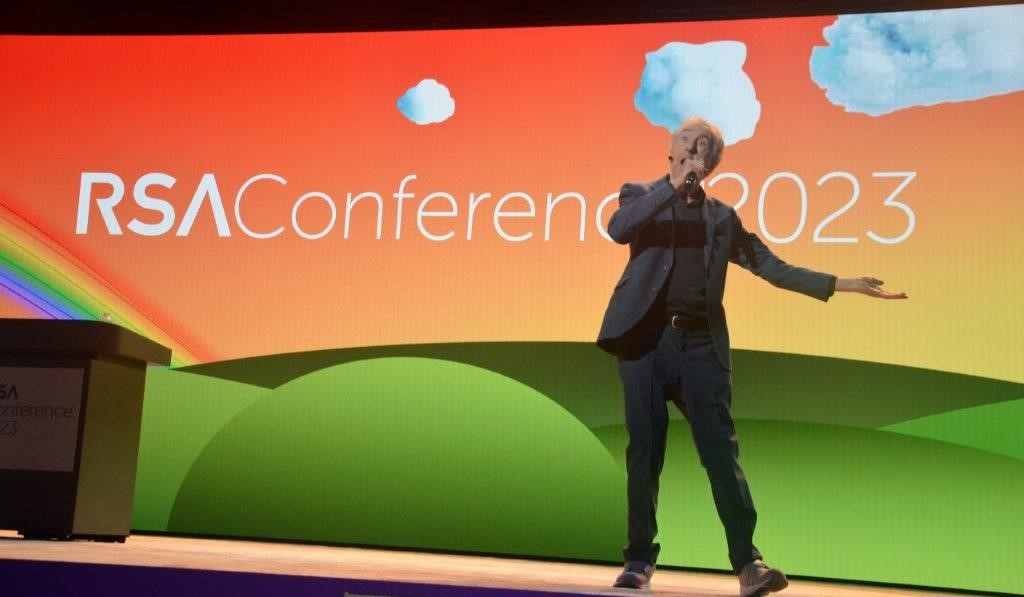
RSA Program Committee Chair and RSA Opening Keynote speaker, Hugh Thompson addressing the crowd at the RSA Conference 2023. Photo courtesy of RSA Conference.

What were the most disruptive dual use advancements in science or technology in the last fifty years?

That was the supreme question that Hugh Thompson, the RSA Program Committee Chair and RSA Opening Keynote speaker, presented not only to his live audience, but also to a small survey of various scientists, technologists, and cybersecurity experts whom he deeply respected who are experts in their field prior to his keynote.

Since he had such a small sample size and wanted to get absolute certainty for his answer, he decided to ask ChatCGP-4, which is a premium version of ChatGPT.

“And what it said was number one on the list was the introduction of the Internet…I think maybe we would agree with that…dual use technology… and very helpful…we used all the time…but also has a set of shadows of it that that we deal with every day”, Thompson continued. “Number two ironically, especially coming from ChatCGP-4…was the proliferation of A.I.”.

Thompson couldn’t have said it much better with such clarity. With A.I. being such an integral tool for security professionals, it will also be one for its adversaries; the cybercriminals.

“I would argue in history where science and technology is advancing very, very quickly. Whenever that happens you get the light of the advancement, meaning all of the good that can come from it, but unfortunately, whenever you have a bright light it casts a very deep shadow”, Thompson warned.

“We are the shadow experts. We study the shadow. We understand the shadow. We try and mitigate the shadow. We try and put other lights in the shadow to get rid of the shadow. There is never been a more important time for that.”.

Preparing for the conference, Thompson and the RSAC Vice President, Content & Curation, Britta Glade, worked early on in the process on which content would be used for the conference. With well over 2400 submissions in a very competitive year, it was very difficult to filter down, not just in terms of quantity, but in quality. Unsurprisingly, most of the sessions revolved around A.I.

“Topics like this AI availability, Generative AI availability, Quantum Computing Advancements…What does it do? How can we prepare? “We’ve got what I would argue is the best program we’ve ever had at RSA conference.”, Thompson exclaims.

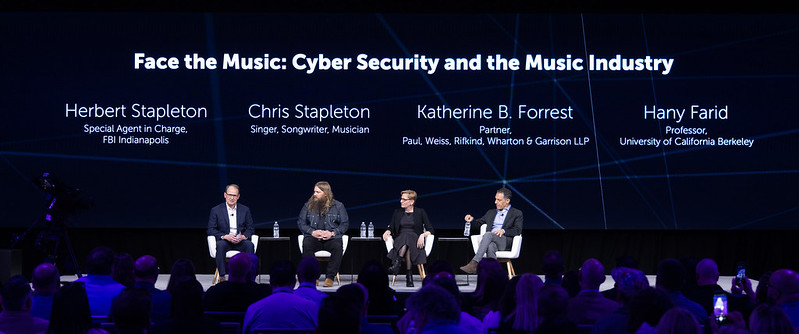
Grammy Award-winning artist Chris Stapleton onstage as a panelist on a session that explores cybersecurity and the music industry. Courtesy of RSA Conference.

There was even a session called “Face the Music: Cybersecurity and the Music Industry” where leaders from the music industry, law enforcement, and academia all collaborated and discussed A.I. intelligence and cyber-enabled threats to the music industry. Keynote panelist and Grammy-winning country music star Chris Stapleton also weighed in on the topic of generative AI in music, discussing how bad actors now have the capability to easily steal artist IP and what both legislators and the security industry can do to help.

Even the movie industry has to deal with it, as well. It is pretty evident that even actor Christopher Lloyd, who played eccentric inventor Emmett ‘Doc’ Brown in the Back to The Future trilogy, would know. He was on also on stage to discuss his Hollywood blockbuster experience along with real quantum computing and cryptography experts.

With the onset of A.I., the challenges of how to leverage and harness the power of this technology along with the accessibility of generative large language model technologies, such as ChatGPT, it looks like we are indeed in a brand new world in cybersecurity, for better or worse.

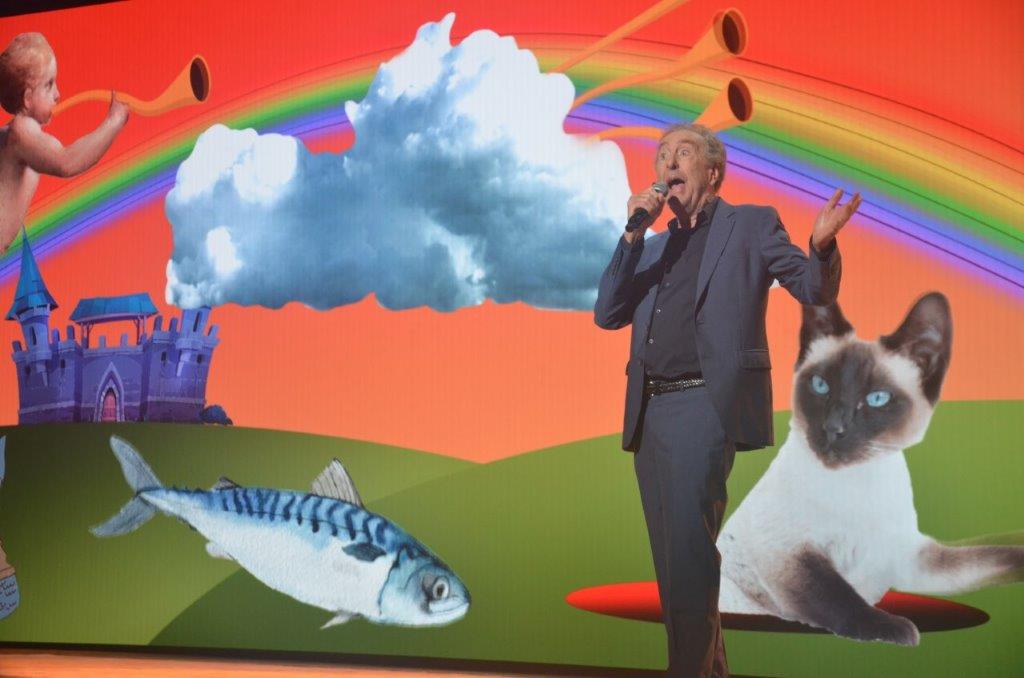
Eric Idle reminds us that A.I. may even replace Monty Python. However, you should always look at the bright side of life. Photo by Marcus Siu

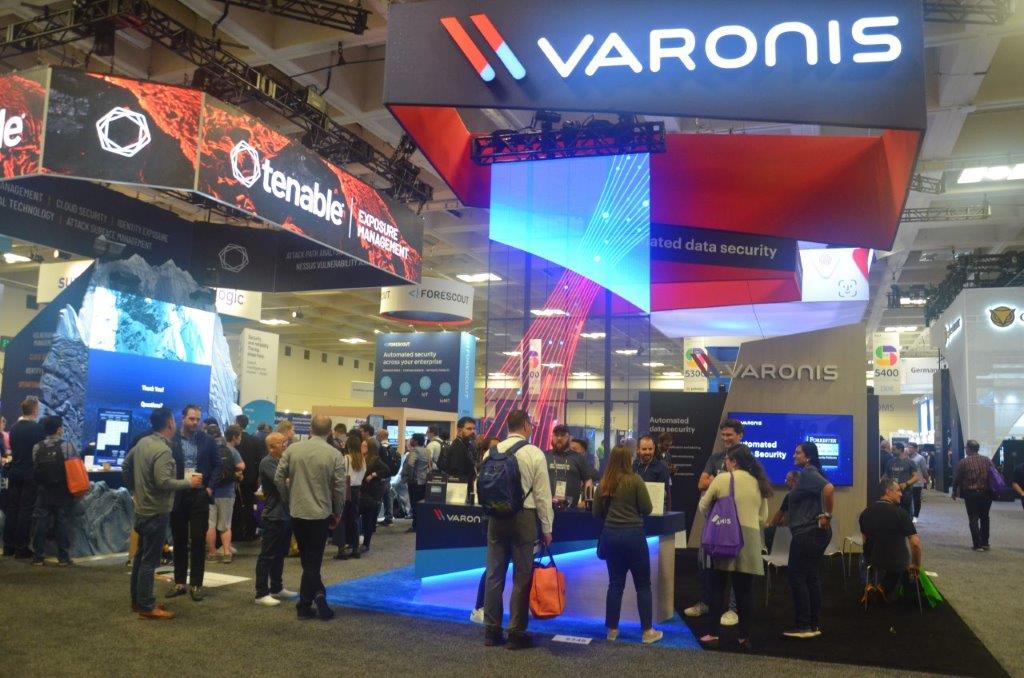
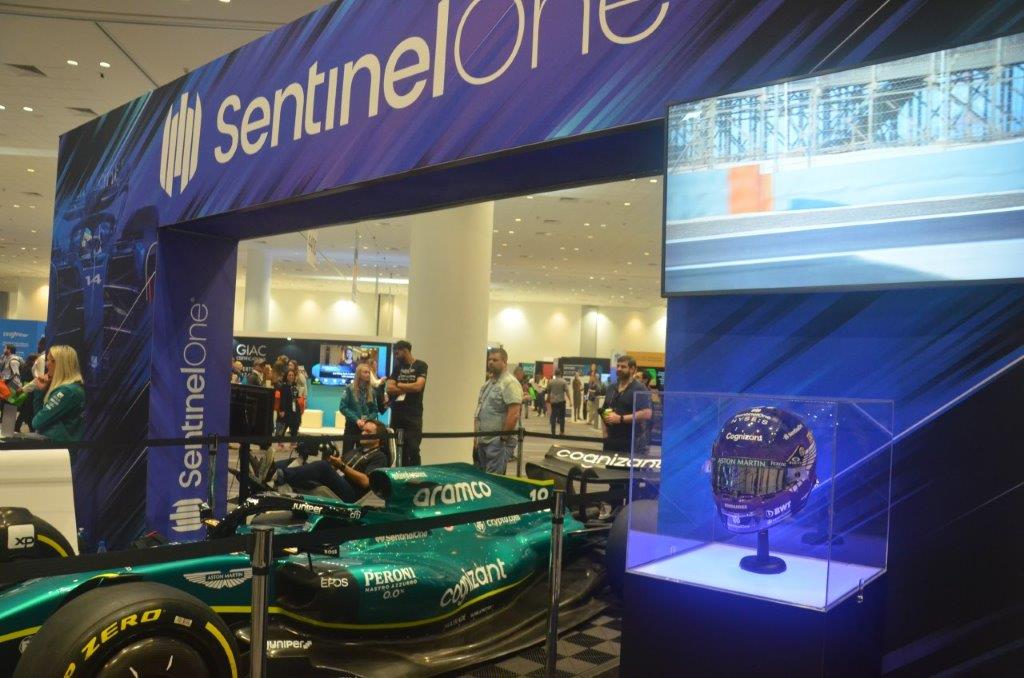
Overall, this year’s successful RSA Conference attracted well over 40,000 attendees, including 650+ speakers, 500+ exhibitors and 500+ members of the media. Throughout the week, attendees networked on the expo floor and participated in keynote presentations, track sessions, tutorials, seminars and special networking events.

Posted in Entertainment, Technology | Tagged , , , , , , , , , , , , , , , , | Leave a comment

THE 2023 GAME DEVELOPERS CONFERENCE IT’S ABOUT THE SPECTACLE…

Attendees gathering at the annual GDC at Moscone Center in San Francisco. Photo by Marcus Siu.

Article and photos by Marcus Siu

You could feel the sheer excitement in the air surrounding San Francisco’s Moscone Center where exhibitor’s and attendees convened at the 2023 Game Developer’s Conference. It recently happened a few weeks ago from March 20th thru the 24th when the Games Developer’s Conference tied its pre-pandemic record of 28,000 attendees in San Francisco that was set in 2019, more than doubling the number of in-person attendees from last year at San Francisco’s Moscone Convention Center.

It was all about the return of the “in-person” experience, having the strong desire and necessity of connecting with one another. Whether it was at one of the many numerous and inspiring sessions that was going on all week, or in one of the populated halls on the expo floor with some of the biggest names in the gaming world, or at a social mixer networking party with peers and leaders in the games industry; everyone seemed eager to seek and discover connections and to gain insight within their craft.

It seemed as though the conference hadn’t missed a beat since the pandemic.

Sony PlayStation VR2 brought in some new demos at GDC2023. Photo by Marcus Siu.

For those who are unfamiliar with GDC, The Game Developers Conference® (GDC) is the world’s largest professional game industry event with market-defining content for programmers, artists, producers, game designers, audio professionals, business decision-makers, and others involved in the development of interactive games and immersive experiences. It also is the world’s largest and longest-running event serving professionals dedicated to the art and science of making games

All in all, GDC 2023 featured more than 1,000 speakers and 700+ sessions, workshops, roundtable discussions and networking opportunities. 330+ exhibitors were present to display their newest technologies, programs and services on the GDC Expo Floor, including industry leaders like Amazon Web Services, Adobe, Discord, Google, NEXON and more.

It was also a space for attendees to play and connect with the developers behind new and exciting independent games, including the finalists from the Independent Games Festival (IGF) and the alt.ctrl.GDC exhibit that is home to games that use alternative controllers like toaster ovens, giant oversized hats and others.

Attendees trying on the Meta Quest 2 and Meta Quest Pro VR sets. Photo by Marcus Siu.

When you walk in the entrance on the South Side, some of the biggest name in gaming with attendees waiting in line for a demo as soon as they entered the hall, including Meta and Sony. Unity and Unreal were to the left of them and had even bigger booths with lots of play space. In fact, many of the companies were not signing anyone up for demos because they filled up within the first hour after the expo opened. Sign ups were available the next morning, as soon as they opened at 10 am, but filled up quickly. What I noticed this year compared to previous years is that there are more companies are using VR/AR/MR/XR and smart glasses for immersive gaming.

WELCOME TO THE METAWORLD

At the Meta booth, they had four demos, including Demeo, Ironman, Among Us, and a Mixed Reality Fencing Prototype which is the one I participated in. I requested the demo that would make use of the Meta Quest Pro, their flagship VR goggles. Unfortunately, Meta was having some wi-fi or battery issues and it took awhile to fix, but when it worked, I had a blast in my ten minute slot sword fighting against my opponent on the other side of the wall.

My opponent quickly got up to ten points, and just when I thought it was over, I was quick to go for another ten rounds. I was able to come out victorious. Ironically, after meeting my opponent, I found out he used to fence in Finland. Not sure if I should try the real thing next time I’m in Europe.

A swordfight at the Meta booth. The player on the left actually won, even thought the player on the right was an experience fencer.

A Meta rep also was roaming around the booth and touting their new Meta-Ray Ban glasses. She had me put them on and told me that they can capture what you are seeing in real time. Meta’s first generation of smart glasses have built-in cameras, open-ear audio, and seamless social sharing. Sort of a POV for the user that is sharable to others.

I can imagine that people may not have rush out and shoot with their smartphones any longer, if they wanted to capture something spontaneously by the touch of their finger. I immediately thought that this would be a great way to monitor the world around us and share our experiences together, as it doesn’t necessarily need to be for game sharing purposes. Perhaps, it could cut down on crime, since we might all be wearing these on a daily basis?

Meta-Ray Ban glasses captures everything you see with a touch of a button at GDC2023. Photo by Marcus Siu

AUGMENTED REALITY IS JUST NREAL

Another company that I was happy to see having a nice booth at the Expo Hall was Nreal. I was first introduced to them at the Augmented World Expo in Santa Clara in 2019 and wrote about them with their impressive augmented reality technology. This time, they were demonstrated their latest “Air” AR Glasses on laptops and smartphones, which reminds me of Google Glass, but has much better promise.

My first impression with these ultra-lightweight Nreal Air glasses, which could easily be confused as regular fashion sunglasses, is an amazing 201″ spatial display that gets casted from your device, whether it’s streaming from a game on the cloud, a compatible smartphone, or a iMac.

It has Micro-OLED panels and it is just has an amazing immersive display. As I put them on, I was looking at floating apps and browsers that I could select with my mouse, and be transported watching videos. Imagine watching Netflix or having a big screen for cloud gaming on the big screen anywhere you go.

NReal booth demos the Air Glasses at GDC2023. Photo by Marcus Siu

META’S MAIN COMPETITOR?

If there is a Meta competitor on the Expo floor, it would probably be Pico from China who made their debut at GDC. They had a nice booth showing the evolution of their hardware products over they years, much displayed like it would be at a VR museum, if there was one.

The release of their Pico 4 was getting some buzz on the floor, but didn’t get any official announcement when it would actually be released. This is probably due to the fact that their parent company, Bytedance, also owns TikTok, is still trying to settle with the Senate hearings.

What a great time to be a game developer! Here are a slideshow of a few scenes from the Expo floor.

Posted in Entertainment, Technology | Tagged , , , , , , , , , , , , , , , , , , , , , , , , , , , , , , , , , , , , , , , | Leave a comment